{"title":"Virtual Nephron: Evaluation of a Novel Virtual Reality Educational Tool","authors":"","doi":"10.1016/j.ekir.2024.06.007","DOIUrl":null,"url":null,"abstract":"<div><h3>Introduction</h3><p>Recent technological advancements allowed the development of engaging technological tools. Using ASN funding from the ASN, we developed a 3D Virtual Reality (VR) physiology course entitled DiAL-Neph (Diuretic Action and eLectrolyte transport in the Nephron). We hereby present its evaluation.</p></div><div><h3>Methods</h3><p>The study consisted of 2 parts: evaluation of knowledge gain, and qualitative evaluation of platform reception. Internal medicine PGY1 residents were randomly assigned into 2 groups: a VR group and a conventional group. Knowledge acquisition was assessed with a post-test administered at the end of the course and repeated within 6 to 12 weeks. Independent t-tests were used to compare the number of correct answers between the groups. A survey and focus groups composed of medicine residents evaluated the platform. Sessions were recorded and transcribed verbatim. Data was analyzed through the content analysis approach by two independent reviewers.</p></div><div><h3>Results</h3><p>Of 117 PGY1 resident participants, 64 were randomized to the VR group and 53 were randomized to the traditional group. Initial test results showed higher scores among VR compared to the traditional group (76.5% correct vs. 68.8%). Seventy-eight PGY1s participated in the follow up testing (46 VR group vs. 32 traditional group) and results showed no significant difference in test results. Greater than 90% of the residents rated the platform positively and 77% preferred it as a teaching method.</p></div><div><h3>Conclusion</h3><p>The DiAL-Neph VR platform appeared to improve short-term learning but not long-term retention. Further studies are needed to investigate the impact of such teaching platforms on overall interest in nephrology.</p></div>","PeriodicalId":17761,"journal":{"name":"Kidney International Reports","volume":"9 9","pages":"Pages 2619-2626"},"PeriodicalIF":5.7000,"publicationDate":"2024-09-01","publicationTypes":"Journal Article","fieldsOfStudy":null,"isOpenAccess":false,"openAccessPdf":"https://www.sciencedirect.com/science/article/pii/S2468024924017662/pdfft?md5=c77befb4d84a218ec78338b4cde66fe2&pid=1-s2.0-S2468024924017662-main.pdf","citationCount":"0","resultStr":null,"platform":"Semanticscholar","paperid":null,"PeriodicalName":"Kidney International Reports","FirstCategoryId":"3","ListUrlMain":"https://www.sciencedirect.com/science/article/pii/S2468024924017662","RegionNum":2,"RegionCategory":"医学","ArticlePicture":[],"TitleCN":null,"AbstractTextCN":null,"PMCID":null,"EPubDate":"2024/6/11 0:00:00","PubModel":"Epub","JCR":"Q1","JCRName":"UROLOGY & NEPHROLOGY","Score":null,"Total":0}
引用次数: 0
Abstract
Introduction
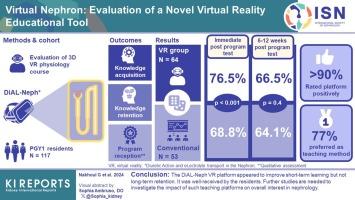
Recent technological advancements allowed the development of engaging technological tools. Using ASN funding from the ASN, we developed a 3D Virtual Reality (VR) physiology course entitled DiAL-Neph (Diuretic Action and eLectrolyte transport in the Nephron). We hereby present its evaluation.
Methods
The study consisted of 2 parts: evaluation of knowledge gain, and qualitative evaluation of platform reception. Internal medicine PGY1 residents were randomly assigned into 2 groups: a VR group and a conventional group. Knowledge acquisition was assessed with a post-test administered at the end of the course and repeated within 6 to 12 weeks. Independent t-tests were used to compare the number of correct answers between the groups. A survey and focus groups composed of medicine residents evaluated the platform. Sessions were recorded and transcribed verbatim. Data was analyzed through the content analysis approach by two independent reviewers.
Results
Of 117 PGY1 resident participants, 64 were randomized to the VR group and 53 were randomized to the traditional group. Initial test results showed higher scores among VR compared to the traditional group (76.5% correct vs. 68.8%). Seventy-eight PGY1s participated in the follow up testing (46 VR group vs. 32 traditional group) and results showed no significant difference in test results. Greater than 90% of the residents rated the platform positively and 77% preferred it as a teaching method.
Conclusion
The DiAL-Neph VR platform appeared to improve short-term learning but not long-term retention. Further studies are needed to investigate the impact of such teaching platforms on overall interest in nephrology.
期刊介绍:
Kidney International Reports, an official journal of the International Society of Nephrology, is a peer-reviewed, open access journal devoted to the publication of leading research and developments related to kidney disease. With the primary aim of contributing to improved care of patients with kidney disease, the journal will publish original clinical and select translational articles and educational content related to the pathogenesis, evaluation and management of acute and chronic kidney disease, end stage renal disease (including transplantation), acid-base, fluid and electrolyte disturbances and hypertension. Of particular interest are submissions related to clinical trials, epidemiology, systematic reviews (including meta-analyses) and outcomes research. The journal will also provide a platform for wider dissemination of national and regional guidelines as well as consensus meeting reports.




 京公网安备 11010802042870号
京ICP备2023020795号-1
京公网安备 11010802042870号
京ICP备2023020795号-1

 分享
分享
 求助内容:
求助内容: 应助结果提醒方式:
 扫码关注我们
