D. A. Kasatov, Y. A. Kolesnikov, V. D. Konovalova, V. V. Porosev, E. O. Sokolova, I. M. Shchudlo, S. Y. Taskaev
{"title":"Development of a System for Forming a Beam of Cold Neutrons for the VITA Accelerating Neutron Source","authors":"D. A. Kasatov, Y. A. Kolesnikov, V. D. Konovalova, V. V. Porosev, E. O. Sokolova, I. M. Shchudlo, S. Y. Taskaev","doi":"10.1134/S1547477124700353","DOIUrl":null,"url":null,"abstract":"<p>Cold neutrons (with energy 10<sup>–7</sup>–10<sup>–4</sup> eV) have found broad application in many areas of modern physics. A new and prospective field of application of low-energy neutrons is the boron neutron capture therapy of oncological illness. This method is based on neutron capture by boron-10, previously accumulated in a tumor, and reaction <sup>10</sup>B(n,α)<sup>7</sup>Li with following escape of energetic α particle and lithium atomic nucleus. The delivery of cold neutrons directly to the area of a malignant tumor can make it possible to increase the localization of the therapeutic dose in the tumor, exclude any impact on healthy cells, and increase the effectiveness of boron neutron capture therapy (BNСT), both in the case of deep-lying malignant tumors and those on the surface. The research described in the article is devoted to the generation of cold neutrons on the VITA accelerator-based epithermal neutron source. This paper describes the cold neutron beam shaping assembly (BSA) that has been designed. The simulation of neutron passage through the BSA performed using Geant4 software is described. The possibility of generating cold neutrons on the VITA accelerator-based epithermal neutron source was demonstrated.</p>","PeriodicalId":730,"journal":{"name":"Physics of Particles and Nuclei Letters","volume":"21 3","pages":"404 - 409"},"PeriodicalIF":0.4000,"publicationDate":"2024-06-07","publicationTypes":"Journal Article","fieldsOfStudy":null,"isOpenAccess":false,"openAccessPdf":"","citationCount":"0","resultStr":null,"platform":"Semanticscholar","paperid":null,"PeriodicalName":"Physics of Particles and Nuclei Letters","FirstCategoryId":"1085","ListUrlMain":"https://link.springer.com/article/10.1134/S1547477124700353","RegionNum":0,"RegionCategory":null,"ArticlePicture":[],"TitleCN":null,"AbstractTextCN":null,"PMCID":null,"EPubDate":"","PubModel":"","JCR":"Q4","JCRName":"PHYSICS, PARTICLES & FIELDS","Score":null,"Total":0}
引用次数: 0
Abstract
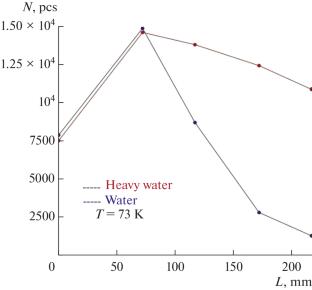
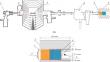
Cold neutrons (with energy 10–7–10–4 eV) have found broad application in many areas of modern physics. A new and prospective field of application of low-energy neutrons is the boron neutron capture therapy of oncological illness. This method is based on neutron capture by boron-10, previously accumulated in a tumor, and reaction 10B(n,α)7Li with following escape of energetic α particle and lithium atomic nucleus. The delivery of cold neutrons directly to the area of a malignant tumor can make it possible to increase the localization of the therapeutic dose in the tumor, exclude any impact on healthy cells, and increase the effectiveness of boron neutron capture therapy (BNСT), both in the case of deep-lying malignant tumors and those on the surface. The research described in the article is devoted to the generation of cold neutrons on the VITA accelerator-based epithermal neutron source. This paper describes the cold neutron beam shaping assembly (BSA) that has been designed. The simulation of neutron passage through the BSA performed using Geant4 software is described. The possibility of generating cold neutrons on the VITA accelerator-based epithermal neutron source was demonstrated.
期刊介绍:
The journal Physics of Particles and Nuclei Letters, brief name Particles and Nuclei Letters, publishes the articles with results of the original theoretical, experimental, scientific-technical, methodological and applied research. Subject matter of articles covers: theoretical physics, elementary particle physics, relativistic nuclear physics, nuclear physics and related problems in other branches of physics, neutron physics, condensed matter physics, physics and engineering at low temperatures, physics and engineering of accelerators, physical experimental instruments and methods, physical computation experiments, applied research in these branches of physics and radiology, ecology and nuclear medicine.




 京公网安备 11010802042870号
京ICP备2023020795号-1
京公网安备 11010802042870号
京ICP备2023020795号-1

 分享
分享
 求助内容:
求助内容: 应助结果提醒方式:
 扫码关注我们
