Renwei Zhang, Ningning Sun, Zehong Zhao, Shixu Wang, Mengfan Zhang, Lei Zhao, Yahua Liu and Shile Feng
{"title":"Bionic dual-scale structured films for efficient passive radiative cooling accompanied by robust durability†","authors":"Renwei Zhang, Ningning Sun, Zehong Zhao, Shixu Wang, Mengfan Zhang, Lei Zhao, Yahua Liu and Shile Feng","doi":"10.1039/D4NH00136B","DOIUrl":null,"url":null,"abstract":"<p >Passive radiative cooling (PRC), as an energy-free cooling approach, is ingeniously harnessed for certain natural organisms to withstand extreme high-temperature climates, which has inspired numerous bionic designs. However, it is a great challenge to enhance the durability of the designed materials in practical scenarios while inheriting the natural biological principles. We demonstrate bionic dual-scale structured (BDSS) films for efficient passive radiative cooling accompanied by robust durability after discovering the excellent thermoregulatory properties of the inner surface of Hawaiian scallop shell. We found that the inner surface of the shell consists of large-scale triangular ridges scattered with small-scale terrace steps. This dual-scale structure can enhance the reflectivity of sunlight by efficient Mie scattering and increase the emissivity in the mid-infrared range by lengthening the propagation of photons, thereby decreasing the surface temperature. Underpinned by this finding, we developed a BDSS film that features a strong solar spectrum reflectivity of 0.95 and a high mid-infrared emissivity of 0.98, achieving a sub-ambient cooling of 10.8 °C under direct sunlight. Additionally, the designed films possess robust durability including excellent self-cleaning, flexibility, mechanical strength, chemical stability, and anti-ultraviolet radiation, which is promising for thermal thermoregulation in various harsh scenarios.</p>","PeriodicalId":93,"journal":{"name":"Nanoscale Horizons","volume":" 8","pages":" 1354-1363"},"PeriodicalIF":6.6000,"publicationDate":"2024-06-13","publicationTypes":"Journal Article","fieldsOfStudy":null,"isOpenAccess":false,"openAccessPdf":"","citationCount":"0","resultStr":null,"platform":"Semanticscholar","paperid":null,"PeriodicalName":"Nanoscale Horizons","FirstCategoryId":"88","ListUrlMain":"https://pubs.rsc.org/en/content/articlelanding/2024/nh/d4nh00136b","RegionNum":2,"RegionCategory":"材料科学","ArticlePicture":[],"TitleCN":null,"AbstractTextCN":null,"PMCID":null,"EPubDate":"","PubModel":"","JCR":"Q1","JCRName":"CHEMISTRY, PHYSICAL","Score":null,"Total":0}
引用次数: 0
Abstract
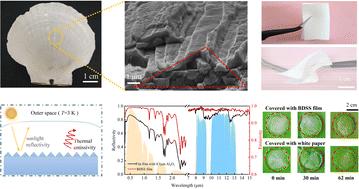
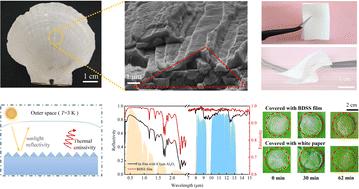
Passive radiative cooling (PRC), as an energy-free cooling approach, is ingeniously harnessed for certain natural organisms to withstand extreme high-temperature climates, which has inspired numerous bionic designs. However, it is a great challenge to enhance the durability of the designed materials in practical scenarios while inheriting the natural biological principles. We demonstrate bionic dual-scale structured (BDSS) films for efficient passive radiative cooling accompanied by robust durability after discovering the excellent thermoregulatory properties of the inner surface of Hawaiian scallop shell. We found that the inner surface of the shell consists of large-scale triangular ridges scattered with small-scale terrace steps. This dual-scale structure can enhance the reflectivity of sunlight by efficient Mie scattering and increase the emissivity in the mid-infrared range by lengthening the propagation of photons, thereby decreasing the surface temperature. Underpinned by this finding, we developed a BDSS film that features a strong solar spectrum reflectivity of 0.95 and a high mid-infrared emissivity of 0.98, achieving a sub-ambient cooling of 10.8 °C under direct sunlight. Additionally, the designed films possess robust durability including excellent self-cleaning, flexibility, mechanical strength, chemical stability, and anti-ultraviolet radiation, which is promising for thermal thermoregulation in various harsh scenarios.
期刊介绍:
Nanoscale Horizons stands out as a premier journal for publishing exceptionally high-quality and innovative nanoscience and nanotechnology. The emphasis lies on original research that introduces a new concept or a novel perspective (a conceptual advance), prioritizing this over reporting technological improvements. Nevertheless, outstanding articles showcasing truly groundbreaking developments, including record-breaking performance, may also find a place in the journal. Published work must be of substantial general interest to our broad and diverse readership across the nanoscience and nanotechnology community.



 京公网安备 11010802042870号
京ICP备2023020795号-1
京公网安备 11010802042870号
京ICP备2023020795号-1

 分享
分享
 求助内容:
求助内容: 应助结果提醒方式:
 扫码关注我们
