{"title":"Pivot to the South: Achieving the Sustainable Development Goals through China's Belt and Road Initiative","authors":"Hannah McNicol","doi":"10.1111/gec3.12762","DOIUrl":null,"url":null,"abstract":"<p>Whilst China's aid and development model has been traditionally understood as divergent from the dominant post-1945 liberal development model, scholars are also increasingly exploring convergence between features of the two development models. Recently, scholars from a range of disciplines including development studies, development geography and international (business, environment and legal) studies have explored a process whereby China's Belt and Road Initiative and the United Nations Sustainable Development Goals converge (‘BRI-SDG integration’). This paper brings these multidisciplinary strands of scholarship together and places them in dialogue with social sciences convergence theory to understand how BRI-SDG integration aligns with or challenges previous conceptualisations of Chinese-dominant development convergence. The paper first demonstrates that BRI-SDG integration proposes a novel and deliberate convergence process - which the paper names ‘complementary convergence’. However, BRI-SDG integration also underscores the need for more multidirectional frameworks that reject Eurocentricity for evaluating the contemporary Chinese-dominant relationship, and an enhanced focus on how China is influencing dominant development institutions. Finally, BRI-SDG integration reiterates the methodological difficulties of delineating between ‘development models’ in an increasingly interrelated global governance of development.</p>","PeriodicalId":51411,"journal":{"name":"Geography Compass","volume":"18 6","pages":""},"PeriodicalIF":3.5000,"publicationDate":"2024-06-17","publicationTypes":"Journal Article","fieldsOfStudy":null,"isOpenAccess":false,"openAccessPdf":"https://onlinelibrary.wiley.com/doi/epdf/10.1111/gec3.12762","citationCount":"0","resultStr":null,"platform":"Semanticscholar","paperid":null,"PeriodicalName":"Geography Compass","FirstCategoryId":"89","ListUrlMain":"https://compass.onlinelibrary.wiley.com/doi/10.1111/gec3.12762","RegionNum":1,"RegionCategory":"社会学","ArticlePicture":[],"TitleCN":null,"AbstractTextCN":null,"PMCID":null,"EPubDate":"","PubModel":"","JCR":"Q1","JCRName":"GEOGRAPHY","Score":null,"Total":0}
引用次数: 0
Abstract
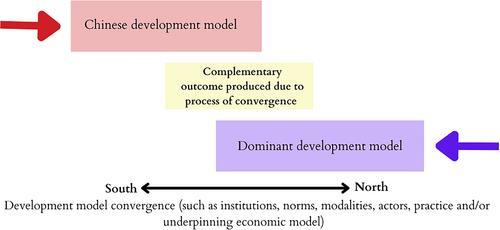
Whilst China's aid and development model has been traditionally understood as divergent from the dominant post-1945 liberal development model, scholars are also increasingly exploring convergence between features of the two development models. Recently, scholars from a range of disciplines including development studies, development geography and international (business, environment and legal) studies have explored a process whereby China's Belt and Road Initiative and the United Nations Sustainable Development Goals converge (‘BRI-SDG integration’). This paper brings these multidisciplinary strands of scholarship together and places them in dialogue with social sciences convergence theory to understand how BRI-SDG integration aligns with or challenges previous conceptualisations of Chinese-dominant development convergence. The paper first demonstrates that BRI-SDG integration proposes a novel and deliberate convergence process - which the paper names ‘complementary convergence’. However, BRI-SDG integration also underscores the need for more multidirectional frameworks that reject Eurocentricity for evaluating the contemporary Chinese-dominant relationship, and an enhanced focus on how China is influencing dominant development institutions. Finally, BRI-SDG integration reiterates the methodological difficulties of delineating between ‘development models’ in an increasingly interrelated global governance of development.
期刊介绍:
Unique in its range, Geography Compass is an online-only journal publishing original, peer-reviewed surveys of current research from across the entire discipline. Geography Compass publishes state-of-the-art reviews, supported by a comprehensive bibliography and accessible to an international readership. Geography Compass is aimed at senior undergraduates, postgraduates and academics, and will provide a unique reference tool for researching essays, preparing lectures, writing a research proposal, or just keeping up with new developments in a specific area of interest.





 京公网安备 11010802042870号
京ICP备2023020795号-1
京公网安备 11010802042870号
京ICP备2023020795号-1

 分享
分享
 求助内容:
求助内容: 应助结果提醒方式:
 扫码关注我们
