Hao Liang, Yinqiao Zhang, Xiaona Zhang, Erzhuo Zhao, Wendan Xue, Enguang Nie, Jianqiu Chen, Sijin Zuo and Minghua Zhou
{"title":"Conductivity-mediated in situ electrochemical reconstruction of CuOx for nitrate reduction to ammonia†","authors":"Hao Liang, Yinqiao Zhang, Xiaona Zhang, Erzhuo Zhao, Wendan Xue, Enguang Nie, Jianqiu Chen, Sijin Zuo and Minghua Zhou","doi":"10.1039/D4NR01625D","DOIUrl":null,"url":null,"abstract":"<p >The electrocatalytic nitrate reduction reaction (NO<small><sub>3</sub></small>RR) is an ideal NH<small><sub>3</sub></small> synthesis route with ease of operation, high energy efficiency, and low environmental detriment. Electrocatalytic cathodes play a dominant role in the NO<small><sub>3</sub></small>RR. Herein, we constructed a carbon fiber paper-supported CuO<small><sub><em>x</em></sub></small> nanoarray catalyst (CP/CuO<small><sub><em>x</em></sub></small>) by an <em>in situ</em> electrochemical reconstruction method for NO<small><sub>3</sub></small><small><sup>−</sup></small>-to-NH<small><sub>3</sub></small> conversion. A series of characterization techniques, such as X-ray diffraction (XRD) and <em>in situ</em> Raman spectroscopy, unveil that CP/CuO<small><sub><em>x</em></sub></small> is a polycrystalline-faceted composite copper nanocatalyst with a valence composition containing Cu<small><sup>0</sup></small>, Cu<small><sup>+</sup></small> and Cu<small><sup>2+</sup></small>. CP/CuO<small><sub><em>x</em></sub></small> shows more efficient NO<small><sub>3</sub></small><small><sup>−</sup></small>-to-NH<small><sub>3</sub></small> conversion than CP/Cu and CP/Cu<small><sub>2</sub></small>O, which indicates that the coexistence of various Cu valence states could play a dominant role. CP/CuO<small><sub><em>x</em></sub></small> with a suitable Cu<small><sup>2+</sup></small> content obtained by adjusting the conductivity during the <em>in situ</em> electrochemical reconstruction process exhibited more than 90% faradaic efficiencies for the NO<small><sub>3</sub></small>RR in a broad range of −0.3 to −1.0 V <em>vs.</em> RHE, 28.65 mg cm<small><sup>−2</sup></small> h<small><sup>−1</sup></small> peak ammonia yield, and stable NO<small><sub>3</sub></small>RR efficiencies for ten cycles. These findings suggest that CP/CuO<small><sub><em>x</em></sub></small> with suitable copper valence states obtained by fine-tuning the conductivity of the electrochemical reconstruction may provide a competitive cathode catalyst for achieving excellent activity and selectivity of NO<small><sub>3</sub></small><small><sup>−</sup></small>-to-NH<small><sub>3</sub></small> conversion.</p>","PeriodicalId":92,"journal":{"name":"Nanoscale","volume":" 29","pages":" 13895-13904"},"PeriodicalIF":5.1000,"publicationDate":"2024-06-21","publicationTypes":"Journal Article","fieldsOfStudy":null,"isOpenAccess":false,"openAccessPdf":"","citationCount":"0","resultStr":null,"platform":"Semanticscholar","paperid":null,"PeriodicalName":"Nanoscale","FirstCategoryId":"88","ListUrlMain":"https://pubs.rsc.org/en/content/articlelanding/2024/nr/d4nr01625d","RegionNum":3,"RegionCategory":"材料科学","ArticlePicture":[],"TitleCN":null,"AbstractTextCN":null,"PMCID":null,"EPubDate":"","PubModel":"","JCR":"Q1","JCRName":"CHEMISTRY, MULTIDISCIPLINARY","Score":null,"Total":0}
引用次数: 0
Abstract
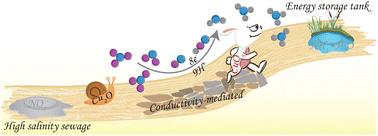
The electrocatalytic nitrate reduction reaction (NO3RR) is an ideal NH3 synthesis route with ease of operation, high energy efficiency, and low environmental detriment. Electrocatalytic cathodes play a dominant role in the NO3RR. Herein, we constructed a carbon fiber paper-supported CuOx nanoarray catalyst (CP/CuOx) by an in situ electrochemical reconstruction method for NO3−-to-NH3 conversion. A series of characterization techniques, such as X-ray diffraction (XRD) and in situ Raman spectroscopy, unveil that CP/CuOx is a polycrystalline-faceted composite copper nanocatalyst with a valence composition containing Cu0, Cu+ and Cu2+. CP/CuOx shows more efficient NO3−-to-NH3 conversion than CP/Cu and CP/Cu2O, which indicates that the coexistence of various Cu valence states could play a dominant role. CP/CuOx with a suitable Cu2+ content obtained by adjusting the conductivity during the in situ electrochemical reconstruction process exhibited more than 90% faradaic efficiencies for the NO3RR in a broad range of −0.3 to −1.0 V vs. RHE, 28.65 mg cm−2 h−1 peak ammonia yield, and stable NO3RR efficiencies for ten cycles. These findings suggest that CP/CuOx with suitable copper valence states obtained by fine-tuning the conductivity of the electrochemical reconstruction may provide a competitive cathode catalyst for achieving excellent activity and selectivity of NO3−-to-NH3 conversion.
期刊介绍:
Nanoscale is a high-impact international journal, publishing high-quality research across nanoscience and nanotechnology. Nanoscale publishes a full mix of research articles on experimental and theoretical work, including reviews, communications, and full papers.Highly interdisciplinary, this journal appeals to scientists, researchers and professionals interested in nanoscience and nanotechnology, quantum materials and quantum technology, including the areas of physics, chemistry, biology, medicine, materials, energy/environment, information technology, detection science, healthcare and drug discovery, and electronics.



 京公网安备 11010802042870号
京ICP备2023020795号-1
京公网安备 11010802042870号
京ICP备2023020795号-1

 分享
分享
 求助内容:
求助内容: 应助结果提醒方式:
 扫码关注我们
