Fernanda de Souza E Silva Ramos, André Luiz Fraga Briso, Larissa Albertinazzi, Vitória Marega Marchetti, Marina Trevelin Souza, Ticiane Cestari Fagundes
{"title":"Efficacy of different in-office treatments for dentin hypersensitivity: randomized and parallel clinical trial.","authors":"Fernanda de Souza E Silva Ramos, André Luiz Fraga Briso, Larissa Albertinazzi, Vitória Marega Marchetti, Marina Trevelin Souza, Ticiane Cestari Fagundes","doi":"10.1590/0103-6440202405487","DOIUrl":null,"url":null,"abstract":"<p><p>The aim of this clinical, prospective, randomized, and parallel study was to evaluate different in-office treatments for dentin hypersensitivity (DH). One hundred ninety-two teeth with non-cavitated root exposures were treated using different desensitizers: fluoride varnish (Duraphat - FLU); bioactive ceramic solution (Biosilicate - BIOS); universal self-etching adhesive (Single Bond Universal - SBU); bioactive photoactivated varnish (PRG filler - SPRG). The degree of DH was analyzed using a visual analog scale (VAS) and computerized visual scale (CoVAS), before treatments and after 7, 15, and 30 days from the first session. Comparisons among desensitizers were performed using the Kruskal-Wallis and Dunn's tests. Friedman test was used to compare between times (p ≤ 0.05). Comparing desensitizers FLU presented a higher value of DH than BIOS using VAS at 7 days, however, no differences were found using CoVAS analysis. Comparing times, BIOS and SBU showed a reduction in DH after 7 days and SBU showed a reduction at 30 days compared to 7 days using VAS. FLU and SPRG groups reduced DH from 15 days to 30 days using VAS. There was a reduction in DH for FLU, BIOS, and SBU after 7 days and for BIOS this reduction also occurred at 30 days when compared to 15 days using CoVAS. SPRG group showed a reduction from 15 to 30 days. All desensitizers tested were able to reduce the initial sensitivity. The bioactive ceramic solution reduced the DH gradually after 30 days using computerized analysis.</p>","PeriodicalId":101363,"journal":{"name":"Brazilian dental journal","volume":"35 ","pages":"e245487"},"PeriodicalIF":0.0000,"publicationDate":"2024-06-24","publicationTypes":"Journal Article","fieldsOfStudy":null,"isOpenAccess":false,"openAccessPdf":"https://www.ncbi.nlm.nih.gov/pmc/articles/PMC11196028/pdf/","citationCount":"0","resultStr":null,"platform":"Semanticscholar","paperid":null,"PeriodicalName":"Brazilian dental journal","FirstCategoryId":"1085","ListUrlMain":"https://doi.org/10.1590/0103-6440202405487","RegionNum":0,"RegionCategory":null,"ArticlePicture":[],"TitleCN":null,"AbstractTextCN":null,"PMCID":null,"EPubDate":"2024/1/1 0:00:00","PubModel":"eCollection","JCR":"","JCRName":"","Score":null,"Total":0}
引用次数: 0
Abstract
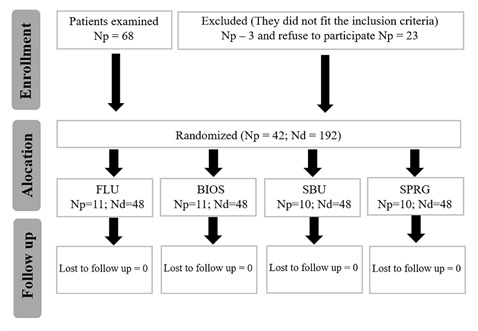
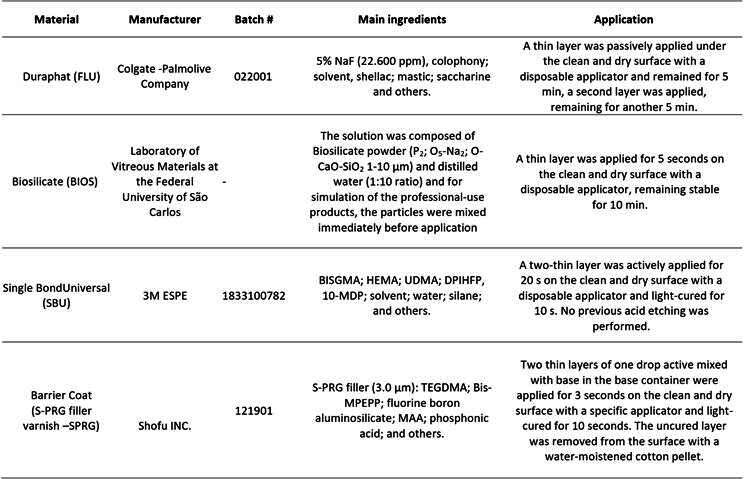
The aim of this clinical, prospective, randomized, and parallel study was to evaluate different in-office treatments for dentin hypersensitivity (DH). One hundred ninety-two teeth with non-cavitated root exposures were treated using different desensitizers: fluoride varnish (Duraphat - FLU); bioactive ceramic solution (Biosilicate - BIOS); universal self-etching adhesive (Single Bond Universal - SBU); bioactive photoactivated varnish (PRG filler - SPRG). The degree of DH was analyzed using a visual analog scale (VAS) and computerized visual scale (CoVAS), before treatments and after 7, 15, and 30 days from the first session. Comparisons among desensitizers were performed using the Kruskal-Wallis and Dunn's tests. Friedman test was used to compare between times (p ≤ 0.05). Comparing desensitizers FLU presented a higher value of DH than BIOS using VAS at 7 days, however, no differences were found using CoVAS analysis. Comparing times, BIOS and SBU showed a reduction in DH after 7 days and SBU showed a reduction at 30 days compared to 7 days using VAS. FLU and SPRG groups reduced DH from 15 days to 30 days using VAS. There was a reduction in DH for FLU, BIOS, and SBU after 7 days and for BIOS this reduction also occurred at 30 days when compared to 15 days using CoVAS. SPRG group showed a reduction from 15 to 30 days. All desensitizers tested were able to reduce the initial sensitivity. The bioactive ceramic solution reduced the DH gradually after 30 days using computerized analysis.



 京公网安备 11010802042870号
京ICP备2023020795号-1
京公网安备 11010802042870号
京ICP备2023020795号-1

 分享
分享

 求助内容:
求助内容: 应助结果提醒方式:
 扫码关注我们
