Dr. Federica Angiolari, Giacomo Mandelli, Dr. Simon Huppert, Dr. Chiara Aieta, Dr. Riccardo Spezia
{"title":"Elucidating Heavy-Atom-Tunneling Kinetics in the Cope Rearrangement of Semibullvalene","authors":"Dr. Federica Angiolari, Giacomo Mandelli, Dr. Simon Huppert, Dr. Chiara Aieta, Dr. Riccardo Spezia","doi":"10.1002/chem.202401000","DOIUrl":null,"url":null,"abstract":"<p>In this work, we characterize the temperature dependence of kinetic properties in heavy atom tunneling reactions by means of molecular dynamics simulations, including nuclear quantum effects (NQEs) via Path Integral theory. To this end, we consider the prototypical Cope rearrangement of semibullvalene. The reaction was studied in the 25–300 K temperature range observing that the inclusion of NQEs modifies the temperature behavior of both free energy barriers and dynamical recrossing factors with respect to classical dynamics. Notably, while in classical simulations the activation free energy shows a very weak temperature dependence, it becomes strongly dependent on temperature when NQEs are included. This temperature behavior shows a transition from a regime where the quantum effects are limited and can mainly be traced back to zero point energy, to a low temperature regime where tunneling plays a dominant role. In this regime, the free energy curve tunnels below the potential energy barrier along the reaction coordinate, allowing much faster reaction rates. Finally, the temperature dependence of the rate constants obtained from molecular dynamics simulations was compared with available experimental data and with semi-classical transition state theory calculations, showing comparable behaviors and similar transition temperatures from thermal to (deep) tunneling regime.</p>","PeriodicalId":144,"journal":{"name":"Chemistry - A European Journal","volume":"30 60","pages":""},"PeriodicalIF":3.7000,"publicationDate":"2024-06-26","publicationTypes":"Journal Article","fieldsOfStudy":null,"isOpenAccess":false,"openAccessPdf":"https://onlinelibrary.wiley.com/doi/epdf/10.1002/chem.202401000","citationCount":"0","resultStr":null,"platform":"Semanticscholar","paperid":null,"PeriodicalName":"Chemistry - A European Journal","FirstCategoryId":"92","ListUrlMain":"https://chemistry-europe.onlinelibrary.wiley.com/doi/10.1002/chem.202401000","RegionNum":2,"RegionCategory":"化学","ArticlePicture":[],"TitleCN":null,"AbstractTextCN":null,"PMCID":null,"EPubDate":"","PubModel":"","JCR":"Q2","JCRName":"CHEMISTRY, MULTIDISCIPLINARY","Score":null,"Total":0}
引用次数: 0
Abstract
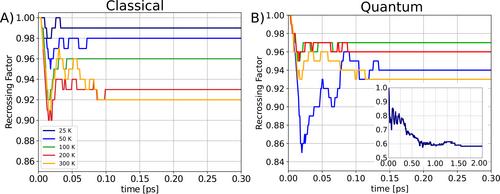
In this work, we characterize the temperature dependence of kinetic properties in heavy atom tunneling reactions by means of molecular dynamics simulations, including nuclear quantum effects (NQEs) via Path Integral theory. To this end, we consider the prototypical Cope rearrangement of semibullvalene. The reaction was studied in the 25–300 K temperature range observing that the inclusion of NQEs modifies the temperature behavior of both free energy barriers and dynamical recrossing factors with respect to classical dynamics. Notably, while in classical simulations the activation free energy shows a very weak temperature dependence, it becomes strongly dependent on temperature when NQEs are included. This temperature behavior shows a transition from a regime where the quantum effects are limited and can mainly be traced back to zero point energy, to a low temperature regime where tunneling plays a dominant role. In this regime, the free energy curve tunnels below the potential energy barrier along the reaction coordinate, allowing much faster reaction rates. Finally, the temperature dependence of the rate constants obtained from molecular dynamics simulations was compared with available experimental data and with semi-classical transition state theory calculations, showing comparable behaviors and similar transition temperatures from thermal to (deep) tunneling regime.
期刊介绍:
Chemistry—A European Journal is a truly international journal with top quality contributions (2018 ISI Impact Factor: 5.16). It publishes a wide range of outstanding Reviews, Minireviews, Concepts, Full Papers, and Communications from all areas of chemistry and related fields.
Based in Europe Chemistry—A European Journal provides an excellent platform for increasing the visibility of European chemistry as well as for featuring the best research from authors from around the world.
All manuscripts are peer-reviewed, and electronic processing ensures accurate reproduction of text and data, plus short publication times.
The Concepts section provides nonspecialist readers with a useful conceptual guide to unfamiliar areas and experts with new angles on familiar problems.
Chemistry—A European Journal is published on behalf of ChemPubSoc Europe, a group of 16 national chemical societies from within Europe, and supported by the Asian Chemical Editorial Societies. The ChemPubSoc Europe family comprises: Angewandte Chemie, Chemistry—A European Journal, European Journal of Organic Chemistry, European Journal of Inorganic Chemistry, ChemPhysChem, ChemBioChem, ChemMedChem, ChemCatChem, ChemSusChem, ChemPlusChem, ChemElectroChem, and ChemistryOpen.




 京公网安备 11010802042870号
京ICP备2023020795号-1
京公网安备 11010802042870号
京ICP备2023020795号-1

 分享
分享
 求助内容:
求助内容: 应助结果提醒方式:
 扫码关注我们
