Rasmus H Gantzel, Emilie E Møller, Niels K Aagaard, Hugh Watson, Peter Jepsen, Henning Grønbæk
{"title":"Randomized clinical trial on safety of the natriuretic peptide ularitide as treatment of refractory cirrhotic ascites.","authors":"Rasmus H Gantzel, Emilie E Møller, Niels K Aagaard, Hugh Watson, Peter Jepsen, Henning Grønbæk","doi":"10.1097/HC9.0000000000000481","DOIUrl":null,"url":null,"abstract":"<p><strong>Background: </strong>Sodium and water retention is a mainstay of the pathophysiology leading to ascites formation in patients with advanced cirrhosis. Refractory ascites denotes the most severe ascites status with limited treatment options and a poor prognosis. We investigated the efficacy and safety of the natriuretic peptide ularitide in patients with refractory cirrhotic ascites.</p><p><strong>Methods: </strong>We conducted a randomized placebo-controlled trial investigating ularitide to manage refractory ascites. Until trial termination after interim analyses, we randomized 17 participants in a 2:1 ratio between ularitide (n=11) and placebo (n=6). While hospitalized, the participants received treatment for up to 48 hours. The primary efficacy endpoint was a change in renal water excretion, and secondary end points included changes in renal sodium excretion rate and body weight. The starting dose was 30 ng/kg/min, though later reduced to 20 for safety reasons.</p><p><strong>Results: </strong>In contrast to the study hypothesis, the mean urine production decreased after 24 hours of ularitide treatment compared with the baseline level (22.8 vs. 47.5 mL/h, p=0.04) and decreased more in participants randomized to ularitide than placebo (24.7 vs. -6.2 mL/h, p=0.05). Ularitide did not increase the renal sodium excretion rate or reduce the weight gain. The incidence rate ratio of adverse reactions in ularitide versus placebo was 8.5 (95% CI: 2-35, p=0.003). Participants treated with ularitide developed serious blood pressure reductions, impacting their renal responsiveness.</p><p><strong>Conclusions: </strong>Ularitide in doses of 20-30 ng/kg/min did not benefit urine production and renal sodium excretion rate in patients with refractory ascites. The participants randomized to ularitide overall developed more adverse reactions than placebo. EudraCT no. 2019-002268-28.</p>","PeriodicalId":12978,"journal":{"name":"Hepatology Communications","volume":"8 7","pages":""},"PeriodicalIF":5.6000,"publicationDate":"2024-06-27","publicationTypes":"Journal Article","fieldsOfStudy":null,"isOpenAccess":false,"openAccessPdf":"https://www.ncbi.nlm.nih.gov/pmc/articles/PMC11213594/pdf/","citationCount":"0","resultStr":null,"platform":"Semanticscholar","paperid":null,"PeriodicalName":"Hepatology Communications","FirstCategoryId":"3","ListUrlMain":"https://doi.org/10.1097/HC9.0000000000000481","RegionNum":2,"RegionCategory":"医学","ArticlePicture":[],"TitleCN":null,"AbstractTextCN":null,"PMCID":null,"EPubDate":"2024/7/1 0:00:00","PubModel":"eCollection","JCR":"Q1","JCRName":"GASTROENTEROLOGY & HEPATOLOGY","Score":null,"Total":0}
引用次数: 0
Abstract
Background: Sodium and water retention is a mainstay of the pathophysiology leading to ascites formation in patients with advanced cirrhosis. Refractory ascites denotes the most severe ascites status with limited treatment options and a poor prognosis. We investigated the efficacy and safety of the natriuretic peptide ularitide in patients with refractory cirrhotic ascites.
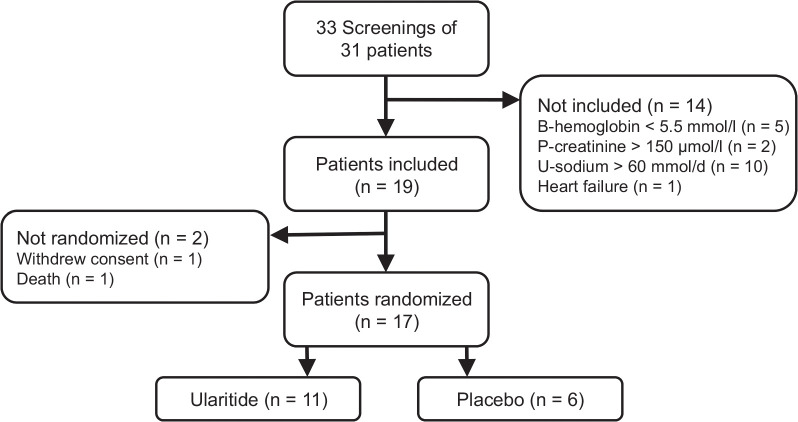
Methods: We conducted a randomized placebo-controlled trial investigating ularitide to manage refractory ascites. Until trial termination after interim analyses, we randomized 17 participants in a 2:1 ratio between ularitide (n=11) and placebo (n=6). While hospitalized, the participants received treatment for up to 48 hours. The primary efficacy endpoint was a change in renal water excretion, and secondary end points included changes in renal sodium excretion rate and body weight. The starting dose was 30 ng/kg/min, though later reduced to 20 for safety reasons.
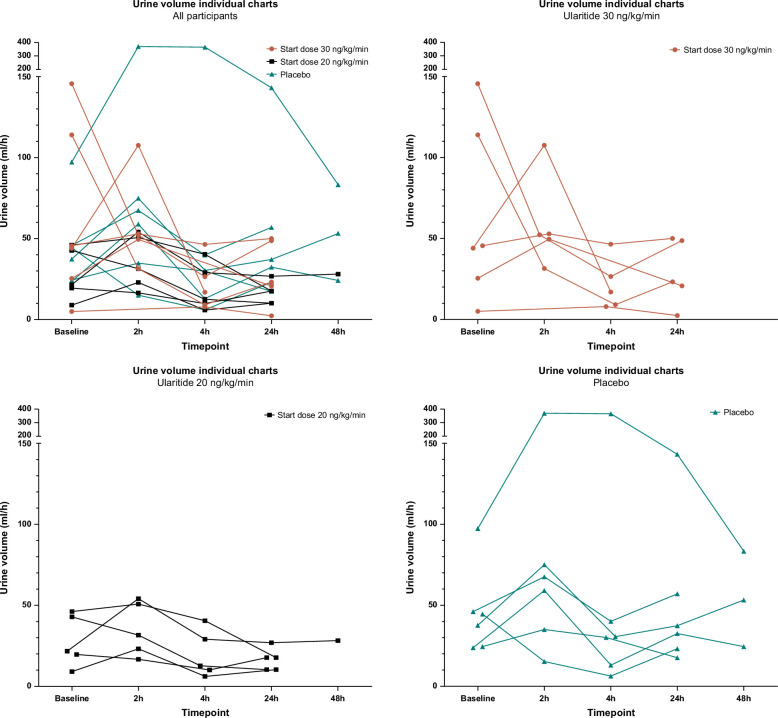
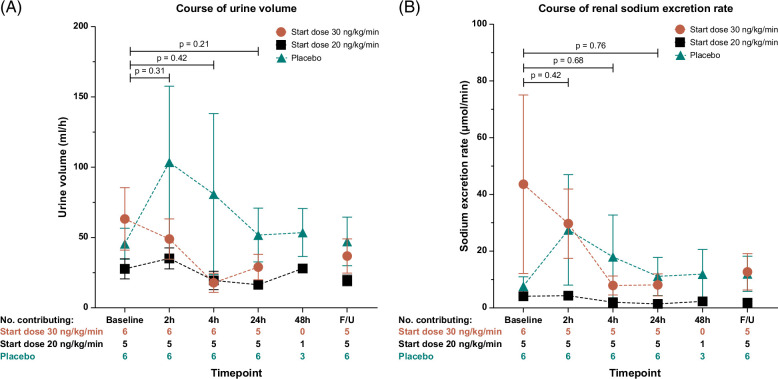
Results: In contrast to the study hypothesis, the mean urine production decreased after 24 hours of ularitide treatment compared with the baseline level (22.8 vs. 47.5 mL/h, p=0.04) and decreased more in participants randomized to ularitide than placebo (24.7 vs. -6.2 mL/h, p=0.05). Ularitide did not increase the renal sodium excretion rate or reduce the weight gain. The incidence rate ratio of adverse reactions in ularitide versus placebo was 8.5 (95% CI: 2-35, p=0.003). Participants treated with ularitide developed serious blood pressure reductions, impacting their renal responsiveness.
Conclusions: Ularitide in doses of 20-30 ng/kg/min did not benefit urine production and renal sodium excretion rate in patients with refractory ascites. The participants randomized to ularitide overall developed more adverse reactions than placebo. EudraCT no. 2019-002268-28.
期刊介绍:
Hepatology Communications is a peer-reviewed, online-only, open access journal for fast dissemination of high quality basic, translational, and clinical research in hepatology. Hepatology Communications maintains high standard and rigorous peer review. Because of its open access nature, authors retain the copyright to their works, all articles are immediately available and free to read and share, and it is fully compliant with funder and institutional mandates. The journal is committed to fast publication and author satisfaction.




 京公网安备 11010802042870号
京ICP备2023020795号-1
京公网安备 11010802042870号
京ICP备2023020795号-1

 分享
分享
 求助内容:
求助内容: 应助结果提醒方式:
 扫码关注我们
