Xiaotian Wei, Chung Kim Nguyen, Patrick D. Taylor, Vaishnavi Krishnamurthi, Nitu Syed, Phuong Y. Le, Michelle J. S. Spencer, Torben Daeneke and Lei Bao
{"title":"Surface chemistry altering electronic behaviour of liquid metal-derived tin oxide nanosheets†","authors":"Xiaotian Wei, Chung Kim Nguyen, Patrick D. Taylor, Vaishnavi Krishnamurthi, Nitu Syed, Phuong Y. Le, Michelle J. S. Spencer, Torben Daeneke and Lei Bao","doi":"10.1039/D4NR01841A","DOIUrl":null,"url":null,"abstract":"<p >Possessing excellent electronic properties and high chemical stability, semiconducting n-type two-dimensional (2D) tin dioxide (SnO<small><sub>2</sub></small>) nanosheets have been featured in sensing and electrocatalysis applications recently. Derived from non-layered crystal structures, 2D SnO<small><sub>2</sub></small> has abundant unsaturated dangling bonds existing at the surface, providing interfacial activity. How the surface chemistry alters the electronic properties of 2D SnO<small><sub>2</sub></small> nanomaterials remains unexplored. In this study, we synthesised ultra-thin 2D SnO<small><sub>2</sub></small> nanosheets using a liquid metal (LM) touch printing technique and investigated experimentally and theoretically how the interactions of organic solvents composed of alkyl and hydroxyl groups with the surface of LM-derived 2D SnO<small><sub>2</sub></small> modulate the electronic properties. It was found that alkane solvents can physically absorb onto the SnO<small><sub>2</sub></small> surface with no impact on the material conductivity. Alcohol-based solvents on the other hand interact with the SnO<small><sub>2</sub></small> surface <em>via</em> chemical absorptions primarily, in which oxygen atoms of hydroxyl groups in the alcohols form bonds with the surface atoms of SnO<small><sub>2</sub></small>. The binding stability is determined by the length and configuration of the hydrocarbon chain in alcohols. As representative long-chain alcohols, 1-octanol and 1-pentanol attach onto the SnO<small><sub>2</sub></small> surface strongly, lowering the binding energy of Sn<small><sup>4+</sup></small> and reducing the electron transfer ability of SnO<small><sub>2</sub></small> nanosheets. Consequently, the electronic properties, <em>i.e.</em> conductivity and electronic mobility of SnO<small><sub>2</sub></small> nanosheet-based electronic devices are decreased significantly.</p>","PeriodicalId":92,"journal":{"name":"Nanoscale","volume":" 28","pages":" 13551-13561"},"PeriodicalIF":5.1000,"publicationDate":"2024-06-27","publicationTypes":"Journal Article","fieldsOfStudy":null,"isOpenAccess":false,"openAccessPdf":"","citationCount":"0","resultStr":null,"platform":"Semanticscholar","paperid":null,"PeriodicalName":"Nanoscale","FirstCategoryId":"88","ListUrlMain":"https://pubs.rsc.org/en/content/articlelanding/2024/nr/d4nr01841a","RegionNum":3,"RegionCategory":"材料科学","ArticlePicture":[],"TitleCN":null,"AbstractTextCN":null,"PMCID":null,"EPubDate":"","PubModel":"","JCR":"Q1","JCRName":"CHEMISTRY, MULTIDISCIPLINARY","Score":null,"Total":0}
引用次数: 0
Abstract
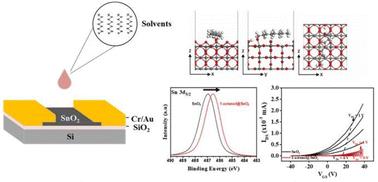
Possessing excellent electronic properties and high chemical stability, semiconducting n-type two-dimensional (2D) tin dioxide (SnO2) nanosheets have been featured in sensing and electrocatalysis applications recently. Derived from non-layered crystal structures, 2D SnO2 has abundant unsaturated dangling bonds existing at the surface, providing interfacial activity. How the surface chemistry alters the electronic properties of 2D SnO2 nanomaterials remains unexplored. In this study, we synthesised ultra-thin 2D SnO2 nanosheets using a liquid metal (LM) touch printing technique and investigated experimentally and theoretically how the interactions of organic solvents composed of alkyl and hydroxyl groups with the surface of LM-derived 2D SnO2 modulate the electronic properties. It was found that alkane solvents can physically absorb onto the SnO2 surface with no impact on the material conductivity. Alcohol-based solvents on the other hand interact with the SnO2 surface via chemical absorptions primarily, in which oxygen atoms of hydroxyl groups in the alcohols form bonds with the surface atoms of SnO2. The binding stability is determined by the length and configuration of the hydrocarbon chain in alcohols. As representative long-chain alcohols, 1-octanol and 1-pentanol attach onto the SnO2 surface strongly, lowering the binding energy of Sn4+ and reducing the electron transfer ability of SnO2 nanosheets. Consequently, the electronic properties, i.e. conductivity and electronic mobility of SnO2 nanosheet-based electronic devices are decreased significantly.
期刊介绍:
Nanoscale is a high-impact international journal, publishing high-quality research across nanoscience and nanotechnology. Nanoscale publishes a full mix of research articles on experimental and theoretical work, including reviews, communications, and full papers.Highly interdisciplinary, this journal appeals to scientists, researchers and professionals interested in nanoscience and nanotechnology, quantum materials and quantum technology, including the areas of physics, chemistry, biology, medicine, materials, energy/environment, information technology, detection science, healthcare and drug discovery, and electronics.




 京公网安备 11010802042870号
京ICP备2023020795号-1
京公网安备 11010802042870号
京ICP备2023020795号-1

 分享
分享
 求助内容:
求助内容: 应助结果提醒方式:
 扫码关注我们
