Sheng-Cai Wang, Xiang Zhou, Ying-Xian Li, Chun-Yan Zhang, Zi-Yan Zhang, Dr. Yan-Shi Xiong, Prof. Dr. Gui Lu, Prof. Dr. Jiajia Dong, Prof. Dr. Jiang Weng
{"title":"Enabling Modular Click Chemistry Library through Sequential Ligations of Carboxylic Acids and Amines","authors":"Sheng-Cai Wang, Xiang Zhou, Ying-Xian Li, Chun-Yan Zhang, Zi-Yan Zhang, Dr. Yan-Shi Xiong, Prof. Dr. Gui Lu, Prof. Dr. Jiajia Dong, Prof. Dr. Jiang Weng","doi":"10.1002/anie.202410699","DOIUrl":null,"url":null,"abstract":"<p>High-throughput synthesis and screening of chemical libraries play pivotal roles in drug discovery. Click chemistry has emerged as a powerful strategy for constructing highly modular chemical libraries. However, the development of new click reactions and unlocking new clickable building blocks remain exceedingly challenging. Herein, we describe a double-click strategy that enables the sequential ligations of widely available carboxylic acids and amines with fluorosulfuryl isocyanate (FSO<sub>2</sub>NCO) via a modular amidation/SuFEx (sulfur-fluoride exchange) process. This method provides facile access to chemical libraries of N-fluorosulfonyl amides (RCONHSO<sub>2</sub>F) and N-acylsulfamides (RCONHSO<sub>2</sub>NR′R′′) in near-quantitative yields under simple and practical conditions. The robustness and efficiency of this double click strategy is showcased by the facile construction of chemical libraries in 96-well microtiter plates from a large number of carboxylic acids and amines. Preliminary biological activity screening reveals that some compounds exhibit high antimicrobial activities against Gram-positive bacterium S. aureus and drug-resistant MRSA (MIC up to 6.25 μg ⋅ mL<sup>−1</sup>). These results provide compelling evidence for the potential application of modular click chemistry library as an enabling technology in high-throughput medicinal chemistry.</p>","PeriodicalId":125,"journal":{"name":"Angewandte Chemie International Edition","volume":"63 40","pages":""},"PeriodicalIF":16.9000,"publicationDate":"2024-06-28","publicationTypes":"Journal Article","fieldsOfStudy":null,"isOpenAccess":false,"openAccessPdf":"","citationCount":"0","resultStr":null,"platform":"Semanticscholar","paperid":null,"PeriodicalName":"Angewandte Chemie International Edition","FirstCategoryId":"92","ListUrlMain":"https://onlinelibrary.wiley.com/doi/10.1002/anie.202410699","RegionNum":1,"RegionCategory":"化学","ArticlePicture":[],"TitleCN":null,"AbstractTextCN":null,"PMCID":null,"EPubDate":"","PubModel":"","JCR":"Q1","JCRName":"CHEMISTRY, MULTIDISCIPLINARY","Score":null,"Total":0}
引用次数: 0
Abstract
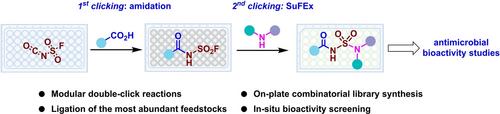
High-throughput synthesis and screening of chemical libraries play pivotal roles in drug discovery. Click chemistry has emerged as a powerful strategy for constructing highly modular chemical libraries. However, the development of new click reactions and unlocking new clickable building blocks remain exceedingly challenging. Herein, we describe a double-click strategy that enables the sequential ligations of widely available carboxylic acids and amines with fluorosulfuryl isocyanate (FSO2NCO) via a modular amidation/SuFEx (sulfur-fluoride exchange) process. This method provides facile access to chemical libraries of N-fluorosulfonyl amides (RCONHSO2F) and N-acylsulfamides (RCONHSO2NR′R′′) in near-quantitative yields under simple and practical conditions. The robustness and efficiency of this double click strategy is showcased by the facile construction of chemical libraries in 96-well microtiter plates from a large number of carboxylic acids and amines. Preliminary biological activity screening reveals that some compounds exhibit high antimicrobial activities against Gram-positive bacterium S. aureus and drug-resistant MRSA (MIC up to 6.25 μg ⋅ mL−1). These results provide compelling evidence for the potential application of modular click chemistry library as an enabling technology in high-throughput medicinal chemistry.
期刊介绍:
Angewandte Chemie, a journal of the German Chemical Society (GDCh), maintains a leading position among scholarly journals in general chemistry with an impressive Impact Factor of 16.6 (2022 Journal Citation Reports, Clarivate, 2023). Published weekly in a reader-friendly format, it features new articles almost every day. Established in 1887, Angewandte Chemie is a prominent chemistry journal, offering a dynamic blend of Review-type articles, Highlights, Communications, and Research Articles on a weekly basis, making it unique in the field.



 京公网安备 11010802042870号
京ICP备2023020795号-1
京公网安备 11010802042870号
京ICP备2023020795号-1

 分享
分享
 求助内容:
求助内容: 应助结果提醒方式:
 扫码关注我们
