David Pellerin MD, Jens Seemann MSc, Andreas Traschütz MD, PhD, Bernard Brais MDCM, PhD, Winfried Ilg PhD, Matthis Synofzik MD
{"title":"Reduced Age-Dependent Penetrance of a Large FGF14 GAA Repeat Expansion in a 74-Year-Old Woman from a German Family with SCA27B","authors":"David Pellerin MD, Jens Seemann MSc, Andreas Traschütz MD, PhD, Bernard Brais MDCM, PhD, Winfried Ilg PhD, Matthis Synofzik MD","doi":"10.1002/mds.29915","DOIUrl":null,"url":null,"abstract":"<p>Spinocerebellar ataxia 27B (SCA27B) is a recently described autosomal dominant cerebellar ataxia caused by an intronic GAA repeat expansion in the <i>FGF14</i> gene.<span><sup>1</sup></span> Since SCA27B is one of the most common genetic ataxias worldwide,<span><sup>2, 3</sup></span> a better understanding of disease penetrance is essential for improving genetic counseling and management of at-risk individuals, as well as for guiding eligibility assessment for future clinical trials.</p><p>Initial reports have suggested a pathogenic threshold of (GAA)<sub>≥250</sub> repeat units, albeit with reduced penetrance for (GAA)<sub>250–300</sub> alleles, since they were observed in ~1.5%–2% of controls.<span><sup>1, 2</sup></span> A subsequent study identified expansions ranging from 308 to 380 GAA repeat units in 5 of 475 controls, raising the possibility that (GAA)<sub>>300</sub> expansions may also show incomplete penetrance.<span><sup>4</sup></span> Notwithstanding, direct evidence for the reduced penetrance of <i>FGF14</i> GAA repeat expansions remains limited. Here, we provide an in-depth, multimodal assessment of an asymptomatic 74-year-old woman carrying a (GAA)<sub>483</sub> expansion from a family with SCA27B, thus providing further direct evidence for the reduced age-dependent penetrance even of large <i>FGF14</i> GAA repeat expansions.</p><p>A 74-year-old woman of German descent presented to the Ataxia Clinic in Tübingen for evaluation of her genetic risk following the diagnosis of SCA27B in two of her relatives (Fig. 1A). She reported no symptoms suggestive of SCA27B,<span><sup>2</sup></span> such as episodic or progressive imbalance, visual disturbances, vertigo and/or dizziness, and alcohol sensitivity. Neurological examination by two independent SCA27B experts (M.S., A.T.) was unremarkable (including absence of downbeat nystagmus), except for questionable mild dysdiadochokinesia of the right upper extremity and mild reduction of vibration sense at the ankles bilaterally. The total score on the Scale for the Assessment and Rating of Ataxia (SARA) was 0.5/40 points (threshold for ataxia: ≥3 points<span><sup>5</sup></span>). Furthermore, the score on the Friedreich Ataxia Rating Scale (FARS) Part E, a gait and balance assessment tool with even higher senstivity,<span><sup>6</sup></span> was 0. We next performed quantitative gait analysis using body-worn sensors (see Supporting Information), which is able to detect even subtle gait and balance changes in the very early stages of cerebellar disease.<span><sup>7-9</sup></span> Her gait performance, as assessed by the ataxic-sensitive measures “lateral step deviation” and “stride length variability”<span><sup>7</sup></span> lay outside the 90% confidence intervals for aged-matched ataxic patients, but within the 90% confidence interval for age-matched healthy controls (Fig. 1B,C). Following a standardized protocol employing long-range polymerase chain reaction (PCR) and bidirectional repeat-primed PCRs,<span><sup>10</sup></span> genetic testing revealed that her <i>FGF14</i> genotype was 483 and 9 GAA repeat units, without evidence of interruptions within the expanded allele. This result was confirmed with two independent blood samples. In comparison, the subject's brother and cousin, who respectively carried a (GAA)<sub>488</sub> and (GAA)<sub>496</sub> expansion, developed slowly progressive cerebellar ataxia at the age of 55 and 63 years, respectively (Table S1).</p><p>Through in-depth, multimodal assessment that included highly sensitive standardized clinical scoring (FARS-E) and quantitative digital-motor gait analysis, this study provides first direct evidence for reduced age-dependent penetrance of a large <i>FGF14</i> (GAA)<sub>483</sub> repeat expansion in an otherwise still asymptomatic 74-year-old woman from a German family with SCA27B. Quantitative analysis of gait parameters shown to be highly sensitive to mild gait and balance deficits, namely lateral step deviation and stride length variability,<span><sup>7</sup></span> showed that the subject had a performance within the range of age-matched healthy controls, but outside the range of ataxic individuals. Our findings extend previous evidence of reduced penetrance of <i>FGF14</i> GAA repeat expansions, as supported by their observation in non-ataxic controls and inferred from the frequent sporadic presentation of SCA27B (15%–50%),<span><sup>2</sup></span> where an asymptomatic parent must have been an obligate expansion carrier. Although it is not clear how thoroughly the relatives of sporadic cases reported in previous series were assessed, they were likely not assessed using highly sensitive clinical scales like the FARS-E and quantitative gait assessment.</p><p>While most patients with SCA27B develop ataxia in their 50s and 60s,<span><sup>2</sup></span> some occasionally manifest ataxia in their 80s,<span><sup>1</sup></span> thus not ruling out that the subject reported here may develop SCA27B later in life. While longitudinal follow-up is warranted to investigate this, our results support the reduced age-dependent penetrance of large <i>FGF14</i> repeat expansions past the age of 70 years. They also further corroborate the observed intrafamilial variability in the age at onset associated even with <i>FGF14</i> GAA repeat expansions of same size.<span><sup>2</sup></span> The reduced penetrance of <i>FGF14</i> expansions may be the result of modifying genetic factors and/or somatic mosaicism in the central nervous system, similar to what has previously been shown in Friedreich ataxia.<span><sup>11</sup></span></p><p>In conclusion, our findings show that reduced age-dependent penetrance may also be observed with large <i>FGF14</i> repeat expansions past the age of 70 years, which is of importance for genetic counseling and future trial planning. In addition, they highlight the need to comprehensively study factors that modulate age of onset and age-dependent penetrance of SCA27B, given its high frequency.</p><p>The study was approved by the Institutional Review Board of the University of Tübingen (AZ 598/2011BO1). Written informed consent was obtained from all study participants before enrollment.</p><p>(1) Research Project: A. Conceptualization, B. Design, C. Execution and Data Acquisition; (2) Statistical Analysis: A. Design, B. Execution, C. Review and Critique; (3) Manuscript Preparation: A. Writing of the First Draft, B. Review and Critique.</p><p>D.P.: 1A, 1B, 1C, 3A, 3B.</p><p>J.S.: 1A, 1B, 1C, 3A, 3B.</p><p>A.T.: 1C, 3A, 3B.</p><p>B.B.: 1C, 3A, 3B.</p><p>W.I.: 1A, 1B, 1C, 3A, 3B.</p><p>M.S.: 1A, 1B, 1C, 3A, 3B.</p><p>All authors had full access to all the data in the study and accept responsibility for submission for publication.</p>","PeriodicalId":213,"journal":{"name":"Movement Disorders","volume":"39 10","pages":"1892-1894"},"PeriodicalIF":7.6000,"publicationDate":"2024-07-01","publicationTypes":"Journal Article","fieldsOfStudy":null,"isOpenAccess":false,"openAccessPdf":"https://onlinelibrary.wiley.com/doi/epdf/10.1002/mds.29915","citationCount":"0","resultStr":null,"platform":"Semanticscholar","paperid":null,"PeriodicalName":"Movement Disorders","FirstCategoryId":"3","ListUrlMain":"https://movementdisorders.onlinelibrary.wiley.com/doi/10.1002/mds.29915","RegionNum":1,"RegionCategory":"医学","ArticlePicture":[],"TitleCN":null,"AbstractTextCN":null,"PMCID":null,"EPubDate":"","PubModel":"","JCR":"Q1","JCRName":"CLINICAL NEUROLOGY","Score":null,"Total":0}
引用次数: 0
Abstract
Spinocerebellar ataxia 27B (SCA27B) is a recently described autosomal dominant cerebellar ataxia caused by an intronic GAA repeat expansion in the FGF14 gene.1 Since SCA27B is one of the most common genetic ataxias worldwide,2, 3 a better understanding of disease penetrance is essential for improving genetic counseling and management of at-risk individuals, as well as for guiding eligibility assessment for future clinical trials.
Initial reports have suggested a pathogenic threshold of (GAA)≥250 repeat units, albeit with reduced penetrance for (GAA)250–300 alleles, since they were observed in ~1.5%–2% of controls.1, 2 A subsequent study identified expansions ranging from 308 to 380 GAA repeat units in 5 of 475 controls, raising the possibility that (GAA)>300 expansions may also show incomplete penetrance.4 Notwithstanding, direct evidence for the reduced penetrance of FGF14 GAA repeat expansions remains limited. Here, we provide an in-depth, multimodal assessment of an asymptomatic 74-year-old woman carrying a (GAA)483 expansion from a family with SCA27B, thus providing further direct evidence for the reduced age-dependent penetrance even of large FGF14 GAA repeat expansions.
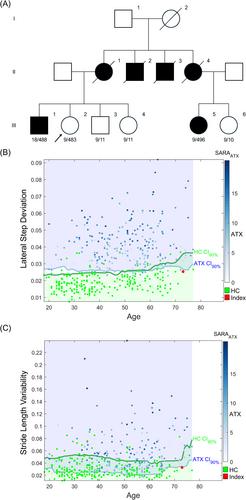
A 74-year-old woman of German descent presented to the Ataxia Clinic in Tübingen for evaluation of her genetic risk following the diagnosis of SCA27B in two of her relatives (Fig. 1A). She reported no symptoms suggestive of SCA27B,2 such as episodic or progressive imbalance, visual disturbances, vertigo and/or dizziness, and alcohol sensitivity. Neurological examination by two independent SCA27B experts (M.S., A.T.) was unremarkable (including absence of downbeat nystagmus), except for questionable mild dysdiadochokinesia of the right upper extremity and mild reduction of vibration sense at the ankles bilaterally. The total score on the Scale for the Assessment and Rating of Ataxia (SARA) was 0.5/40 points (threshold for ataxia: ≥3 points5). Furthermore, the score on the Friedreich Ataxia Rating Scale (FARS) Part E, a gait and balance assessment tool with even higher senstivity,6 was 0. We next performed quantitative gait analysis using body-worn sensors (see Supporting Information), which is able to detect even subtle gait and balance changes in the very early stages of cerebellar disease.7-9 Her gait performance, as assessed by the ataxic-sensitive measures “lateral step deviation” and “stride length variability”7 lay outside the 90% confidence intervals for aged-matched ataxic patients, but within the 90% confidence interval for age-matched healthy controls (Fig. 1B,C). Following a standardized protocol employing long-range polymerase chain reaction (PCR) and bidirectional repeat-primed PCRs,10 genetic testing revealed that her FGF14 genotype was 483 and 9 GAA repeat units, without evidence of interruptions within the expanded allele. This result was confirmed with two independent blood samples. In comparison, the subject's brother and cousin, who respectively carried a (GAA)488 and (GAA)496 expansion, developed slowly progressive cerebellar ataxia at the age of 55 and 63 years, respectively (Table S1).
Through in-depth, multimodal assessment that included highly sensitive standardized clinical scoring (FARS-E) and quantitative digital-motor gait analysis, this study provides first direct evidence for reduced age-dependent penetrance of a large FGF14 (GAA)483 repeat expansion in an otherwise still asymptomatic 74-year-old woman from a German family with SCA27B. Quantitative analysis of gait parameters shown to be highly sensitive to mild gait and balance deficits, namely lateral step deviation and stride length variability,7 showed that the subject had a performance within the range of age-matched healthy controls, but outside the range of ataxic individuals. Our findings extend previous evidence of reduced penetrance of FGF14 GAA repeat expansions, as supported by their observation in non-ataxic controls and inferred from the frequent sporadic presentation of SCA27B (15%–50%),2 where an asymptomatic parent must have been an obligate expansion carrier. Although it is not clear how thoroughly the relatives of sporadic cases reported in previous series were assessed, they were likely not assessed using highly sensitive clinical scales like the FARS-E and quantitative gait assessment.
While most patients with SCA27B develop ataxia in their 50s and 60s,2 some occasionally manifest ataxia in their 80s,1 thus not ruling out that the subject reported here may develop SCA27B later in life. While longitudinal follow-up is warranted to investigate this, our results support the reduced age-dependent penetrance of large FGF14 repeat expansions past the age of 70 years. They also further corroborate the observed intrafamilial variability in the age at onset associated even with FGF14 GAA repeat expansions of same size.2 The reduced penetrance of FGF14 expansions may be the result of modifying genetic factors and/or somatic mosaicism in the central nervous system, similar to what has previously been shown in Friedreich ataxia.11
In conclusion, our findings show that reduced age-dependent penetrance may also be observed with large FGF14 repeat expansions past the age of 70 years, which is of importance for genetic counseling and future trial planning. In addition, they highlight the need to comprehensively study factors that modulate age of onset and age-dependent penetrance of SCA27B, given its high frequency.
The study was approved by the Institutional Review Board of the University of Tübingen (AZ 598/2011BO1). Written informed consent was obtained from all study participants before enrollment.
(1) Research Project: A. Conceptualization, B. Design, C. Execution and Data Acquisition; (2) Statistical Analysis: A. Design, B. Execution, C. Review and Critique; (3) Manuscript Preparation: A. Writing of the First Draft, B. Review and Critique.
D.P.: 1A, 1B, 1C, 3A, 3B.
J.S.: 1A, 1B, 1C, 3A, 3B.
A.T.: 1C, 3A, 3B.
B.B.: 1C, 3A, 3B.
W.I.: 1A, 1B, 1C, 3A, 3B.
M.S.: 1A, 1B, 1C, 3A, 3B.
All authors had full access to all the data in the study and accept responsibility for submission for publication.
期刊介绍:
Movement Disorders publishes a variety of content types including Reviews, Viewpoints, Full Length Articles, Historical Reports, Brief Reports, and Letters. The journal considers original manuscripts on topics related to the diagnosis, therapeutics, pharmacology, biochemistry, physiology, etiology, genetics, and epidemiology of movement disorders. Appropriate topics include Parkinsonism, Chorea, Tremors, Dystonia, Myoclonus, Tics, Tardive Dyskinesia, Spasticity, and Ataxia.





 京公网安备 11010802042870号
京ICP备2023020795号-1
京公网安备 11010802042870号
京ICP备2023020795号-1

 分享
分享
 求助内容:
求助内容: 应助结果提醒方式:
 扫码关注我们
