Christine Mages MD , Heike Gampp , Ann-Kathrin Rahm MD , Juline Hackbarth , Julia Pfeiffer , Finn Petersenn , Xenia Kramp , Fatemeh Kermani , Juan Zhang PhD , Daniel A. Pijnappels PhD , Antoine A.F. de Vries PhD , Katharina Seidensaal MD , Bernhard Rhein PhD , Jürgen Debus MD , Nina D. Ullrich PhD , Norbert Frey MD , Dierk Thomas MD , Patrick Lugenbiel MD
{"title":"Cardiac stereotactic body radiotherapy to treat malignant ventricular arrhythmias directly affects the cardiomyocyte electrophysiology","authors":"Christine Mages MD , Heike Gampp , Ann-Kathrin Rahm MD , Juline Hackbarth , Julia Pfeiffer , Finn Petersenn , Xenia Kramp , Fatemeh Kermani , Juan Zhang PhD , Daniel A. Pijnappels PhD , Antoine A.F. de Vries PhD , Katharina Seidensaal MD , Bernhard Rhein PhD , Jürgen Debus MD , Nina D. Ullrich PhD , Norbert Frey MD , Dierk Thomas MD , Patrick Lugenbiel MD","doi":"10.1016/j.hrthm.2024.06.043","DOIUrl":null,"url":null,"abstract":"<div><h3>Background</h3><div>Promising as a treatment option for life-threatening ventricular arrhythmias, cardiac stereotactic body radiotherapy (cSBRT) has demonstrated early antiarrhythmic effects within days of treatment. The mechanisms underlying the immediate and short-term antiarrhythmic effects are poorly understood.</div></div><div><h3>Objective</h3><div>We hypothesize that cSBRT has a direct antiarrhythmic effect on cellular electrophysiology through reprogramming of ion channel and gap junction protein expression.</div></div><div><h3>Methods</h3><div>After exposure to 20 Gy of x-rays in a single fraction, neonatal rat ventricular cardiomyocytes were analyzed 24 and 96 hours postradiation to determine changes in conduction velocity, beating frequency, calcium transients, and action potential duration in both monolayers and single cells. In addition, the expression of gap junction proteins, ion channels, and calcium handling proteins was evaluated at protein and messenger RNA levels.</div></div><div><h3>Results</h3><div>After irradiation with 20 Gy, neonatal rat ventricular cardiomyocytes exhibited increased beat rate and conduction velocity 24 and 96 hours after treatment. Messenger RNA and protein levels of ion channels were altered, with the most significant changes observed at the 96-hour mark. Upregulation of <em>Cacna1c</em> (Ca<sub>v</sub>1.2), <em>Kcnd3</em> (K<sub>v</sub>4.3), <em>Kcnh2</em> (K<sub>v</sub>11.1), <em>Kcnq1</em> (K<sub>v</sub>7.1), <em>Kcnk2</em> (K<sub>2P</sub>2.1), <em>Kcnj2</em> (K<sub>ir</sub>2.1), and <em>Gja1</em> (Cx43) was noted, along with improved gap junctional coupling. Calcium handling was affected, with increased <em>Ryr2</em> ryanodin-rezeptor 2 and <em>Slc8a1</em> Na<sup>+</sup>/Ca<sup>2+</sup> exchanger expression and altered properties 96 hours posttreatment. Fibroblast and myofibroblast levels remained unchanged.</div></div><div><h3>Conclusion</h3><div>cSBRT modulates the expression of various ion channels, calcium handling proteins, and gap junction proteins. The described alterations in cellular electrophysiology may be the underlying cause of the immediate antiarrhythmic effects observed after cSBRT.</div></div>","PeriodicalId":12886,"journal":{"name":"Heart rhythm","volume":"22 1","pages":"Pages 90-99"},"PeriodicalIF":5.7000,"publicationDate":"2025-01-01","publicationTypes":"Journal Article","fieldsOfStudy":null,"isOpenAccess":false,"openAccessPdf":"","citationCount":"0","resultStr":null,"platform":"Semanticscholar","paperid":null,"PeriodicalName":"Heart rhythm","FirstCategoryId":"3","ListUrlMain":"https://www.sciencedirect.com/science/article/pii/S1547527124028170","RegionNum":2,"RegionCategory":"医学","ArticlePicture":[],"TitleCN":null,"AbstractTextCN":null,"PMCID":null,"EPubDate":"2024/6/25 0:00:00","PubModel":"Epub","JCR":"Q1","JCRName":"CARDIAC & CARDIOVASCULAR SYSTEMS","Score":null,"Total":0}
引用次数: 0
Abstract
Background
Promising as a treatment option for life-threatening ventricular arrhythmias, cardiac stereotactic body radiotherapy (cSBRT) has demonstrated early antiarrhythmic effects within days of treatment. The mechanisms underlying the immediate and short-term antiarrhythmic effects are poorly understood.
Objective
We hypothesize that cSBRT has a direct antiarrhythmic effect on cellular electrophysiology through reprogramming of ion channel and gap junction protein expression.
Methods
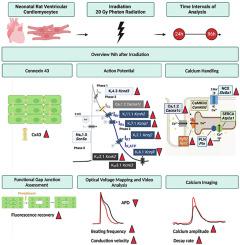
After exposure to 20 Gy of x-rays in a single fraction, neonatal rat ventricular cardiomyocytes were analyzed 24 and 96 hours postradiation to determine changes in conduction velocity, beating frequency, calcium transients, and action potential duration in both monolayers and single cells. In addition, the expression of gap junction proteins, ion channels, and calcium handling proteins was evaluated at protein and messenger RNA levels.
Results
After irradiation with 20 Gy, neonatal rat ventricular cardiomyocytes exhibited increased beat rate and conduction velocity 24 and 96 hours after treatment. Messenger RNA and protein levels of ion channels were altered, with the most significant changes observed at the 96-hour mark. Upregulation of Cacna1c (Cav1.2), Kcnd3 (Kv4.3), Kcnh2 (Kv11.1), Kcnq1 (Kv7.1), Kcnk2 (K2P2.1), Kcnj2 (Kir2.1), and Gja1 (Cx43) was noted, along with improved gap junctional coupling. Calcium handling was affected, with increased Ryr2 ryanodin-rezeptor 2 and Slc8a1 Na+/Ca2+ exchanger expression and altered properties 96 hours posttreatment. Fibroblast and myofibroblast levels remained unchanged.
Conclusion
cSBRT modulates the expression of various ion channels, calcium handling proteins, and gap junction proteins. The described alterations in cellular electrophysiology may be the underlying cause of the immediate antiarrhythmic effects observed after cSBRT.
期刊介绍:
HeartRhythm, the official Journal of the Heart Rhythm Society and the Cardiac Electrophysiology Society, is a unique journal for fundamental discovery and clinical applicability.
HeartRhythm integrates the entire cardiac electrophysiology (EP) community from basic and clinical academic researchers, private practitioners, engineers, allied professionals, industry, and trainees, all of whom are vital and interdependent members of our EP community.
The Heart Rhythm Society is the international leader in science, education, and advocacy for cardiac arrhythmia professionals and patients, and the primary information resource on heart rhythm disorders. Its mission is to improve the care of patients by promoting research, education, and optimal health care policies and standards.



 京公网安备 11010802042870号
京ICP备2023020795号-1
京公网安备 11010802042870号
京ICP备2023020795号-1

 分享
分享
 求助内容:
求助内容: 应助结果提醒方式:
 扫码关注我们
