{"title":"Association between regional phase angle and level of locomotion among older females requiring long-term care in a health facility.","authors":"Akira Kubo, Minami Sato, Akihiro Yakabi, Ayaka Takayama, Masahiro Ishizaka","doi":"10.1589/jpts.36.392","DOIUrl":null,"url":null,"abstract":"<p><p>[Purpose] This study aimed to determine the characteristics of regional phase angles based on locomotion level among older Japanese females requiring long-term care in a health facility. [Participants and Methods] This was a cross-sectional observational study. The participants included 91 residents (mean age ± standard deviation: 90.2 ± 5.6 years) admitted to an older health facility. Based on their indoor locomotion status, the participants were divided into three groups: group I, able to walk with or without walking aids; group II, able to move in a wheelchair without assistance; and group III, able to move in a wheelchair with assistance. The regional phase angle was measured using a bioimpedance device. [Results] Significant differences were observed in the regional phase angle of the upper limbs between groups I and III and between groups II and III; in that of the lower limbs among all groups; and in that of the trunk between groups I and II and between groups I and III. [Conclusion] The level of locomotion may be explained by the regional phase angles of the lower limbs.</p>","PeriodicalId":16834,"journal":{"name":"Journal of Physical Therapy Science","volume":"36 7","pages":"392-395"},"PeriodicalIF":0.0000,"publicationDate":"2024-07-01","publicationTypes":"Journal Article","fieldsOfStudy":null,"isOpenAccess":false,"openAccessPdf":"https://www.ncbi.nlm.nih.gov/pmc/articles/PMC11214818/pdf/","citationCount":"0","resultStr":null,"platform":"Semanticscholar","paperid":null,"PeriodicalName":"Journal of Physical Therapy Science","FirstCategoryId":"1085","ListUrlMain":"https://doi.org/10.1589/jpts.36.392","RegionNum":0,"RegionCategory":null,"ArticlePicture":[],"TitleCN":null,"AbstractTextCN":null,"PMCID":null,"EPubDate":"","PubModel":"","JCR":"","JCRName":"","Score":null,"Total":0}
引用次数: 0
Abstract
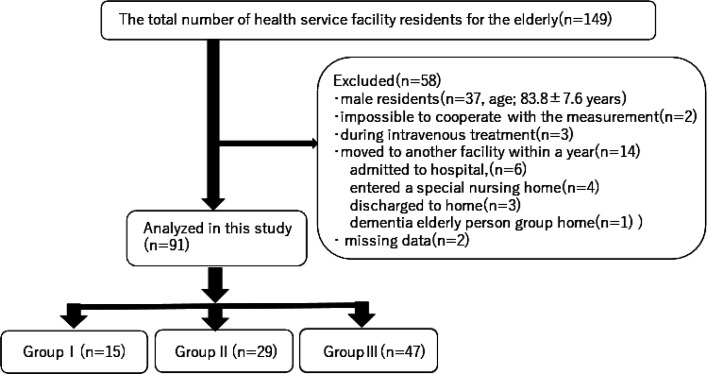
[Purpose] This study aimed to determine the characteristics of regional phase angles based on locomotion level among older Japanese females requiring long-term care in a health facility. [Participants and Methods] This was a cross-sectional observational study. The participants included 91 residents (mean age ± standard deviation: 90.2 ± 5.6 years) admitted to an older health facility. Based on their indoor locomotion status, the participants were divided into three groups: group I, able to walk with or without walking aids; group II, able to move in a wheelchair without assistance; and group III, able to move in a wheelchair with assistance. The regional phase angle was measured using a bioimpedance device. [Results] Significant differences were observed in the regional phase angle of the upper limbs between groups I and III and between groups II and III; in that of the lower limbs among all groups; and in that of the trunk between groups I and II and between groups I and III. [Conclusion] The level of locomotion may be explained by the regional phase angles of the lower limbs.



 京公网安备 11010802042870号
京ICP备2023020795号-1
京公网安备 11010802042870号
京ICP备2023020795号-1

 分享
分享
 求助内容:
求助内容: 应助结果提醒方式:
 扫码关注我们
