{"title":"Using static magnetic field to recover ammonia efficiently by DNRA process","authors":"Yuyang Xie, Zhibin Wang, Shou-Qing Ni","doi":"10.1038/s41545-024-00352-3","DOIUrl":null,"url":null,"abstract":"Dissimilatory nitrate reduction to ammonium (DNRA) has garnered attention due to its ability to recover ammonia and reduce greenhouse gas emissions simultaneously. In this study, the potential of using static magnetic field (SMF) to improve DNRA process was explored from the sight of molecular biology. Functional genes, microbial community structure, and metabolism pathways were discussed. SMF of 40 mT shortened the start-up time of DNRA from 75 days to 41 days, while 80 mT SMF delayed it to 103 days. On day 80, DNRA potential rate under 40 mT SMF, reached 174 ± 11 μmol kg−1 h−1, significantly surpassing 0 mT (88 ± 6 μmol kg−1 h−1) and 80 mT SMF (52 ± 4 μmol kg−1 h−1). SMF of 40 mT also accelerated community succession and the enrichment of functional bacteria like Geobacter (from 15.71% to 32.11%). qPCR results suggested that 40 mT SMF promoted the rapid enrichment of DNRA functional gene nrfA and 80 mT SMF promoted the enrichment of nirS gene on day 40. Dynamic responses of Thauera sp. RT1901, Stutzerimonas stutzeri, Shewanella oneidensis MR-1, and Shewanella loihica PV-4 to SMF at transcriptional levels confirmed SMF could improve the nitrogen removal and electron transfer of DNRA and denitrification bacteria. Consequently, this work validated the possibility of using SMF to improve DNRA process for ammonia recovery and investigated the underlying mechanisms, which could promote the application of DNRA in full-scale.","PeriodicalId":19375,"journal":{"name":"npj Clean Water","volume":" ","pages":"1-15"},"PeriodicalIF":11.0000,"publicationDate":"2024-07-02","publicationTypes":"Journal Article","fieldsOfStudy":null,"isOpenAccess":false,"openAccessPdf":"https://www.nature.com/articles/s41545-024-00352-3.pdf","citationCount":"0","resultStr":null,"platform":"Semanticscholar","paperid":null,"PeriodicalName":"npj Clean Water","FirstCategoryId":"5","ListUrlMain":"https://www.nature.com/articles/s41545-024-00352-3","RegionNum":1,"RegionCategory":"工程技术","ArticlePicture":[],"TitleCN":null,"AbstractTextCN":null,"PMCID":null,"EPubDate":"","PubModel":"","JCR":"Q1","JCRName":"ENGINEERING, CHEMICAL","Score":null,"Total":0}
引用次数: 0
Abstract
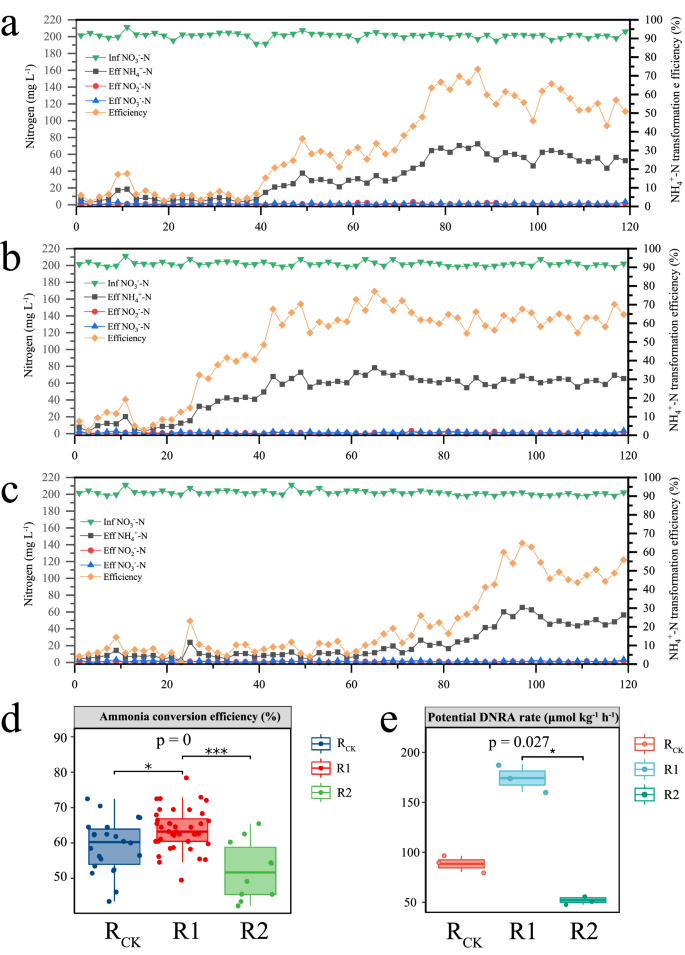
Dissimilatory nitrate reduction to ammonium (DNRA) has garnered attention due to its ability to recover ammonia and reduce greenhouse gas emissions simultaneously. In this study, the potential of using static magnetic field (SMF) to improve DNRA process was explored from the sight of molecular biology. Functional genes, microbial community structure, and metabolism pathways were discussed. SMF of 40 mT shortened the start-up time of DNRA from 75 days to 41 days, while 80 mT SMF delayed it to 103 days. On day 80, DNRA potential rate under 40 mT SMF, reached 174 ± 11 μmol kg−1 h−1, significantly surpassing 0 mT (88 ± 6 μmol kg−1 h−1) and 80 mT SMF (52 ± 4 μmol kg−1 h−1). SMF of 40 mT also accelerated community succession and the enrichment of functional bacteria like Geobacter (from 15.71% to 32.11%). qPCR results suggested that 40 mT SMF promoted the rapid enrichment of DNRA functional gene nrfA and 80 mT SMF promoted the enrichment of nirS gene on day 40. Dynamic responses of Thauera sp. RT1901, Stutzerimonas stutzeri, Shewanella oneidensis MR-1, and Shewanella loihica PV-4 to SMF at transcriptional levels confirmed SMF could improve the nitrogen removal and electron transfer of DNRA and denitrification bacteria. Consequently, this work validated the possibility of using SMF to improve DNRA process for ammonia recovery and investigated the underlying mechanisms, which could promote the application of DNRA in full-scale.
npj Clean WaterEnvironmental Science-Water Science and Technology
CiteScore
15.30
自引率
2.60%
发文量
61
审稿时长
5 weeks
期刊介绍:
npj Clean Water publishes high-quality papers that report cutting-edge science, technology, applications, policies, and societal issues contributing to a more sustainable supply of clean water. The journal's publications may also support and accelerate the achievement of Sustainable Development Goal 6, which focuses on clean water and sanitation.




 京公网安备 11010802042870号
京ICP备2023020795号-1
京公网安备 11010802042870号
京ICP备2023020795号-1

 分享
分享
 求助内容:
求助内容: 应助结果提醒方式:
 扫码关注我们
