Gayathri Devi N, The-Hung Mai, Ram K. Gupta and Phuong V. Pham
{"title":"Art etching of graphene","authors":"Gayathri Devi N, The-Hung Mai, Ram K. Gupta and Phuong V. Pham","doi":"10.1039/D4NH00077C","DOIUrl":null,"url":null,"abstract":"<p >The growth of graphene on a metal substrate using chemical vapor deposition (CVD), assisted by hydrocarbons such as CH<small><sub>4</sub></small>, C<small><sub>3</sub></small>H<small><sub>8</sub></small>, C<small><sub>2</sub></small>H<small><sub>6</sub></small>, <em>etc.</em> leads to the formation of carbon clusters, amorphous carbon, or any other structure. These carbon species are considered as unwanted impurities; thus a conventional etching step is used simultaneously with CVD graphene growth to remove them using an etching agent. Meanwhile, art etching is a specific method of producing controlled non-Euclidean and Euclidean geometries by employing intricate and precise etching parameters or integrated growth/etching modes. Agents such as H<small><sub>2</sub></small>, O<small><sub>2</sub></small>, CH<small><sub>4</sub></small>, Ar, and others are applied as art etching agents to support the art etching technology. This technique can generate nanopores and customize the properties of graphene, facilitating specific applications such as nanodevices, nanosensors, nanofilters, <em>etc.</em> This comprehensive review investigates how precursor gases concurrently induce graphene growth and art etching during a chemical vapor deposition process, resulting in beautifully etched patterns. Furthermore, it discusses the techniques leading to the creation of these patterns. Finally, the challenges, uses, and perspectives of these non-Euclidean and Euclidean-shaped art etched graphene geometries are discussed.</p>","PeriodicalId":93,"journal":{"name":"Nanoscale Horizons","volume":" 8","pages":" 1230-1249"},"PeriodicalIF":6.6000,"publicationDate":"2024-07-03","publicationTypes":"Journal Article","fieldsOfStudy":null,"isOpenAccess":false,"openAccessPdf":"","citationCount":"0","resultStr":null,"platform":"Semanticscholar","paperid":null,"PeriodicalName":"Nanoscale Horizons","FirstCategoryId":"88","ListUrlMain":"https://pubs.rsc.org/en/content/articlelanding/2024/nh/d4nh00077c","RegionNum":2,"RegionCategory":"材料科学","ArticlePicture":[],"TitleCN":null,"AbstractTextCN":null,"PMCID":null,"EPubDate":"","PubModel":"","JCR":"Q1","JCRName":"CHEMISTRY, PHYSICAL","Score":null,"Total":0}
引用次数: 0
Abstract
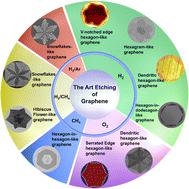
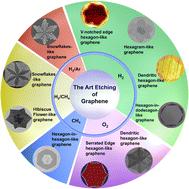
The growth of graphene on a metal substrate using chemical vapor deposition (CVD), assisted by hydrocarbons such as CH4, C3H8, C2H6, etc. leads to the formation of carbon clusters, amorphous carbon, or any other structure. These carbon species are considered as unwanted impurities; thus a conventional etching step is used simultaneously with CVD graphene growth to remove them using an etching agent. Meanwhile, art etching is a specific method of producing controlled non-Euclidean and Euclidean geometries by employing intricate and precise etching parameters or integrated growth/etching modes. Agents such as H2, O2, CH4, Ar, and others are applied as art etching agents to support the art etching technology. This technique can generate nanopores and customize the properties of graphene, facilitating specific applications such as nanodevices, nanosensors, nanofilters, etc. This comprehensive review investigates how precursor gases concurrently induce graphene growth and art etching during a chemical vapor deposition process, resulting in beautifully etched patterns. Furthermore, it discusses the techniques leading to the creation of these patterns. Finally, the challenges, uses, and perspectives of these non-Euclidean and Euclidean-shaped art etched graphene geometries are discussed.
期刊介绍:
Nanoscale Horizons stands out as a premier journal for publishing exceptionally high-quality and innovative nanoscience and nanotechnology. The emphasis lies on original research that introduces a new concept or a novel perspective (a conceptual advance), prioritizing this over reporting technological improvements. Nevertheless, outstanding articles showcasing truly groundbreaking developments, including record-breaking performance, may also find a place in the journal. Published work must be of substantial general interest to our broad and diverse readership across the nanoscience and nanotechnology community.




 京公网安备 11010802042870号
京ICP备2023020795号-1
京公网安备 11010802042870号
京ICP备2023020795号-1

 分享
分享
 求助内容:
求助内容: 应助结果提醒方式:
 扫码关注我们
