Yuanxin Du, Chengqi Li, Yali Dai, Haijiao Yin and Manzhou Zhu
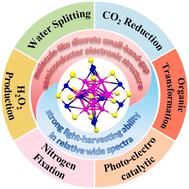
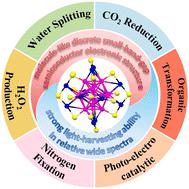
{"title":"Recent progress in atomically precise metal nanoclusters for photocatalytic application","authors":"Yuanxin Du, Chengqi Li, Yali Dai, Haijiao Yin and Manzhou Zhu","doi":"10.1039/D4NH00197D","DOIUrl":null,"url":null,"abstract":"<p >Photocatalysis is a widely recognized green and sustainable technology that can harness inexhaustible solar energy to carry out chemical reactions, offering the opportunity to mitigate environmental issues and the energy crisis. Photocatalysts with wide spectral response and rapid charge transfer capability are crucial for highly efficient photocatalytic activity. Atomically precise metal nanoclusters (NCs), an emerging atomic-level material, have attracted great interests owing to their ultrasmall size, unique atomic stacking, abundant surface active sites, and quantum confinement effect. In particular, the molecule-like discrete electronic energy level endows them with small-band-gap semiconductor behavior, which allows for photoexcitation in order to generate electrons and holes to participate in the photoredox reaction. In addition, metal NCs exhibit strong light-harvesting ability in the wide spectral UV–near IR region, and the diversity of optical absorption properties can be precisely regulated by the composition and structure. These merits make metal NCs ideal candidates for photocatalysis. In this review, the recent advances in atomically-precise metal NCs for photocatalytic application are summarized, including photocatalytic water splitting, CO<small><sub>2</sub></small> reduction, organic transformation, photoelectrocatalytic reactions, N<small><sub>2</sub></small> fixation and H<small><sub>2</sub></small>O<small><sub>2</sub></small> production. In addition, the strategy for promoting photostability, charge transfer and separation efficiency of metal NCs is highlighted. Finally, a perspective on the challenges and opportunities for NCs-based photocatalysts is provided.</p>","PeriodicalId":93,"journal":{"name":"Nanoscale Horizons","volume":" 8","pages":" 1262-1278"},"PeriodicalIF":6.6000,"publicationDate":"2024-06-24","publicationTypes":"Journal Article","fieldsOfStudy":null,"isOpenAccess":false,"openAccessPdf":"","citationCount":"0","resultStr":null,"platform":"Semanticscholar","paperid":null,"PeriodicalName":"Nanoscale Horizons","FirstCategoryId":"88","ListUrlMain":"https://pubs.rsc.org/en/content/articlelanding/2024/nh/d4nh00197d","RegionNum":2,"RegionCategory":"材料科学","ArticlePicture":[],"TitleCN":null,"AbstractTextCN":null,"PMCID":null,"EPubDate":"","PubModel":"","JCR":"Q1","JCRName":"CHEMISTRY, PHYSICAL","Score":null,"Total":0}
引用次数: 0
Abstract
Photocatalysis is a widely recognized green and sustainable technology that can harness inexhaustible solar energy to carry out chemical reactions, offering the opportunity to mitigate environmental issues and the energy crisis. Photocatalysts with wide spectral response and rapid charge transfer capability are crucial for highly efficient photocatalytic activity. Atomically precise metal nanoclusters (NCs), an emerging atomic-level material, have attracted great interests owing to their ultrasmall size, unique atomic stacking, abundant surface active sites, and quantum confinement effect. In particular, the molecule-like discrete electronic energy level endows them with small-band-gap semiconductor behavior, which allows for photoexcitation in order to generate electrons and holes to participate in the photoredox reaction. In addition, metal NCs exhibit strong light-harvesting ability in the wide spectral UV–near IR region, and the diversity of optical absorption properties can be precisely regulated by the composition and structure. These merits make metal NCs ideal candidates for photocatalysis. In this review, the recent advances in atomically-precise metal NCs for photocatalytic application are summarized, including photocatalytic water splitting, CO2 reduction, organic transformation, photoelectrocatalytic reactions, N2 fixation and H2O2 production. In addition, the strategy for promoting photostability, charge transfer and separation efficiency of metal NCs is highlighted. Finally, a perspective on the challenges and opportunities for NCs-based photocatalysts is provided.
期刊介绍:
Nanoscale Horizons stands out as a premier journal for publishing exceptionally high-quality and innovative nanoscience and nanotechnology. The emphasis lies on original research that introduces a new concept or a novel perspective (a conceptual advance), prioritizing this over reporting technological improvements. Nevertheless, outstanding articles showcasing truly groundbreaking developments, including record-breaking performance, may also find a place in the journal. Published work must be of substantial general interest to our broad and diverse readership across the nanoscience and nanotechnology community.



 京公网安备 11010802042870号
京ICP备2023020795号-1
京公网安备 11010802042870号
京ICP备2023020795号-1

 分享
分享
 求助内容:
求助内容: 应助结果提醒方式:
 扫码关注我们
