A change in metal cation switches selectivity of a phospholipid sensor from phosphatidic acid to phosphatidylserine†

IF 2.7 3区 化学 Q1 CHEMISTRY, ORGANIC Organic & Biomolecular Chemistry Pub Date : 2024-07-17 Epub Date: 2024-06-25 DOI:10.1039/d4ob00418c
{"title":"A change in metal cation switches selectivity of a phospholipid sensor from phosphatidic acid to phosphatidylserine†","authors":"","doi":"10.1039/d4ob00418c","DOIUrl":null,"url":null,"abstract":"<div><p>Phosphatidic acid and phosphatidylserine are anionic phospholipids with emerging signalling roles in cells. Determination of how phosphatidic acid and phosphatidylserine change location and quantity in cells over time requires selective fluorescent sensors that can distinguish these two anionic phospholipids. However, the design of such synthetic sensors that can selectively bind and respond to a single phospholipid within the complex membrane milieu remains challenging. In this work, we present a simple and robust strategy to control the selectivity of synthetic sensors for phosphatidic acid and phosphatidylserine. By changing the coordination metal of a dipicolylamine (DPA) ligand from Zn(<span>ii</span>) to Ni(<span>ii</span>) on the same synthetic sensor with a peptide backbone, we achieve a complete switch in selectivity from phosphatidic acid to phosphatidylserine in model lipid membranes. Furthermore, this strategy was largely unaffected by the choice and the position of the fluorophores. We envision that this strategy will provide a platform for the rational design of targeted synthetic phospholipid sensors to probe plasma and intracellular membranes.</p></div>","PeriodicalId":96,"journal":{"name":"Organic & Biomolecular Chemistry","volume":"22 28","pages":"Pages 5843-5849"},"PeriodicalIF":2.7000,"publicationDate":"2024-07-17","publicationTypes":"Journal Article","fieldsOfStudy":null,"isOpenAccess":false,"openAccessPdf":"","citationCount":"0","resultStr":null,"platform":"Semanticscholar","paperid":null,"PeriodicalName":"Organic & Biomolecular Chemistry","FirstCategoryId":"92","ListUrlMain":"https://www.sciencedirect.com/org/science/article/pii/S1477052024005755","RegionNum":3,"RegionCategory":"化学","ArticlePicture":[],"TitleCN":null,"AbstractTextCN":null,"PMCID":null,"EPubDate":"2024/6/25 0:00:00","PubModel":"Epub","JCR":"Q1","JCRName":"CHEMISTRY, ORGANIC","Score":null,"Total":0}
引用次数: 0

Abstract

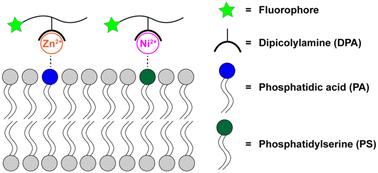
Phosphatidic acid and phosphatidylserine are anionic phospholipids with emerging signalling roles in cells. Determination of how phosphatidic acid and phosphatidylserine change location and quantity in cells over time requires selective fluorescent sensors that can distinguish these two anionic phospholipids. However, the design of such synthetic sensors that can selectively bind and respond to a single phospholipid within the complex membrane milieu remains challenging. In this work, we present a simple and robust strategy to control the selectivity of synthetic sensors for phosphatidic acid and phosphatidylserine. By changing the coordination metal of a dipicolylamine (DPA) ligand from Zn(ii) to Ni(ii) on the same synthetic sensor with a peptide backbone, we achieve a complete switch in selectivity from phosphatidic acid to phosphatidylserine in model lipid membranes. Furthermore, this strategy was largely unaffected by the choice and the position of the fluorophores. We envision that this strategy will provide a platform for the rational design of targeted synthetic phospholipid sensors to probe plasma and intracellular membranes.
Abstract Image

Abstract Image

查看原文
分享 分享
微信好友 朋友圈 QQ好友 复制链接
本刊更多论文
金属阳离子的变化会改变磷脂传感器从磷脂酸到磷脂酰丝氨酸的选择性。
磷脂酸和磷脂酰丝氨酸是阴离子磷脂,在细胞中发挥着新的信号作用。要确定磷脂酸和磷脂酰丝氨酸在细胞中的位置和数量如何随时间发生变化,就需要能区分这两种阴离子磷脂的选择性荧光传感器。然而,设计这种能在复杂的膜环境中选择性结合并响应单一磷脂的合成传感器仍具有挑战性。在这项工作中,我们提出了一种简单而稳健的策略来控制合成传感器对磷脂酸和磷脂酰丝氨酸的选择性。通过将同一合成传感器上带有肽骨架的二咪唑胺 (DPA) 配体的配位金属从 Zn(II) 改为 Ni(II),我们实现了在模型脂膜中从磷脂酸到磷脂酰丝氨酸选择性的完全转换。此外,这种策略在很大程度上不受荧光团的选择和位置的影响。我们设想这一策略将为合理设计有针对性的合成磷脂传感器提供一个平台,以探测等离子体和细胞内膜。
本文章由计算机程序翻译,如有差异,请以英文原文为准。
求助全文
约1分钟内获得全文 去求助
来源期刊
Organic & Biomolecular Chemistry
Organic & Biomolecular Chemistry 化学-有机化学
CiteScore
5.50
自引率
9.40%
发文量
1056
审稿时长
1.3 months
期刊介绍: Organic & Biomolecular Chemistry is an international journal using integrated research in chemistry-organic chemistry. Founded in 2003 by the Royal Society of Chemistry, the journal is published in Semimonthly issues and has been indexed by SCIE, a leading international database. The journal focuses on the key research and cutting-edge progress in the field of chemistry-organic chemistry, publishes and reports the research results in this field in a timely manner, and is committed to becoming a window and platform for rapid academic exchanges among peers in this field. The journal's impact factor in 2023 is 2.9, and its CiteScore is 5.5.
期刊最新文献
Late-stage chirality generation strategies for the total synthesis of macrocyclic natural products. Metal triflimide-mediated acylation of sulfonamides and transacylation of N-acylsulfonamides. Metabolic labeling and imaging of native Saccharomyces cerevisiae glycan by using N-acetylglucosamine-6-phosphate analogs. tert-Butanol as an isobutene equivalent in the IED-HDA reaction of in situ-generated oxindole-embedded o-QMs. Ultrafast fluorescent detection of mercury(II) ions in aqueous and biological systems using a boronic acid-based reaction probe.
×
引用
GB/T 7714-2015
复制
MLA
复制
APA
复制
导出至
BibTeX EndNote RefMan NoteFirst NoteExpress
×
×
提示
您的信息不完整,为了账户安全,请先补充。
现在去补充
×
提示
您因"违规操作"
具体请查看互助需知
我知道了
×
提示
现在去查看 取消
×
提示
确定
0
微信
客服QQ
Book学术公众号 扫码关注我们
反馈
×
意见反馈
请填写您的意见或建议
请填写您的手机或邮箱
已复制链接
已复制链接
快去分享给好友吧!
我知道了
×
扫码分享
扫码分享
Book学术官方微信
Book学术文献互助
Book学术文献互助群
群 号:604180095
Book学术
文献互助 智能选刊 最新文献 互助须知 联系我们:info@booksci.cn
Book学术提供免费学术资源搜索服务,方便国内外学者检索中英文文献。致力于提供最便捷和优质的服务体验。
Copyright © 2023 Book学术 All rights reserved.
ghs 京公网安备 11010802042870号 京ICP备2023020795号-1