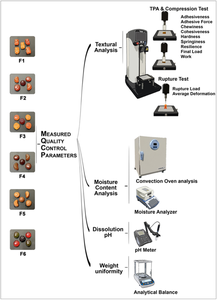
{"title":"Characterization of Prototype Gummy Formulations Provides Insight into Setting Quality Standards","authors":"Oluwatoyin A. Adeleke, Saba Abedin","doi":"10.1208/s12249-024-02876-w","DOIUrl":null,"url":null,"abstract":"<div><p>Gummy formulations are considered suitable alternatives to traditional oral dosage forms like tablets and capsules due to their merits that include chewability, softness/flexibility, improved drug release, administration without water, appealing organoleptic properties, better patient compliance, easy preparation and usefulness for persons of different ages (e.g. children). Though there is increasing interest in gummy formulations containing drugs, measurable parameters, and specification limits for evaluating their quality are scarce. Quality check forms an essential part of the pharmaceutical development process because drug products must be distributed as consistently stable, safe, and therapeutically effective entities. Consequently, some quality parameters that could contribute to the overall performance of typical gummy formulations were investigated employing six brands of non-medicinal gummies as specimens. Accordingly, key physicochemical and micromechanical characteristics namely adhesiveness (0.009 – 0.028 mJ), adhesive force (0.009 – 0.055 N), chewiness (2.780 – 6.753 N), cohesiveness (0.910 – 0.990), hardness (2.984 – 7.453 N), springiness (0.960 – 1.000), and resilience (0.388 – 0.572), matrix firmness – compression load (2.653 – 6.753 N) and work done (3.288 – 6.829 mJ), rupture (5.315 – 29.016 N), moisture content (< 5%), weight uniformity (< 2.5 g; < 7.5% deviation), and intraoral dissolution pH (≥ 3.5 ≤ 6.8) were quantified to identify measures that may potentially function as specification limits and serve as prospective reference points for evaluating the quality of gummy formulations. Findings from this work contribute to ongoing efforts to standardize the quality control strategies for gummy formulations, particularly those intended for oral drug delivery.</p><h3>Graphical Abstract</h3>\n<div><figure><div><div><picture><source><img></source></picture></div></div></figure></div></div>","PeriodicalId":6925,"journal":{"name":"AAPS PharmSciTech","volume":"25 6","pages":""},"PeriodicalIF":4.0000,"publicationDate":"2024-07-03","publicationTypes":"Journal Article","fieldsOfStudy":null,"isOpenAccess":false,"openAccessPdf":"","citationCount":"0","resultStr":null,"platform":"Semanticscholar","paperid":null,"PeriodicalName":"AAPS PharmSciTech","FirstCategoryId":"3","ListUrlMain":"https://link.springer.com/article/10.1208/s12249-024-02876-w","RegionNum":4,"RegionCategory":"医学","ArticlePicture":[],"TitleCN":null,"AbstractTextCN":null,"PMCID":null,"EPubDate":"","PubModel":"","JCR":"Q2","JCRName":"PHARMACOLOGY & PHARMACY","Score":null,"Total":0}
引用次数: 0
Abstract
Gummy formulations are considered suitable alternatives to traditional oral dosage forms like tablets and capsules due to their merits that include chewability, softness/flexibility, improved drug release, administration without water, appealing organoleptic properties, better patient compliance, easy preparation and usefulness for persons of different ages (e.g. children). Though there is increasing interest in gummy formulations containing drugs, measurable parameters, and specification limits for evaluating their quality are scarce. Quality check forms an essential part of the pharmaceutical development process because drug products must be distributed as consistently stable, safe, and therapeutically effective entities. Consequently, some quality parameters that could contribute to the overall performance of typical gummy formulations were investigated employing six brands of non-medicinal gummies as specimens. Accordingly, key physicochemical and micromechanical characteristics namely adhesiveness (0.009 – 0.028 mJ), adhesive force (0.009 – 0.055 N), chewiness (2.780 – 6.753 N), cohesiveness (0.910 – 0.990), hardness (2.984 – 7.453 N), springiness (0.960 – 1.000), and resilience (0.388 – 0.572), matrix firmness – compression load (2.653 – 6.753 N) and work done (3.288 – 6.829 mJ), rupture (5.315 – 29.016 N), moisture content (< 5%), weight uniformity (< 2.5 g; < 7.5% deviation), and intraoral dissolution pH (≥ 3.5 ≤ 6.8) were quantified to identify measures that may potentially function as specification limits and serve as prospective reference points for evaluating the quality of gummy formulations. Findings from this work contribute to ongoing efforts to standardize the quality control strategies for gummy formulations, particularly those intended for oral drug delivery.
期刊介绍:
AAPS PharmSciTech is a peer-reviewed, online-only journal committed to serving those pharmaceutical scientists and engineers interested in the research, development, and evaluation of pharmaceutical dosage forms and delivery systems, including drugs derived from biotechnology and the manufacturing science pertaining to the commercialization of such dosage forms. Because of its electronic nature, AAPS PharmSciTech aspires to utilize evolving electronic technology to enable faster and diverse mechanisms of information delivery to its readership. Submission of uninvited expert reviews and research articles are welcomed.




 京公网安备 11010802042870号
京ICP备2023020795号-1
京公网安备 11010802042870号
京ICP备2023020795号-1

 分享
分享
 求助内容:
求助内容: 应助结果提醒方式:
 扫码关注我们
