Bryan E. Alvarez-Serna, Tania A. García-Mejía, Sandra Arzate, Ana Yañez-Aulestia, Roberto G. Ramírez-Chavarría, Rosa María Ramírez-Zamora
{"title":"Cost-effective amperometric sensor for monitoring levofloxacin in groundwater","authors":"Bryan E. Alvarez-Serna, Tania A. García-Mejía, Sandra Arzate, Ana Yañez-Aulestia, Roberto G. Ramírez-Chavarría, Rosa María Ramírez-Zamora","doi":"10.1002/elan.202400096","DOIUrl":null,"url":null,"abstract":"<p>The presence of water micropollutants, such as antibiotics, has proved the necessity to develop novel and cost-effective devices for their identification and quantification. These devices aim to save time, reagent usage, and costs associated with conventional analytical methods. In this work, we introduce poly(methylene blue) based screen-printed electrodes (SPE-PMB) as electrochemical sensors designed for the quantification of levofloxacin (LVX), given its current prevalence as a micropollutant. Integrating the fabrication and measurement processes into a single electrochemical device is a significant step in creating affordable detection tools. The proposed sensor was assessed using LVX solutions prepared in real groundwater samples, demonstrating its selectivity and achieving a detection limit of 3.3 μM. Finally, we compared the SPE-PMB sensor and high-performance liquid chromatography (HPLC) to validate its operation and performance. Consequently, our results suggest that the sensor can be a viable alternative to chromatographic methods for identifying and quantifying micropollutants at very low concentrations in complex matrices.</p>","PeriodicalId":162,"journal":{"name":"Electroanalysis","volume":"37 1","pages":""},"PeriodicalIF":2.3000,"publicationDate":"2024-06-25","publicationTypes":"Journal Article","fieldsOfStudy":null,"isOpenAccess":false,"openAccessPdf":"https://onlinelibrary.wiley.com/doi/epdf/10.1002/elan.202400096","citationCount":"0","resultStr":null,"platform":"Semanticscholar","paperid":null,"PeriodicalName":"Electroanalysis","FirstCategoryId":"92","ListUrlMain":"https://analyticalsciencejournals.onlinelibrary.wiley.com/doi/10.1002/elan.202400096","RegionNum":3,"RegionCategory":"化学","ArticlePicture":[],"TitleCN":null,"AbstractTextCN":null,"PMCID":null,"EPubDate":"","PubModel":"","JCR":"Q2","JCRName":"CHEMISTRY, ANALYTICAL","Score":null,"Total":0}
引用次数: 0
Abstract
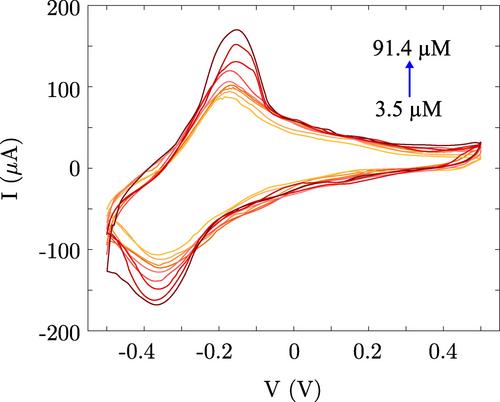
The presence of water micropollutants, such as antibiotics, has proved the necessity to develop novel and cost-effective devices for their identification and quantification. These devices aim to save time, reagent usage, and costs associated with conventional analytical methods. In this work, we introduce poly(methylene blue) based screen-printed electrodes (SPE-PMB) as electrochemical sensors designed for the quantification of levofloxacin (LVX), given its current prevalence as a micropollutant. Integrating the fabrication and measurement processes into a single electrochemical device is a significant step in creating affordable detection tools. The proposed sensor was assessed using LVX solutions prepared in real groundwater samples, demonstrating its selectivity and achieving a detection limit of 3.3 μM. Finally, we compared the SPE-PMB sensor and high-performance liquid chromatography (HPLC) to validate its operation and performance. Consequently, our results suggest that the sensor can be a viable alternative to chromatographic methods for identifying and quantifying micropollutants at very low concentrations in complex matrices.
期刊介绍:
Electroanalysis is an international, peer-reviewed journal covering all branches of electroanalytical chemistry, including both fundamental and application papers as well as reviews dealing with new electrochemical sensors and biosensors, nanobioelectronics devices, analytical voltammetry, potentiometry, new electrochemical detection schemes based on novel nanomaterials, fuel cells and biofuel cells, and important practical applications.
Serving as a vital communication link between the research labs and the field, Electroanalysis helps you to quickly adapt the latest innovations into practical clinical, environmental, food analysis, industrial and energy-related applications. Electroanalysis provides the most comprehensive coverage of the field and is the number one source for information on electroanalytical chemistry, electrochemical sensors and biosensors and fuel/biofuel cells.






 京公网安备 11010802042870号
京ICP备2023020795号-1
京公网安备 11010802042870号
京ICP备2023020795号-1

 分享
分享
 求助内容:
求助内容: 应助结果提醒方式:
 扫码关注我们
