New redox behavior and electrochemical sensing of anticoagulant rodenticide bromadiolone using low-cost graphite electrode: An ultrasensitive tool for forensic and environmental analysis
Thaylor Teixeira Conrado, Evandro Rodrigo Pedão, Valdir Souza Ferreira, Rodrigo Amorim Bezerra da Silva, Jacqueline Marques Petroni, Bruno Gabriel Lucca
{"title":"New redox behavior and electrochemical sensing of anticoagulant rodenticide bromadiolone using low-cost graphite electrode: An ultrasensitive tool for forensic and environmental analysis","authors":"Thaylor Teixeira Conrado, Evandro Rodrigo Pedão, Valdir Souza Ferreira, Rodrigo Amorim Bezerra da Silva, Jacqueline Marques Petroni, Bruno Gabriel Lucca","doi":"10.1002/elan.202400146","DOIUrl":null,"url":null,"abstract":"<p>The development of analytical methods for the rapid detection of noxious species in forensic, environmental and biological samples is a global trend. This work reports a new, portable and low-cost electroanalytical method for the ultrasensitive detection of bromadiolone using pencil graphite electrode (PGE) and square-wave adsorptive stripping voltammetry (SWAdSV). Bromadiolone exhibited an irreversible cathodic peak at around −0.8 V in acid medium (2.5 to 5.5), which was unreported in literature until now. Considering this novel electrochemical behavior, a redox reaction mechanism for bromadiolone reduction on PGE is proposed. The limit of detection (LOD) obtained was 0.50 nmol L<sup>−1</sup>, which is close or lower than those obtained in some chromatographic methods utilized for analyzing biological samples. This LOD is also below the value recommended by the World Health Organization (WHO) regarding analytical methods employed to detect bromadiolone in environmental/biological samples. A linear response was observed in the concentration range from 2.0 to 100.0 nmol L<sup>−1</sup>. Quantitative assays performed in spiked samples of surface water and synthetic urine suggested good accuracy (recoveries between 93 and 107 %) and great precision (relative standard deviations were ≤3.9 %). Furthermore, the method was successfully applied for the screening of bromadiolone in real forensic samples, which is an approach unexplored in previous works. In this sense, the proposed PGE-SWAdSV method described here shows great potential for the rapid and sensitive detection of bromadiolone in forensic, biological and environmental fields.</p>","PeriodicalId":162,"journal":{"name":"Electroanalysis","volume":"37 1","pages":""},"PeriodicalIF":2.3000,"publicationDate":"2024-06-21","publicationTypes":"Journal Article","fieldsOfStudy":null,"isOpenAccess":false,"openAccessPdf":"","citationCount":"0","resultStr":null,"platform":"Semanticscholar","paperid":null,"PeriodicalName":"Electroanalysis","FirstCategoryId":"92","ListUrlMain":"https://analyticalsciencejournals.onlinelibrary.wiley.com/doi/10.1002/elan.202400146","RegionNum":3,"RegionCategory":"化学","ArticlePicture":[],"TitleCN":null,"AbstractTextCN":null,"PMCID":null,"EPubDate":"","PubModel":"","JCR":"Q2","JCRName":"CHEMISTRY, ANALYTICAL","Score":null,"Total":0}
引用次数: 0
Abstract
The development of analytical methods for the rapid detection of noxious species in forensic, environmental and biological samples is a global trend. This work reports a new, portable and low-cost electroanalytical method for the ultrasensitive detection of bromadiolone using pencil graphite electrode (PGE) and square-wave adsorptive stripping voltammetry (SWAdSV). Bromadiolone exhibited an irreversible cathodic peak at around −0.8 V in acid medium (2.5 to 5.5), which was unreported in literature until now. Considering this novel electrochemical behavior, a redox reaction mechanism for bromadiolone reduction on PGE is proposed. The limit of detection (LOD) obtained was 0.50 nmol L−1, which is close or lower than those obtained in some chromatographic methods utilized for analyzing biological samples. This LOD is also below the value recommended by the World Health Organization (WHO) regarding analytical methods employed to detect bromadiolone in environmental/biological samples. A linear response was observed in the concentration range from 2.0 to 100.0 nmol L−1. Quantitative assays performed in spiked samples of surface water and synthetic urine suggested good accuracy (recoveries between 93 and 107 %) and great precision (relative standard deviations were ≤3.9 %). Furthermore, the method was successfully applied for the screening of bromadiolone in real forensic samples, which is an approach unexplored in previous works. In this sense, the proposed PGE-SWAdSV method described here shows great potential for the rapid and sensitive detection of bromadiolone in forensic, biological and environmental fields.
期刊介绍:
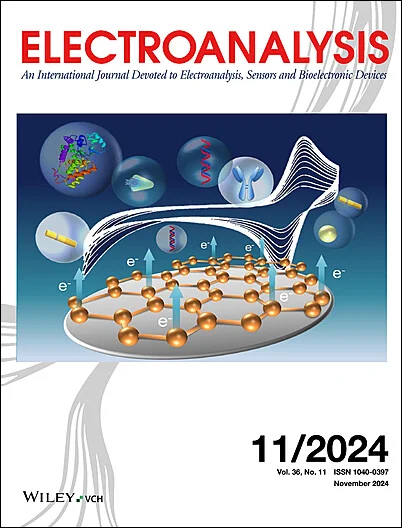
Electroanalysis is an international, peer-reviewed journal covering all branches of electroanalytical chemistry, including both fundamental and application papers as well as reviews dealing with new electrochemical sensors and biosensors, nanobioelectronics devices, analytical voltammetry, potentiometry, new electrochemical detection schemes based on novel nanomaterials, fuel cells and biofuel cells, and important practical applications.
Serving as a vital communication link between the research labs and the field, Electroanalysis helps you to quickly adapt the latest innovations into practical clinical, environmental, food analysis, industrial and energy-related applications. Electroanalysis provides the most comprehensive coverage of the field and is the number one source for information on electroanalytical chemistry, electrochemical sensors and biosensors and fuel/biofuel cells.



 京公网安备 11010802042870号
京ICP备2023020795号-1
京公网安备 11010802042870号
京ICP备2023020795号-1

 分享
分享
 求助内容:
求助内容: 应助结果提醒方式:
 扫码关注我们
