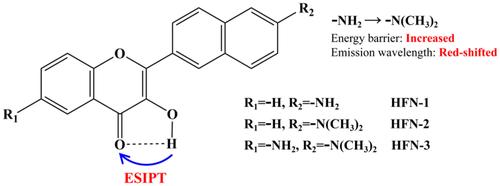
{"title":"Effects of amino- and dimethylamine-groups on the fluorescent properties of novel flavone-based derivatives with ESIPT behavior: A TD-DFT study","authors":"Zhengyi Zhang, Hua Fang","doi":"10.1002/jccs.202400144","DOIUrl":null,"url":null,"abstract":"<p>In this work, the effects of different functional groups on the excited-state intramolecular proton transfer behavior and fluorescent features of 3-hydroxy-2-(naphthalen-2-yl)-4H-chromen-4-one (HFN) are explored in detail. Three new compounds (HFN-1, HFN-2, and HFN-3) are designed based on the HFN by introducing the electron-donating groups (–NH<sub>2</sub>, –N(CH<sub>3</sub>)<sub>2</sub>). The mainly geometrical parameters of optimized configuration showed that the intramolecular hydrogen bonds of the studied compounds are enhanced in the excited (S<sub>1</sub>) state, confirming by the ground (S<sub>0</sub>) and excited states infrared spectra, electron densities and reduced density gradient isosurfaces. The S<sub>0</sub> → S<sub>1</sub> transitions of HFN derivatives are dominated by <i>ππ*</i> charge transfer transition. The introduction of electron-donating group (–NH<sub>2</sub>, –N(CH<sub>3</sub>)<sub>2</sub>) weakens the intramolecular hydrogen bond, increases the excited-state intramolecular proton transfer barrier and red-shifts the absorption/fluorescence peak. The coexistence of –NH<sub>2</sub> and –N(CH<sub>3</sub>)<sub>2</sub> make the absorption and fluorescence wavelengths of HFN-1/HFN-2 red-shift/blue-shift.</p>","PeriodicalId":17262,"journal":{"name":"Journal of The Chinese Chemical Society","volume":"71 9","pages":"1052-1061"},"PeriodicalIF":1.5000,"publicationDate":"2024-06-29","publicationTypes":"Journal Article","fieldsOfStudy":null,"isOpenAccess":false,"openAccessPdf":"","citationCount":"0","resultStr":null,"platform":"Semanticscholar","paperid":null,"PeriodicalName":"Journal of The Chinese Chemical Society","FirstCategoryId":"92","ListUrlMain":"https://onlinelibrary.wiley.com/doi/10.1002/jccs.202400144","RegionNum":4,"RegionCategory":"化学","ArticlePicture":[],"TitleCN":null,"AbstractTextCN":null,"PMCID":null,"EPubDate":"","PubModel":"","JCR":"Q3","JCRName":"CHEMISTRY, MULTIDISCIPLINARY","Score":null,"Total":0}
引用次数: 0
Abstract
In this work, the effects of different functional groups on the excited-state intramolecular proton transfer behavior and fluorescent features of 3-hydroxy-2-(naphthalen-2-yl)-4H-chromen-4-one (HFN) are explored in detail. Three new compounds (HFN-1, HFN-2, and HFN-3) are designed based on the HFN by introducing the electron-donating groups (–NH2, –N(CH3)2). The mainly geometrical parameters of optimized configuration showed that the intramolecular hydrogen bonds of the studied compounds are enhanced in the excited (S1) state, confirming by the ground (S0) and excited states infrared spectra, electron densities and reduced density gradient isosurfaces. The S0 → S1 transitions of HFN derivatives are dominated by ππ* charge transfer transition. The introduction of electron-donating group (–NH2, –N(CH3)2) weakens the intramolecular hydrogen bond, increases the excited-state intramolecular proton transfer barrier and red-shifts the absorption/fluorescence peak. The coexistence of –NH2 and –N(CH3)2 make the absorption and fluorescence wavelengths of HFN-1/HFN-2 red-shift/blue-shift.
期刊介绍:
The Journal of the Chinese Chemical Society was founded by The Chemical Society Located in Taipei in 1954, and is the oldest general chemistry journal in Taiwan. It is strictly peer-reviewed and welcomes review articles, full papers, notes and communications written in English. The scope of the Journal of the Chinese Chemical Society covers all major areas of chemistry: organic chemistry, inorganic chemistry, analytical chemistry, biochemistry, physical chemistry, and materials science.



 京公网安备 11010802042870号
京ICP备2023020795号-1
京公网安备 11010802042870号
京ICP备2023020795号-1

 分享
分享
 求助内容:
求助内容: 应助结果提醒方式:
 扫码关注我们
