Dr. Chenhui Li, Bingxin Li, Prof. Ming Jin, Prof. Decheng Wan, Prof. Biqiong Chen
{"title":"Highly Efficient and Robust Platinum Nanocluster Catalyst Mediated by Polyamine Amidine-Decorated Mesoporous Polymer Beads","authors":"Dr. Chenhui Li, Bingxin Li, Prof. Ming Jin, Prof. Decheng Wan, Prof. Biqiong Chen","doi":"10.1002/cnma.202400187","DOIUrl":null,"url":null,"abstract":"<p>Platinum nanoclusters (PtNCs) are promising in catalysis due to their large specific surface area and unique physicochemical properties. Here, ultrasmall and uniform PtNCs are facilely synthesized with the mediation of amidine-functionalized polyamines patched on mesoporous poly(divinylbenzene-4-vinylbenzyl chloride) beads. When each ligand patch has 14 amidines, ultrafine PtNCs (with the size as low as 1.1±0.1 nm) are formed as a result of several factors: deprotonated amidines (carbenes) strongly passivate on Pt atoms, amidines act as co-stabilizers along with weak polyamine ligands, and PtNCs are confined to discrete ligand patches. When one ligand patch contains 9.3 amidines, the resulting PtNCs (1.7±0.3 nm) reach the highest turnover frequency of 536 h<sup>−1</sup> for the catalytic reduction of 4-nitrophenol in a batch reaction. This catalyst remains rather stable in a continuous flow test as a 4-nitrophenol conversion of over 95 % is still achieved after running consecutively for 10 h.</p>","PeriodicalId":54339,"journal":{"name":"ChemNanoMat","volume":"10 9","pages":""},"PeriodicalIF":2.6000,"publicationDate":"2024-06-30","publicationTypes":"Journal Article","fieldsOfStudy":null,"isOpenAccess":false,"openAccessPdf":"","citationCount":"0","resultStr":null,"platform":"Semanticscholar","paperid":null,"PeriodicalName":"ChemNanoMat","FirstCategoryId":"88","ListUrlMain":"https://aces.onlinelibrary.wiley.com/doi/10.1002/cnma.202400187","RegionNum":4,"RegionCategory":"材料科学","ArticlePicture":[],"TitleCN":null,"AbstractTextCN":null,"PMCID":null,"EPubDate":"","PubModel":"","JCR":"Q2","JCRName":"CHEMISTRY, MULTIDISCIPLINARY","Score":null,"Total":0}
引用次数: 0
Abstract
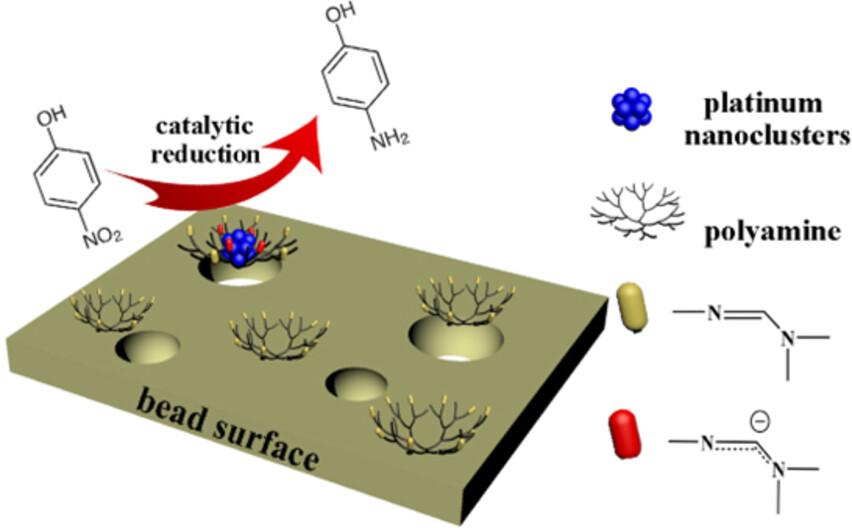
Platinum nanoclusters (PtNCs) are promising in catalysis due to their large specific surface area and unique physicochemical properties. Here, ultrasmall and uniform PtNCs are facilely synthesized with the mediation of amidine-functionalized polyamines patched on mesoporous poly(divinylbenzene-4-vinylbenzyl chloride) beads. When each ligand patch has 14 amidines, ultrafine PtNCs (with the size as low as 1.1±0.1 nm) are formed as a result of several factors: deprotonated amidines (carbenes) strongly passivate on Pt atoms, amidines act as co-stabilizers along with weak polyamine ligands, and PtNCs are confined to discrete ligand patches. When one ligand patch contains 9.3 amidines, the resulting PtNCs (1.7±0.3 nm) reach the highest turnover frequency of 536 h−1 for the catalytic reduction of 4-nitrophenol in a batch reaction. This catalyst remains rather stable in a continuous flow test as a 4-nitrophenol conversion of over 95 % is still achieved after running consecutively for 10 h.
ChemNanoMatEnergy-Energy Engineering and Power Technology
CiteScore
6.10
自引率
2.60%
发文量
236
期刊介绍:
ChemNanoMat is a new journal published in close cooperation with the teams of Angewandte Chemie and Advanced Materials, and is the new sister journal to Chemistry—An Asian Journal.




 京公网安备 11010802042870号
京ICP备2023020795号-1
京公网安备 11010802042870号
京ICP备2023020795号-1

 分享
分享
 求助内容:
求助内容: 应助结果提醒方式:
 扫码关注我们
