Coupling of Paleosedimentary Environment and Lithofacies: Implications for Shale Oil Enrichment in the Lianggaoshan Formation, Northeastern Sichuan Basin, China
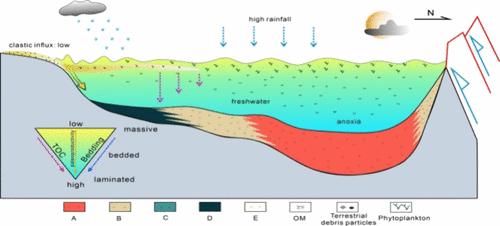
{"title":"Coupling of Paleosedimentary Environment and Lithofacies: Implications for Shale Oil Enrichment in the Lianggaoshan Formation, Northeastern Sichuan Basin, China","authors":"Youzhi Wang, Cui Mao* and Xinguo Duan, ","doi":"10.1021/acsomega.4c01542","DOIUrl":null,"url":null,"abstract":"<p >The sedimentary environment is paramount in dictating depositional processes, ecological settings, and hydrodynamic conditions, all of which are pivotal to the aggregation of organic-rich sediments. A synergistic interplay is observed among the paleosedimentary environment, lithofacies, and enrichment of shale oil. Utilizing an analysis of elemental geochemistry and organic geochemical parameters─such as total organic carbon (TOC) content─this study endeavors to identify the predominant factors that govern the enrichment of organic matter (OM). It reconstructs the evolutionary trajectory of the paleosedimentary environment and introduces a dynamic model for shale oil enrichment within the Jurassic Lianggaoshan Formation of the Sichuan Basin. The results indicate that the Lianggaoshan Formation shale can be categorized into five lithological types, including high TOC felsic-rich shale (A), moderate TOC felsic-rich shale (B), moderate TOC felsic-rich mudstone (C), low TOC felsic-rich shale (D), and low TOC felsic-rich mudstone (E), and high TOC felsic-rich shale has the highest TOC and oil content. The shales of the Lianggaoshan Formation were deposited in an environment characterized by abundant terrestrial input, humid climate, freshwater conditions, reduced oxygen levels, and thriving primary productivity. OM enrichment is mainly controlled by the combination of a humid paleoclimate, high primary productivity, and other factors. The paleoenvironment deposited by lithofacies A coincides with the paleoenvironment conducive to OM enrichment, which makes lithofacies A become the dominant lithofacies for shale oil enrichment. Additionally, the sedimentary environment evolution characteristics and shale oil enrichment model of the Lianggaoshan Formation were established based on geochemical parameters. The paleosedimentary environment of the Lianggaoshan Formation from bottom to top is more and more unfavorable. The No.1 submember of the Lianggaoshan Formation is the most potential shale submember for shale oil exploration due to the paleosedimentary environment that promoted the deposition of lithofacies A and OM enrichment.</p>","PeriodicalId":22,"journal":{"name":"ACS Omega","volume":"9 26","pages":"28237–28252"},"PeriodicalIF":4.3000,"publicationDate":"2024-06-17","publicationTypes":"Journal Article","fieldsOfStudy":null,"isOpenAccess":false,"openAccessPdf":"https://pubs.acs.org/doi/epdf/10.1021/acsomega.4c01542","citationCount":"0","resultStr":null,"platform":"Semanticscholar","paperid":null,"PeriodicalName":"ACS Omega","FirstCategoryId":"92","ListUrlMain":"https://pubs.acs.org/doi/10.1021/acsomega.4c01542","RegionNum":3,"RegionCategory":"化学","ArticlePicture":[],"TitleCN":null,"AbstractTextCN":null,"PMCID":null,"EPubDate":"","PubModel":"","JCR":"Q2","JCRName":"CHEMISTRY, MULTIDISCIPLINARY","Score":null,"Total":0}
引用次数: 0
Abstract
The sedimentary environment is paramount in dictating depositional processes, ecological settings, and hydrodynamic conditions, all of which are pivotal to the aggregation of organic-rich sediments. A synergistic interplay is observed among the paleosedimentary environment, lithofacies, and enrichment of shale oil. Utilizing an analysis of elemental geochemistry and organic geochemical parameters─such as total organic carbon (TOC) content─this study endeavors to identify the predominant factors that govern the enrichment of organic matter (OM). It reconstructs the evolutionary trajectory of the paleosedimentary environment and introduces a dynamic model for shale oil enrichment within the Jurassic Lianggaoshan Formation of the Sichuan Basin. The results indicate that the Lianggaoshan Formation shale can be categorized into five lithological types, including high TOC felsic-rich shale (A), moderate TOC felsic-rich shale (B), moderate TOC felsic-rich mudstone (C), low TOC felsic-rich shale (D), and low TOC felsic-rich mudstone (E), and high TOC felsic-rich shale has the highest TOC and oil content. The shales of the Lianggaoshan Formation were deposited in an environment characterized by abundant terrestrial input, humid climate, freshwater conditions, reduced oxygen levels, and thriving primary productivity. OM enrichment is mainly controlled by the combination of a humid paleoclimate, high primary productivity, and other factors. The paleoenvironment deposited by lithofacies A coincides with the paleoenvironment conducive to OM enrichment, which makes lithofacies A become the dominant lithofacies for shale oil enrichment. Additionally, the sedimentary environment evolution characteristics and shale oil enrichment model of the Lianggaoshan Formation were established based on geochemical parameters. The paleosedimentary environment of the Lianggaoshan Formation from bottom to top is more and more unfavorable. The No.1 submember of the Lianggaoshan Formation is the most potential shale submember for shale oil exploration due to the paleosedimentary environment that promoted the deposition of lithofacies A and OM enrichment.
沉积环境在决定沉积过程、生态环境和水动力条件方面起着至关重要的作用,所有这些因素对于富含有机质的沉积物的聚集都至关重要。古沉积环境、岩相和页岩油富集之间存在协同作用。通过对元素地球化学和有机地球化学参数(如总有机碳(TOC)含量)的分析,本研究试图找出影响有机质(OM)富集的主要因素。它重建了古沉积环境的演化轨迹,并引入了四川盆地侏罗系梁戈山地层页岩油富集的动态模型。结果表明,梁戈山地层页岩可划分为五种岩性类型,包括高TOC富长石页岩(A)、中等TOC富长石页岩(B)、中等TOC富长石泥岩(C)、低TOC富长石页岩(D)和低TOC富长石泥岩(E),其中高TOC富长石页岩的TOC和含油量最高。梁戈山地层页岩沉积于陆地输入丰富、气候湿润、淡水条件良好、含氧量降低、初级生产力旺盛的环境中。OM富集主要是由潮湿的古气候、高初级生产力和其他因素共同控制的。岩相 A 沉积的古环境与有利于 OM 富集的古环境相吻合,这使得岩相 A 成为页岩油富集的主要岩相。此外,还根据地球化学参数建立了梁戈山地层的沉积环境演化特征和页岩油富集模型。梁戈山地层自下而上的古沉积环境越来越不利。由于古沉积环境促进了岩性A的沉积和OM的富集,梁戈山地层1号亚元是页岩油勘探最具潜力的页岩亚元。
ACS OmegaChemical Engineering-General Chemical Engineering
CiteScore
6.60
自引率
4.90%
发文量
3945
审稿时长
2.4 months
期刊介绍:
ACS Omega is an open-access global publication for scientific articles that describe new findings in chemistry and interfacing areas of science, without any perceived evaluation of immediate impact.



 京公网安备 11010802042870号
京ICP备2023020795号-1
京公网安备 11010802042870号
京ICP备2023020795号-1

 分享
分享
 求助内容:
求助内容: 应助结果提醒方式:
 扫码关注我们
