Focal monopolar pulsed field ablation from within the great cardiac vein for idiopathic premature ventricular contractions after failed radiofrequency ablation
{"title":"Focal monopolar pulsed field ablation from within the great cardiac vein for idiopathic premature ventricular contractions after failed radiofrequency ablation","authors":"","doi":"10.1016/j.hrthm.2024.07.002","DOIUrl":null,"url":null,"abstract":"<div><h3>Background</h3><div>Idiopathic epicardial premature ventricular contractions (PVCs) originating from the left ventricular summit are difficult to eliminate.</div></div><div><h3>Objective</h3><div>The purpose of this study was to describe the feasibility and procedural safety of monopolar biphasic focal pulsed field ablation (F-PFA) from within the great cardiac vein (GCV) for treatment of idiopathic epicardial PVCs.</div></div><div><h3>Methods</h3><div>In 4 pigs, F-PFA (Centauri, CardioFocus) was applied from within the GCV followed by macroscopic gross analysis. In 4 patients with previously failed radiofrequency ablation, electroanatomic mapping was used to guide F-PFA from within the GCV and the ventricular outflow tracts. Coronary angiography and optical coherence tomography (OCT) were performed in 2 patients.</div></div><div><h3>Results</h3><div>In pigs, F-PFA from within the GCV (5 mm away from the coronary arteries) resulted in myocardial lesions with a maximal depth of 4 mm, which was associated with nonobstructive transient coronary spasms. In patients, sequential delivery of F-PFA in the ventricular outflow tracts and from within the GCV eliminated the PVCs. During F-PFA delivery from within the GCV with prophylactic nitroglycerin application, coronary angiography showed no coronary spasm when F-PFA was delivered >5 mm away from the coronary artery and a transient coronary spasm without changes in a subsequent OCT, when F-PFA was delivered directly on the coronary artery. Intracardiac echocardiography and computed tomography integration was used to monitor F-PFA delivery from within the GCV. There were no immediate or short-term complications.</div></div><div><h3>Conclusion</h3><div>Sequential mapping-guided F-PFA from endocardial ventricular outflow tracts and from within the GCV is feasible with a favorable procedural safety profile for treatment of epicardial PVCs.</div></div>","PeriodicalId":12886,"journal":{"name":"Heart rhythm","volume":"21 10","pages":"Pages 1877-1887"},"PeriodicalIF":5.7000,"publicationDate":"2024-10-01","publicationTypes":"Journal Article","fieldsOfStudy":null,"isOpenAccess":false,"openAccessPdf":"","citationCount":"0","resultStr":null,"platform":"Semanticscholar","paperid":null,"PeriodicalName":"Heart rhythm","FirstCategoryId":"3","ListUrlMain":"https://www.sciencedirect.com/science/article/pii/S154752712402873X","RegionNum":2,"RegionCategory":"医学","ArticlePicture":[],"TitleCN":null,"AbstractTextCN":null,"PMCID":null,"EPubDate":"","PubModel":"","JCR":"Q1","JCRName":"CARDIAC & CARDIOVASCULAR SYSTEMS","Score":null,"Total":0}
引用次数: 0
Abstract
Background
Idiopathic epicardial premature ventricular contractions (PVCs) originating from the left ventricular summit are difficult to eliminate.
Objective
The purpose of this study was to describe the feasibility and procedural safety of monopolar biphasic focal pulsed field ablation (F-PFA) from within the great cardiac vein (GCV) for treatment of idiopathic epicardial PVCs.
Methods
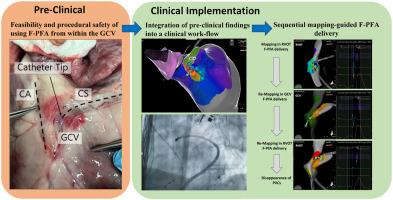
In 4 pigs, F-PFA (Centauri, CardioFocus) was applied from within the GCV followed by macroscopic gross analysis. In 4 patients with previously failed radiofrequency ablation, electroanatomic mapping was used to guide F-PFA from within the GCV and the ventricular outflow tracts. Coronary angiography and optical coherence tomography (OCT) were performed in 2 patients.
Results
In pigs, F-PFA from within the GCV (5 mm away from the coronary arteries) resulted in myocardial lesions with a maximal depth of 4 mm, which was associated with nonobstructive transient coronary spasms. In patients, sequential delivery of F-PFA in the ventricular outflow tracts and from within the GCV eliminated the PVCs. During F-PFA delivery from within the GCV with prophylactic nitroglycerin application, coronary angiography showed no coronary spasm when F-PFA was delivered >5 mm away from the coronary artery and a transient coronary spasm without changes in a subsequent OCT, when F-PFA was delivered directly on the coronary artery. Intracardiac echocardiography and computed tomography integration was used to monitor F-PFA delivery from within the GCV. There were no immediate or short-term complications.
Conclusion
Sequential mapping-guided F-PFA from endocardial ventricular outflow tracts and from within the GCV is feasible with a favorable procedural safety profile for treatment of epicardial PVCs.
期刊介绍:
HeartRhythm, the official Journal of the Heart Rhythm Society and the Cardiac Electrophysiology Society, is a unique journal for fundamental discovery and clinical applicability.
HeartRhythm integrates the entire cardiac electrophysiology (EP) community from basic and clinical academic researchers, private practitioners, engineers, allied professionals, industry, and trainees, all of whom are vital and interdependent members of our EP community.
The Heart Rhythm Society is the international leader in science, education, and advocacy for cardiac arrhythmia professionals and patients, and the primary information resource on heart rhythm disorders. Its mission is to improve the care of patients by promoting research, education, and optimal health care policies and standards.




 京公网安备 11010802042870号
京ICP备2023020795号-1
京公网安备 11010802042870号
京ICP备2023020795号-1

 分享
分享
 求助内容:
求助内容: 应助结果提醒方式:
 扫码关注我们
