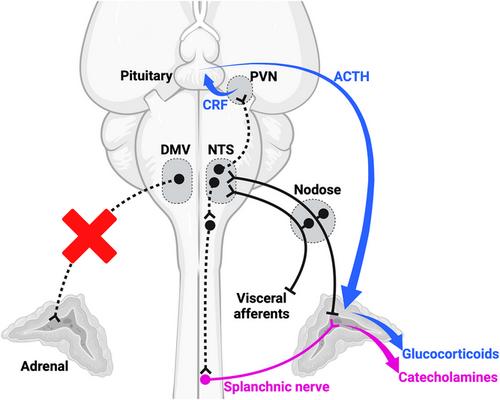
{"title":"What is the Vagal–Adrenal Axis?","authors":"Pedro Trevizan-Baú, Robin M. McAllen","doi":"10.1002/cne.25656","DOIUrl":null,"url":null,"abstract":"<p>Some recent publications have used the term “vagal–adrenal axis” to account for mechanisms involved in the regulation of inflammation by electroacupuncture. This concept proposes that efferent parasympathetic nerve fibers in the vagus directly innervate the adrenal glands to influence catecholamine secretion. Here, we discuss evidence for anatomical and functional links between the vagi and adrenal glands that may be relevant in the context of inflammation and its neural control by factors, including acupuncture. First, we find that evidence for any direct vagal parasympathetic efferent innervation of the adrenal glands is weak and likely artifactual. Second, we find good evidence that vagal afferent fibers directly innervate the adrenal gland, although their function is uncertain. Third, we highlight a wealth of evidence for indirect pathways, whereby vagal afferent signals act via the central nervous system to modify adrenal-dependent anti-inflammatory responses. Vagal afferents, not efferents, are thus the likely key to these phenomena.</p>","PeriodicalId":15552,"journal":{"name":"Journal of Comparative Neurology","volume":"532 7","pages":""},"PeriodicalIF":2.1000,"publicationDate":"2024-07-09","publicationTypes":"Journal Article","fieldsOfStudy":null,"isOpenAccess":false,"openAccessPdf":"https://onlinelibrary.wiley.com/doi/epdf/10.1002/cne.25656","citationCount":"0","resultStr":null,"platform":"Semanticscholar","paperid":null,"PeriodicalName":"Journal of Comparative Neurology","FirstCategoryId":"3","ListUrlMain":"https://onlinelibrary.wiley.com/doi/10.1002/cne.25656","RegionNum":4,"RegionCategory":"医学","ArticlePicture":[],"TitleCN":null,"AbstractTextCN":null,"PMCID":null,"EPubDate":"","PubModel":"","JCR":"Q3","JCRName":"NEUROSCIENCES","Score":null,"Total":0}
引用次数: 0
Abstract
Some recent publications have used the term “vagal–adrenal axis” to account for mechanisms involved in the regulation of inflammation by electroacupuncture. This concept proposes that efferent parasympathetic nerve fibers in the vagus directly innervate the adrenal glands to influence catecholamine secretion. Here, we discuss evidence for anatomical and functional links between the vagi and adrenal glands that may be relevant in the context of inflammation and its neural control by factors, including acupuncture. First, we find that evidence for any direct vagal parasympathetic efferent innervation of the adrenal glands is weak and likely artifactual. Second, we find good evidence that vagal afferent fibers directly innervate the adrenal gland, although their function is uncertain. Third, we highlight a wealth of evidence for indirect pathways, whereby vagal afferent signals act via the central nervous system to modify adrenal-dependent anti-inflammatory responses. Vagal afferents, not efferents, are thus the likely key to these phenomena.
期刊介绍:
Established in 1891, JCN is the oldest continually published basic neuroscience journal. Historically, as the name suggests, the journal focused on a comparison among species to uncover the intricacies of how the brain functions. In modern times, this research is called systems neuroscience where animal models are used to mimic core cognitive processes with the ultimate goal of understanding neural circuits and connections that give rise to behavioral patterns and different neural states.
Research published in JCN covers all species from invertebrates to humans, and the reports inform the readers about the function and organization of nervous systems in species with an emphasis on the way that species adaptations inform about the function or organization of the nervous systems, rather than on their evolution per se.
JCN publishes primary research articles and critical commentaries and review-type articles offering expert insight in to cutting edge research in the field of systems neuroscience; a complete list of contribution types is given in the Author Guidelines. For primary research contributions, only full-length investigative reports are desired; the journal does not accept short communications.



 京公网安备 11010802042870号
京ICP备2023020795号-1
京公网安备 11010802042870号
京ICP备2023020795号-1

 分享
分享
 求助内容:
求助内容: 应助结果提醒方式:
 扫码关注我们
