Caitlin C Clements, Anne-Michelle Engelstad, Carol L Wilkinson, Carly Hyde, Megan Hartney, Alexandra Simmons, Helen Tager-Flusberg, Shafali Jeste, Charles A Nelson
{"title":"Resting state EEG in young children with Tuberous Sclerosis Complex.","authors":"Caitlin C Clements, Anne-Michelle Engelstad, Carol L Wilkinson, Carly Hyde, Megan Hartney, Alexandra Simmons, Helen Tager-Flusberg, Shafali Jeste, Charles A Nelson","doi":"10.21203/rs.3.rs-4543112/v1","DOIUrl":null,"url":null,"abstract":"<p><strong>Background: </strong>Tuberous Sclerosis Complex (TSC) manifests behaviorally with features of autism, epilepsy, and intellectual disability. Resting state electroencephalography (EEG) offers a window into neural oscillatory activity and may serve as an intermediate biomarker between gene expression and behavioral manifestations. Such a biomarker could be useful in clinical trials as an endpoint or predictor of treatment response. However, seizures and antiepileptic medications also affect resting neural oscillatory activity and could undermine the utility of resting state EEG features as biomarkers in neurodevelopmental disorders such as TSC.</p><p><strong>Methods: </strong>This paper compares resting state EEG features in a cross-sectional cohort of young children with TSC (n=49, ages 12-37 months) to 49 age- and sex-matched typically developing controls. Within children with TSC, associations were examined between resting state EEG features, seizure severity composite score, and use of GABA agonists.</p><p><strong>Results: </strong>Compared to matched typically developing controls, children with TSC showed significantly greater alpha and beta power in permutation cluster analyses iterated across a broad frequency range (2-50Hz). Children with TSC also showed significantly greater aperiodic offset after power spectra were parameterized using SpecParam into aperiodic and periodic components. Within children with TSC, greater seizure severity was significantly related to increased periodic peak beta power. Use of GABA agonists was also independently and significantly associated with increased periodic peak beta power; the interaction between seizure severity and GABA agonist use had no significant effect on peak beta power.</p><p><strong>Conclusions: </strong>The elevated peak beta power observed in children with TSC compared to matched typically developing controls may be driven by both seizures and GABA agonist use. It is recommended to collect seizure and mediation data alongside EEG data for clinical trials. These results highlight the challenge of using resting state EEG features as biomarkers in trials with neurodevelopmental disabilities when epilepsy and anti-epileptic medication are common.</p>","PeriodicalId":519972,"journal":{"name":"Research square","volume":" ","pages":""},"PeriodicalIF":0.0000,"publicationDate":"2024-06-27","publicationTypes":"Journal Article","fieldsOfStudy":null,"isOpenAccess":false,"openAccessPdf":"https://www.ncbi.nlm.nih.gov/pmc/articles/PMC11230505/pdf/","citationCount":"0","resultStr":null,"platform":"Semanticscholar","paperid":null,"PeriodicalName":"Research square","FirstCategoryId":"1085","ListUrlMain":"https://doi.org/10.21203/rs.3.rs-4543112/v1","RegionNum":0,"RegionCategory":null,"ArticlePicture":[],"TitleCN":null,"AbstractTextCN":null,"PMCID":null,"EPubDate":"","PubModel":"","JCR":"","JCRName":"","Score":null,"Total":0}
引用次数: 0
Abstract
Background: Tuberous Sclerosis Complex (TSC) manifests behaviorally with features of autism, epilepsy, and intellectual disability. Resting state electroencephalography (EEG) offers a window into neural oscillatory activity and may serve as an intermediate biomarker between gene expression and behavioral manifestations. Such a biomarker could be useful in clinical trials as an endpoint or predictor of treatment response. However, seizures and antiepileptic medications also affect resting neural oscillatory activity and could undermine the utility of resting state EEG features as biomarkers in neurodevelopmental disorders such as TSC.
Methods: This paper compares resting state EEG features in a cross-sectional cohort of young children with TSC (n=49, ages 12-37 months) to 49 age- and sex-matched typically developing controls. Within children with TSC, associations were examined between resting state EEG features, seizure severity composite score, and use of GABA agonists.
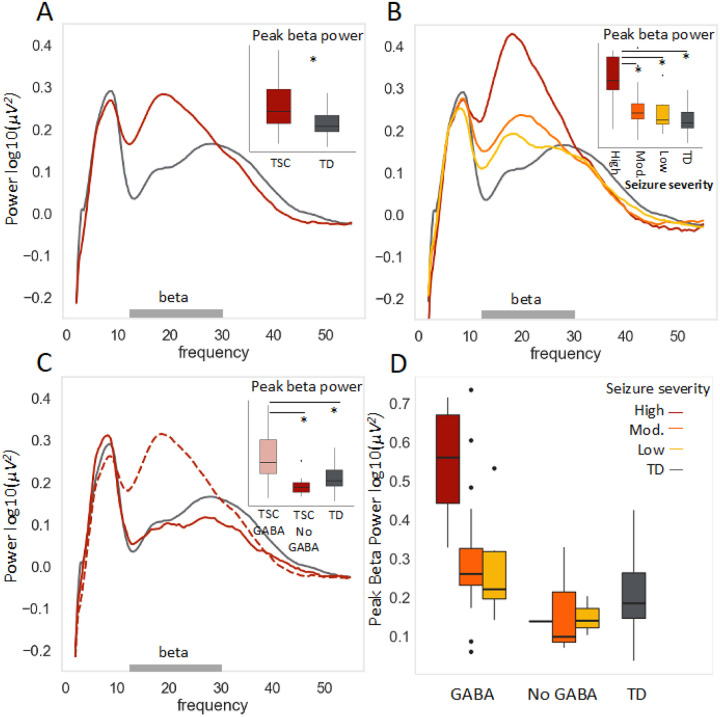
Results: Compared to matched typically developing controls, children with TSC showed significantly greater alpha and beta power in permutation cluster analyses iterated across a broad frequency range (2-50Hz). Children with TSC also showed significantly greater aperiodic offset after power spectra were parameterized using SpecParam into aperiodic and periodic components. Within children with TSC, greater seizure severity was significantly related to increased periodic peak beta power. Use of GABA agonists was also independently and significantly associated with increased periodic peak beta power; the interaction between seizure severity and GABA agonist use had no significant effect on peak beta power.
Conclusions: The elevated peak beta power observed in children with TSC compared to matched typically developing controls may be driven by both seizures and GABA agonist use. It is recommended to collect seizure and mediation data alongside EEG data for clinical trials. These results highlight the challenge of using resting state EEG features as biomarkers in trials with neurodevelopmental disabilities when epilepsy and anti-epileptic medication are common.





 京公网安备 11010802042870号
京ICP备2023020795号-1
京公网安备 11010802042870号
京ICP备2023020795号-1

 分享
分享

 求助内容:
求助内容: 应助结果提醒方式:
 扫码关注我们
