Ruijie Wang, Zezhong Tian, Meiyan Zhu, Bingying Zhang, Yanzhang Li, Yiqi Zheng, Yuheng Mao, Yimin Zhao, Yan Yang
{"title":"SARS-CoV-2 spike protein potentiates platelet aggregation via upregulating integrin αIIbβ3 outside-in signaling pathway.","authors":"Ruijie Wang, Zezhong Tian, Meiyan Zhu, Bingying Zhang, Yanzhang Li, Yiqi Zheng, Yuheng Mao, Yimin Zhao, Yan Yang","doi":"10.1007/s11239-024-03008-8","DOIUrl":null,"url":null,"abstract":"<p><p>Platelet hyperreactivity is one of the crucial causes of coagulative disorders in patients with COVID-19. Few studies have indicated that integrin αIIbβ3 may be a potential target for spike protein binding to platelets. This study aims to investigate whether spike protein interacts with platelet integrin αIIbβ3 and upregulates outside-in signaling to potentiate platelet aggregation. In this study, we found that spike protein significantly potentiated platelet aggregation induced by different agonists and platelet spreading in vitro. Mechanism studies revealed that spike protein upregulated the outside-in signaling, such as increased thrombin-induced phosphorylation of β3, c-Src. Moreover, using tirofiban to inhibit spike protein binding to αIIbβ3 or using PP2 to block outside-in signaling, we found that the potentiating effect of spike protein on platelet aggregation was abolished. These results demonstrate that SARS-CoV-2 spike protein directly enhances platelet aggregation via integrin αIIbβ3 outside-in signaling, and suggest a potential target for platelet hyperreactivity in patients with COVID-19. HIGHLIGHTS: • Spike protein potentiates platelet aggregation and upregulates αIIbβ3 outside-in signaling. • Spike protein interacts with integrin αIIbβ3 to potentiate platelet aggregation. • Blocking outside-in signaling abolishes the effect of spike protein on platelets.</p>","PeriodicalId":17546,"journal":{"name":"Journal of Thrombosis and Thrombolysis","volume":" ","pages":"1225-1232"},"PeriodicalIF":2.2000,"publicationDate":"2024-10-01","publicationTypes":"Journal Article","fieldsOfStudy":null,"isOpenAccess":false,"openAccessPdf":"","citationCount":"0","resultStr":null,"platform":"Semanticscholar","paperid":null,"PeriodicalName":"Journal of Thrombosis and Thrombolysis","FirstCategoryId":"3","ListUrlMain":"https://doi.org/10.1007/s11239-024-03008-8","RegionNum":3,"RegionCategory":"医学","ArticlePicture":[],"TitleCN":null,"AbstractTextCN":null,"PMCID":null,"EPubDate":"2024/7/9 0:00:00","PubModel":"Epub","JCR":"Q2","JCRName":"CARDIAC & CARDIOVASCULAR SYSTEMS","Score":null,"Total":0}
引用次数: 0
Abstract
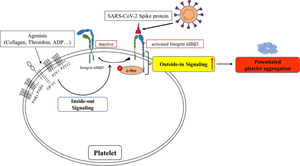
Platelet hyperreactivity is one of the crucial causes of coagulative disorders in patients with COVID-19. Few studies have indicated that integrin αIIbβ3 may be a potential target for spike protein binding to platelets. This study aims to investigate whether spike protein interacts with platelet integrin αIIbβ3 and upregulates outside-in signaling to potentiate platelet aggregation. In this study, we found that spike protein significantly potentiated platelet aggregation induced by different agonists and platelet spreading in vitro. Mechanism studies revealed that spike protein upregulated the outside-in signaling, such as increased thrombin-induced phosphorylation of β3, c-Src. Moreover, using tirofiban to inhibit spike protein binding to αIIbβ3 or using PP2 to block outside-in signaling, we found that the potentiating effect of spike protein on platelet aggregation was abolished. These results demonstrate that SARS-CoV-2 spike protein directly enhances platelet aggregation via integrin αIIbβ3 outside-in signaling, and suggest a potential target for platelet hyperreactivity in patients with COVID-19. HIGHLIGHTS: • Spike protein potentiates platelet aggregation and upregulates αIIbβ3 outside-in signaling. • Spike protein interacts with integrin αIIbβ3 to potentiate platelet aggregation. • Blocking outside-in signaling abolishes the effect of spike protein on platelets.
期刊介绍:
The Journal of Thrombosis and Thrombolysis is a long-awaited resource for contemporary cardiologists, hematologists, vascular medicine specialists and clinician-scientists actively involved in treatment decisions and clinical investigation of thrombotic disorders involving the cardiovascular and cerebrovascular systems. The principal focus of the Journal centers on the pathobiology of thrombosis and vascular disorders and the use of anticoagulants, platelet antagonists, cell-based therapies and interventions in scientific investigation, clinical-translational research and patient care.
The Journal will publish original work which emphasizes the interface between fundamental scientific principles and clinical investigation, stimulating an interdisciplinary and scholarly dialogue in thrombosis and vascular science. Published works will also define platforms for translational research, drug development, clinical trials and patient-directed applications. The Journal of Thrombosis and Thrombolysis'' integrated format will expand the reader''s knowledge base and provide important insights for both the investigation and direct clinical application of the most rapidly growing fields in medicine-thrombosis and vascular science.




 京公网安备 11010802042870号
京ICP备2023020795号-1
京公网安备 11010802042870号
京ICP备2023020795号-1

 分享
分享
 求助内容:
求助内容: 应助结果提醒方式:
 扫码关注我们
