Han Leng, Yulong Xu, Yanzhi Xing, Jingqi Sun, Jiaxin Li, Yufei Guan, Yanfeng Zhang and Xuwei Chen
{"title":"Novel three-dimensional fibrous covalent organic frameworks constructed via silver amalgam bridging for efficient organic dye adsorption and removal†","authors":"Han Leng, Yulong Xu, Yanzhi Xing, Jingqi Sun, Jiaxin Li, Yufei Guan, Yanfeng Zhang and Xuwei Chen","doi":"10.1039/D4NR02193B","DOIUrl":null,"url":null,"abstract":"<p >The construction of covalent organic frameworks (COFs) with unique structures has great significance in exploring the structure–function relationship and extending their potential applications. Fibrous COFs have demonstrated superior performance in specific application scenarios owing to the distinctive three-dimensional (3D) structure. Herein, we report a facile strategy for the fabrication of 3D COF nanofiber by exploiting silver amalgam as a bridging agent to assemble one-dimensional-extended PA-COF modules into a tubular structure. Dimensions of the obtained 3D COF nanofiber were predicted by DFT calculations, and the nanofiber was endowed with the merits of favorable uniformity and high stability. Due to the enhanced exposure of conjugatable binding sites for dye retention offered by the novel 3D architecture, the PA-COF nanofiber exhibits fast adsorption (within 5 min) and superior adsorption capacity to various organic dyes, <em>e.g.</em>, 1717 mg g<small><sup>−1</sup></small> for methylene blue (MB) and 978.3 mg g<small><sup>−1</sup></small> for methyl orange (MO). Moreover, the PA-COF nanofiber shows excellent reusability in dye adsorption, which makes it a potential medium for removing dye pollutants from wastewater. This work presents an effective strategy to construct COF materials with unique architecture and potential prospects in the fields of separation and wastewater treatment.</p>","PeriodicalId":92,"journal":{"name":"Nanoscale","volume":" 34","pages":" 16026-16034"},"PeriodicalIF":5.1000,"publicationDate":"2024-07-09","publicationTypes":"Journal Article","fieldsOfStudy":null,"isOpenAccess":false,"openAccessPdf":"","citationCount":"0","resultStr":null,"platform":"Semanticscholar","paperid":null,"PeriodicalName":"Nanoscale","FirstCategoryId":"88","ListUrlMain":"https://pubs.rsc.org/en/content/articlelanding/2024/nr/d4nr02193b","RegionNum":3,"RegionCategory":"材料科学","ArticlePicture":[],"TitleCN":null,"AbstractTextCN":null,"PMCID":null,"EPubDate":"","PubModel":"","JCR":"Q1","JCRName":"CHEMISTRY, MULTIDISCIPLINARY","Score":null,"Total":0}
引用次数: 0
Abstract
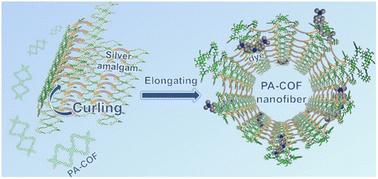
The construction of covalent organic frameworks (COFs) with unique structures has great significance in exploring the structure–function relationship and extending their potential applications. Fibrous COFs have demonstrated superior performance in specific application scenarios owing to the distinctive three-dimensional (3D) structure. Herein, we report a facile strategy for the fabrication of 3D COF nanofiber by exploiting silver amalgam as a bridging agent to assemble one-dimensional-extended PA-COF modules into a tubular structure. Dimensions of the obtained 3D COF nanofiber were predicted by DFT calculations, and the nanofiber was endowed with the merits of favorable uniformity and high stability. Due to the enhanced exposure of conjugatable binding sites for dye retention offered by the novel 3D architecture, the PA-COF nanofiber exhibits fast adsorption (within 5 min) and superior adsorption capacity to various organic dyes, e.g., 1717 mg g−1 for methylene blue (MB) and 978.3 mg g−1 for methyl orange (MO). Moreover, the PA-COF nanofiber shows excellent reusability in dye adsorption, which makes it a potential medium for removing dye pollutants from wastewater. This work presents an effective strategy to construct COF materials with unique architecture and potential prospects in the fields of separation and wastewater treatment.
期刊介绍:
Nanoscale is a high-impact international journal, publishing high-quality research across nanoscience and nanotechnology. Nanoscale publishes a full mix of research articles on experimental and theoretical work, including reviews, communications, and full papers.Highly interdisciplinary, this journal appeals to scientists, researchers and professionals interested in nanoscience and nanotechnology, quantum materials and quantum technology, including the areas of physics, chemistry, biology, medicine, materials, energy/environment, information technology, detection science, healthcare and drug discovery, and electronics.




 京公网安备 11010802042870号
京ICP备2023020795号-1
京公网安备 11010802042870号
京ICP备2023020795号-1

 分享
分享
 求助内容:
求助内容: 应助结果提醒方式:
 扫码关注我们
