Yongqiang Zhou, Zixian Wang, linfeng Guo, Lei Huang, Yichen Liu, Mengyue Wu, Qian Zhang, Kang An, Peng He, Fei Wang, Juan Du, Zhengzheng Liu, Zhiping Hu, Yuxin Leng, Yayun Pu, Jun’an Lai and Xiaosheng Tang
{"title":"Ultrafast and high-resolution X-ray imaging based on zero-dimensional organic silver halides†","authors":"Yongqiang Zhou, Zixian Wang, linfeng Guo, Lei Huang, Yichen Liu, Mengyue Wu, Qian Zhang, Kang An, Peng He, Fei Wang, Juan Du, Zhengzheng Liu, Zhiping Hu, Yuxin Leng, Yayun Pu, Jun’an Lai and Xiaosheng Tang","doi":"10.1039/D4QM00362D","DOIUrl":null,"url":null,"abstract":"<p >Supersensitive and fast X-ray imaging is of great importance in medical diagnosis, industrial flaw detection, security and safety inspection, and frontier science exploration. As the core of detection devices, new generation scintillators require small self-absorption capacity, short fluorescence lifetime, simple film-making protocol, excellent stability and non-toxicity. Herein, a new type of lead-free organic silver halide TPPAgX<small><sub>2</sub></small> (TPP = C<small><sub>24</sub></small>H<small><sub>20</sub></small>P and X = I, Br, and Cl) is rationally developed with a large Stokes shift (176 nm) and ultralow photoluminescence decay (3.8 ns lifetime). It achieves an ultrafast fluorescent response that is the best among all the Pb-free perovskite scintillators. Temperature-dependent PL and DFT calculations together confirm that TPPAgCl<small><sub>2</sub></small> follows an emission mechanism in which a triplet exciton can be rapidly upconverted <em>via</em> thermal activation. A series of TPPAgX<small><sub>2</sub></small>-based flexible scintillator films were fabricated and tested. A detection limit of 0.447 μGy<small><sub>air</sub></small> s<small><sup>−1</sup></small> was obtained for TPPAgCl<small><sub>2</sub></small>, which is one order of magnitude lower than the medical X-ray diagnosis requirement. In addition, it exhibits a superior X-ray imaging resolution of 11.87 lp mm<small><sup>−1</sup></small>. The excellent performance and simple preparation methodology are expected to be potentially applicable for large-scale manufacturing.</p>","PeriodicalId":86,"journal":{"name":"Materials Chemistry Frontiers","volume":" 18","pages":" 3004-3016"},"PeriodicalIF":6.4000,"publicationDate":"2024-07-10","publicationTypes":"Journal Article","fieldsOfStudy":null,"isOpenAccess":false,"openAccessPdf":"","citationCount":"0","resultStr":null,"platform":"Semanticscholar","paperid":null,"PeriodicalName":"Materials Chemistry Frontiers","FirstCategoryId":"88","ListUrlMain":"https://pubs.rsc.org/en/content/articlelanding/2024/qm/d4qm00362d","RegionNum":2,"RegionCategory":"材料科学","ArticlePicture":[],"TitleCN":null,"AbstractTextCN":null,"PMCID":null,"EPubDate":"","PubModel":"","JCR":"Q1","JCRName":"CHEMISTRY, MULTIDISCIPLINARY","Score":null,"Total":0}
引用次数: 0
Abstract
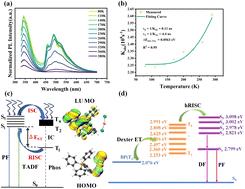
Supersensitive and fast X-ray imaging is of great importance in medical diagnosis, industrial flaw detection, security and safety inspection, and frontier science exploration. As the core of detection devices, new generation scintillators require small self-absorption capacity, short fluorescence lifetime, simple film-making protocol, excellent stability and non-toxicity. Herein, a new type of lead-free organic silver halide TPPAgX2 (TPP = C24H20P and X = I, Br, and Cl) is rationally developed with a large Stokes shift (176 nm) and ultralow photoluminescence decay (3.8 ns lifetime). It achieves an ultrafast fluorescent response that is the best among all the Pb-free perovskite scintillators. Temperature-dependent PL and DFT calculations together confirm that TPPAgCl2 follows an emission mechanism in which a triplet exciton can be rapidly upconverted via thermal activation. A series of TPPAgX2-based flexible scintillator films were fabricated and tested. A detection limit of 0.447 μGyair s−1 was obtained for TPPAgCl2, which is one order of magnitude lower than the medical X-ray diagnosis requirement. In addition, it exhibits a superior X-ray imaging resolution of 11.87 lp mm−1. The excellent performance and simple preparation methodology are expected to be potentially applicable for large-scale manufacturing.
期刊介绍:
Materials Chemistry Frontiers focuses on the synthesis and chemistry of exciting new materials, and the development of improved fabrication techniques. Characterisation and fundamental studies that are of broad appeal are also welcome.
This is the ideal home for studies of a significant nature that further the development of organic, inorganic, composite and nano-materials.



 京公网安备 11010802042870号
京ICP备2023020795号-1
京公网安备 11010802042870号
京ICP备2023020795号-1

 分享
分享
 求助内容:
求助内容: 应助结果提醒方式:
 扫码关注我们
