Juanjuan Zhang , Long Kang , Yang Cao , Caihong Zhang , Qing-Wei Wang
{"title":"Litter decomposition in pure and mixed plantations on the Loess Plateau, China: Lack of home-field advantage","authors":"Juanjuan Zhang , Long Kang , Yang Cao , Caihong Zhang , Qing-Wei Wang","doi":"10.1016/j.catena.2024.108239","DOIUrl":null,"url":null,"abstract":"<div><p>Litter decomposition plays a critical role in the nutrient cycling of terrestrial ecosystems. According to the home-field advantage (HFA) hypothesis, litter decomposes more rapidly in its home habitat (where it originates) compared to other habitats (referred to as away). Although this hypothesis has been widely tested in natural forests, it remains controversial and lacks support for plantations, especially in dry ecosystems where microbial activities are limited. To clarify it, the present study investigated litter mass loss, nutrient dynamics, and decomposer communities in a 549-day reciprocal transplant experiment of litter decomposition in <em>Robinia pseudoacacia</em> (RP) and <em>Hippophae rhamnoides</em> (HR) pure plantations and their mixed plantations (5:5 and 8:2 ratios) on the Loess Plateau, China. The rate of mass, carbon (C), nitrogen (N) and phosphorus (P) loss in litter differed depending on litter type of species component and plantation type they were placed in. HR litter lost mass and released C, N, and P fastest, irrespective of plantation type. The overall mass loss of the four litter types were the fastest under 5:5 mixed plantations. However, litter did not decompose more rapidly in its home soil compared to the away soil. The structural equation modeling revealed that initial litter quality played a significant role in regulating the loss of C and N across decomposition stages, while the climate variations and microbial chemistry also contributed to the process. The similarity in soil microbial communities across plantation types, along with the limited interaction between litter and microbes in arid environments, could help elucidate the lack of HFA, with other factors such as the litter type exerting a minor influence. In summary, this study does not substantiate the hypothesis of home-field advantage but supports its context-dependency. Thus, regional heterogeneity should be taken into account when predicting the carbon cycle of forest ecosystems in future studies.</p></div>","PeriodicalId":9801,"journal":{"name":"Catena","volume":"244 ","pages":""},"PeriodicalIF":5.7000,"publicationDate":"2024-09-01","publicationTypes":"Journal Article","fieldsOfStudy":null,"isOpenAccess":false,"openAccessPdf":"","citationCount":"0","resultStr":null,"platform":"Semanticscholar","paperid":null,"PeriodicalName":"Catena","FirstCategoryId":"97","ListUrlMain":"https://www.sciencedirect.com/science/article/pii/S0341816224004363","RegionNum":1,"RegionCategory":"农林科学","ArticlePicture":[],"TitleCN":null,"AbstractTextCN":null,"PMCID":null,"EPubDate":"2024/7/11 0:00:00","PubModel":"Epub","JCR":"Q1","JCRName":"GEOSCIENCES, MULTIDISCIPLINARY","Score":null,"Total":0}
引用次数: 0
Abstract
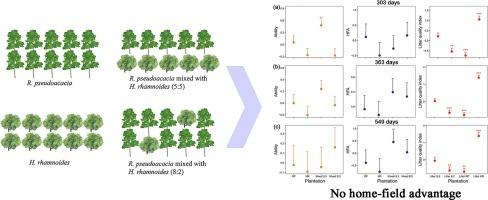
Litter decomposition plays a critical role in the nutrient cycling of terrestrial ecosystems. According to the home-field advantage (HFA) hypothesis, litter decomposes more rapidly in its home habitat (where it originates) compared to other habitats (referred to as away). Although this hypothesis has been widely tested in natural forests, it remains controversial and lacks support for plantations, especially in dry ecosystems where microbial activities are limited. To clarify it, the present study investigated litter mass loss, nutrient dynamics, and decomposer communities in a 549-day reciprocal transplant experiment of litter decomposition in Robinia pseudoacacia (RP) and Hippophae rhamnoides (HR) pure plantations and their mixed plantations (5:5 and 8:2 ratios) on the Loess Plateau, China. The rate of mass, carbon (C), nitrogen (N) and phosphorus (P) loss in litter differed depending on litter type of species component and plantation type they were placed in. HR litter lost mass and released C, N, and P fastest, irrespective of plantation type. The overall mass loss of the four litter types were the fastest under 5:5 mixed plantations. However, litter did not decompose more rapidly in its home soil compared to the away soil. The structural equation modeling revealed that initial litter quality played a significant role in regulating the loss of C and N across decomposition stages, while the climate variations and microbial chemistry also contributed to the process. The similarity in soil microbial communities across plantation types, along with the limited interaction between litter and microbes in arid environments, could help elucidate the lack of HFA, with other factors such as the litter type exerting a minor influence. In summary, this study does not substantiate the hypothesis of home-field advantage but supports its context-dependency. Thus, regional heterogeneity should be taken into account when predicting the carbon cycle of forest ecosystems in future studies.
期刊介绍:
Catena publishes papers describing original field and laboratory investigations and reviews on geoecology and landscape evolution with emphasis on interdisciplinary aspects of soil science, hydrology and geomorphology. It aims to disseminate new knowledge and foster better understanding of the physical environment, of evolutionary sequences that have resulted in past and current landscapes, and of the natural processes that are likely to determine the fate of our terrestrial environment.
Papers within any one of the above topics are welcome provided they are of sufficiently wide interest and relevance.




 京公网安备 11010802042870号
京ICP备2023020795号-1
京公网安备 11010802042870号
京ICP备2023020795号-1

 分享
分享
 求助内容:
求助内容: 应助结果提醒方式:
 扫码关注我们
