Effectiveness of Cognitive-Based Interventions on Psychological Distress in Adolescents With Physical Disabilities: A Systematic Review and Meta-Analysis
Jiaying Li, Yan Li, Xiaoxiao Mei, Honggu He, Lu Yu, Grace Wing Ka Ho, Engle Angela Chan
{"title":"Effectiveness of Cognitive-Based Interventions on Psychological Distress in Adolescents With Physical Disabilities: A Systematic Review and Meta-Analysis","authors":"Jiaying Li, Yan Li, Xiaoxiao Mei, Honggu He, Lu Yu, Grace Wing Ka Ho, Engle Angela Chan","doi":"10.1111/inm.13391","DOIUrl":null,"url":null,"abstract":"<p>Adolescents with physical disabilities experience common psychological distress that interacts with impaired physical function. While cognitive-based interventions have been implemented for adolescents with physical disabilities, their effects on enhancing psychological health remain uncertain. This systematic review aimed to synthesise the effects of cognitive-based interventions on the psychological distress of this population and identify optimal components for evidence-based interventions. Following the PRISMA guideline, nine databases were searched to identify eligible randomised controlled trials examining the effects of cognitive-based interventions for adolescents with physical disabilities from inception to October 2023. Data syntheses were performed using the R software, employing random-effects models. Twelve trials involving 1201 participants were identified. The pooled results revealed that cognitive-based interventions did not yield noticeable effects in reducing anxiety (<i>g</i> = −0.43 for postintervention; −0.14 for medium term; −0.37 for long term), depression (<i>g</i> = −0.05 for postintervention; −0.02 for medium term; −0.15 for long term) and stress levels (<i>g</i> = −0.15) over time. The secondary outcome (physical function) improved significantly in the long term compared to the control groups (<i>g</i> = 0.31). Furthermore, this review identified variations in the effectiveness of CBIs among different recipients, durations and modes of delivery. Given the limited number and overall low quality of identified studies for each outcome, conducting high-quality randomised controlled trials is recommended to validate the effectiveness of cognitive-based interventions in reducing psychological distress among adolescents with physical disabilities.</p>","PeriodicalId":14007,"journal":{"name":"International Journal of Mental Health Nursing","volume":"33 6","pages":"1729-1742"},"PeriodicalIF":3.3000,"publicationDate":"2024-07-15","publicationTypes":"Journal Article","fieldsOfStudy":null,"isOpenAccess":false,"openAccessPdf":"https://onlinelibrary.wiley.com/doi/epdf/10.1111/inm.13391","citationCount":"0","resultStr":null,"platform":"Semanticscholar","paperid":null,"PeriodicalName":"International Journal of Mental Health Nursing","FirstCategoryId":"3","ListUrlMain":"https://onlinelibrary.wiley.com/doi/10.1111/inm.13391","RegionNum":2,"RegionCategory":"医学","ArticlePicture":[],"TitleCN":null,"AbstractTextCN":null,"PMCID":null,"EPubDate":"","PubModel":"","JCR":"Q1","JCRName":"NURSING","Score":null,"Total":0}
引用次数: 0
Abstract
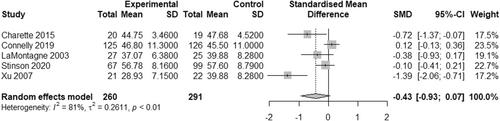
Adolescents with physical disabilities experience common psychological distress that interacts with impaired physical function. While cognitive-based interventions have been implemented for adolescents with physical disabilities, their effects on enhancing psychological health remain uncertain. This systematic review aimed to synthesise the effects of cognitive-based interventions on the psychological distress of this population and identify optimal components for evidence-based interventions. Following the PRISMA guideline, nine databases were searched to identify eligible randomised controlled trials examining the effects of cognitive-based interventions for adolescents with physical disabilities from inception to October 2023. Data syntheses were performed using the R software, employing random-effects models. Twelve trials involving 1201 participants were identified. The pooled results revealed that cognitive-based interventions did not yield noticeable effects in reducing anxiety (g = −0.43 for postintervention; −0.14 for medium term; −0.37 for long term), depression (g = −0.05 for postintervention; −0.02 for medium term; −0.15 for long term) and stress levels (g = −0.15) over time. The secondary outcome (physical function) improved significantly in the long term compared to the control groups (g = 0.31). Furthermore, this review identified variations in the effectiveness of CBIs among different recipients, durations and modes of delivery. Given the limited number and overall low quality of identified studies for each outcome, conducting high-quality randomised controlled trials is recommended to validate the effectiveness of cognitive-based interventions in reducing psychological distress among adolescents with physical disabilities.
期刊介绍:
The International Journal of Mental Health Nursing is the official journal of the Australian College of Mental Health Nurses Inc. It is a fully refereed journal that examines current trends and developments in mental health practice and research.
The International Journal of Mental Health Nursing provides a forum for the exchange of ideas on all issues of relevance to mental health nursing. The Journal informs you of developments in mental health nursing practice and research, directions in education and training, professional issues, management approaches, policy development, ethical questions, theoretical inquiry, and clinical issues.
The Journal publishes feature articles, review articles, clinical notes, research notes and book reviews. Contributions on any aspect of mental health nursing are welcomed.
Statements and opinions expressed in the journal reflect the views of the authors and are not necessarily endorsed by the Australian College of Mental Health Nurses Inc.



 京公网安备 11010802042870号
京ICP备2023020795号-1
京公网安备 11010802042870号
京ICP备2023020795号-1

 分享
分享
 求助内容:
求助内容: 应助结果提醒方式:
 扫码关注我们
