{"title":"INTERCONNECTIONS AND INTERDEPENDENCIES OF ECONOMIC DEVELOPMENT AND SHADOW BANKING SECTOR IN DEVELOPING AND TRANSITIONAL ECONOMIES","authors":"Yao Liang, Xu Jin, Aslan Javid Azimzadeh","doi":"10.3846/tede.2024.20795","DOIUrl":null,"url":null,"abstract":"The research objective is defined as the identification and confirmation of empirical relationships between shadow banking activities and economic development in developing and transitional economies to establish a theoretical basis for minimizing potential risks associated with shadow banking. The methodological design is based on a quantitative approach, implemented through correlation-regression analysis and ARIMA forecasting methods. The research findings confirm Hypothesis 1: China’s shadow banking is closely interconnected with the country’s economic development. However, Hypothesis 2 (the reduction of shadow banking in China contributes to per capita GDP growth) is only supported for specific structural elements of shadow banking that contribute to economic overheating. In contrast, for other structural elements, such as entrusted loans, a strong direct correlation exists, promoting a positive impact of shadow banking on the country’s economic development. This highlights the need for a highly balanced state policy to minimize shadow banking risks. The research results can be valuable for professionals in public administration and academic researchers, particularly in terms of shaping future research directions.","PeriodicalId":4,"journal":{"name":"ACS Applied Energy Materials","volume":"58 27","pages":""},"PeriodicalIF":5.5000,"publicationDate":"2024-07-09","publicationTypes":"Journal Article","fieldsOfStudy":null,"isOpenAccess":false,"openAccessPdf":"","citationCount":"0","resultStr":null,"platform":"Semanticscholar","paperid":null,"PeriodicalName":"ACS Applied Energy Materials","FirstCategoryId":"96","ListUrlMain":"https://doi.org/10.3846/tede.2024.20795","RegionNum":3,"RegionCategory":"材料科学","ArticlePicture":[],"TitleCN":null,"AbstractTextCN":null,"PMCID":null,"EPubDate":"","PubModel":"","JCR":"Q2","JCRName":"CHEMISTRY, PHYSICAL","Score":null,"Total":0}
引用次数: 0
Abstract
The research objective is defined as the identification and confirmation of empirical relationships between shadow banking activities and economic development in developing and transitional economies to establish a theoretical basis for minimizing potential risks associated with shadow banking. The methodological design is based on a quantitative approach, implemented through correlation-regression analysis and ARIMA forecasting methods. The research findings confirm Hypothesis 1: China’s shadow banking is closely interconnected with the country’s economic development. However, Hypothesis 2 (the reduction of shadow banking in China contributes to per capita GDP growth) is only supported for specific structural elements of shadow banking that contribute to economic overheating. In contrast, for other structural elements, such as entrusted loans, a strong direct correlation exists, promoting a positive impact of shadow banking on the country’s economic development. This highlights the need for a highly balanced state policy to minimize shadow banking risks. The research results can be valuable for professionals in public administration and academic researchers, particularly in terms of shaping future research directions.
期刊介绍:
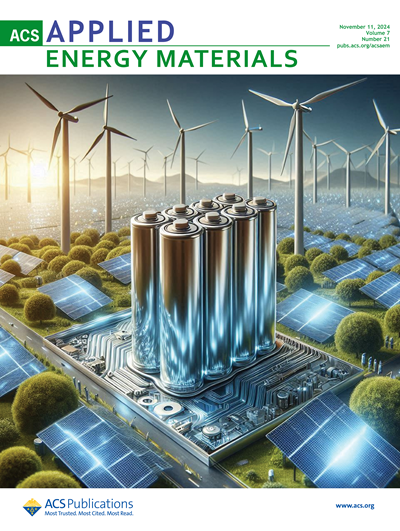
ACS Applied Energy Materials is an interdisciplinary journal publishing original research covering all aspects of materials, engineering, chemistry, physics and biology relevant to energy conversion and storage. The journal is devoted to reports of new and original experimental and theoretical research of an applied nature that integrate knowledge in the areas of materials, engineering, physics, bioscience, and chemistry into important energy applications.



 京公网安备 11010802042870号
京ICP备2023020795号-1
京公网安备 11010802042870号
京ICP备2023020795号-1

 分享
分享
 求助内容:
求助内容: 应助结果提醒方式:
 扫码关注我们
