Tosin Yinka Akintunde, Adekunle Adedeji, Johanna Buchcik, Stanley Oloji Isangha, Sunday Philip Agbede, Nkechi Angela Chukwuemeka
{"title":"Intersection of Adverse Childhood Experiences, Subjective Well-Being and Social Anxiety among Sojourners in China","authors":"Tosin Yinka Akintunde, Adekunle Adedeji, Johanna Buchcik, Stanley Oloji Isangha, Sunday Philip Agbede, Nkechi Angela Chukwuemeka","doi":"10.1007/s42844-024-00144-1","DOIUrl":null,"url":null,"abstract":"<div><p>Growing evidence suggests that adverse childhood experiences (ACEs) significantly threaten sojourners' well-being, depriving them of adaptive strategies to mitigate the negative influences. However, research examining social dysfunctions, such as social anxiety resulting from compromised well-being due to ACEs, remains limited. This study investigate how subjective well-being may mediate the relationship between ACEs and social anxiety among diverse groups of sojourners in China. Utilizing structural equation modeling, this study analyzed data from 470 sojourners in China to assess the direct effects of ACEs on social anxiety and whether subjective well-being mediates this relationship.The findings revealed that ACEs were not directly associated with social anxiety (β = 0.101, <i>p</i> = 0.089). However, ACEs were found to negatively impact subjective well-being (β = -0.483, <i>p</i> < 0.001). Additionally, subjective well-being was negatively associated with social anxiety (β = -0.268, <i>p</i> < 0.001), indicating that higher levels of subjective well-being correspond to lower levels of social anxiety. The study identified a full mediation effect, demonstrating that when ACEs diminish sojourners' subjective well-being, social anxiety tends to increase (β = 0.129, SE = 0.038, CI = [0.072, 0.198], <i>p</i> < 0.01), confirming the enervating effects of ACEs on social anxiety regardless of subjective well-being. No significant gender disparities were observed in the interrelationships among ACEs, subjective well-being, and social anxiety. Outcomes varied among students, expatriates, and business owners based on the model. Support and interventions should consider ACEs as risk factors for low subjective well-being, which can lead to social dysfunctions such as social anxiety. Addressing these factors is crucial for improving the overall well-being of sojourners.</p></div>","PeriodicalId":72113,"journal":{"name":"Adversity and resilience science","volume":"6 1","pages":"73 - 84"},"PeriodicalIF":2.9000,"publicationDate":"2024-07-08","publicationTypes":"Journal Article","fieldsOfStudy":null,"isOpenAccess":false,"openAccessPdf":"","citationCount":"0","resultStr":null,"platform":"Semanticscholar","paperid":null,"PeriodicalName":"Adversity and resilience science","FirstCategoryId":"1085","ListUrlMain":"https://link.springer.com/article/10.1007/s42844-024-00144-1","RegionNum":0,"RegionCategory":null,"ArticlePicture":[],"TitleCN":null,"AbstractTextCN":null,"PMCID":null,"EPubDate":"","PubModel":"","JCR":"","JCRName":"","Score":null,"Total":0}
引用次数: 0
Abstract
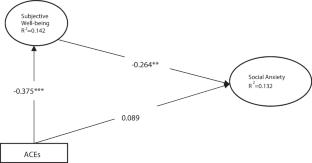
Growing evidence suggests that adverse childhood experiences (ACEs) significantly threaten sojourners' well-being, depriving them of adaptive strategies to mitigate the negative influences. However, research examining social dysfunctions, such as social anxiety resulting from compromised well-being due to ACEs, remains limited. This study investigate how subjective well-being may mediate the relationship between ACEs and social anxiety among diverse groups of sojourners in China. Utilizing structural equation modeling, this study analyzed data from 470 sojourners in China to assess the direct effects of ACEs on social anxiety and whether subjective well-being mediates this relationship.The findings revealed that ACEs were not directly associated with social anxiety (β = 0.101, p = 0.089). However, ACEs were found to negatively impact subjective well-being (β = -0.483, p < 0.001). Additionally, subjective well-being was negatively associated with social anxiety (β = -0.268, p < 0.001), indicating that higher levels of subjective well-being correspond to lower levels of social anxiety. The study identified a full mediation effect, demonstrating that when ACEs diminish sojourners' subjective well-being, social anxiety tends to increase (β = 0.129, SE = 0.038, CI = [0.072, 0.198], p < 0.01), confirming the enervating effects of ACEs on social anxiety regardless of subjective well-being. No significant gender disparities were observed in the interrelationships among ACEs, subjective well-being, and social anxiety. Outcomes varied among students, expatriates, and business owners based on the model. Support and interventions should consider ACEs as risk factors for low subjective well-being, which can lead to social dysfunctions such as social anxiety. Addressing these factors is crucial for improving the overall well-being of sojourners.
越来越多的证据表明,不良的童年经历(ace)严重威胁着旅居者的福祉,剥夺了他们减轻负面影响的适应性策略。然而,关于社交功能障碍的研究,如由于ace导致的健康受损而导致的社交焦虑,仍然有限。本研究旨在探讨主观幸福感如何中介不同群体旅居中国者的不良经历与社交焦虑之间的关系。本研究利用结构方程模型分析了470名中国滞留者的数据,以评估ace对社交焦虑的直接影响,以及主观幸福感是否在这种关系中起中介作用。结果显示,ace与社交焦虑无直接关系(β = 0.101, p = 0.089)。然而,ace对主观幸福感有负面影响(β = -0.483, p < 0.001)。此外,主观幸福感与社交焦虑呈负相关(β = -0.268, p < 0.001),表明主观幸福感水平越高,社交焦虑水平越低。本研究发现了充分的中介效应,表明当ace降低了旅居者的主观幸福感时,社交焦虑倾向于增加(β = 0.129, SE = 0.038, CI = [0.072, 0.198], p < 0.01),证实了ace对社交焦虑的削弱作用与主观幸福感无关。在ace、主观幸福感和社交焦虑之间的相互关系中,没有观察到显著的性别差异。基于该模型,学生、外籍人士和企业主的结果各不相同。支持和干预措施应将ace视为主观幸福感低的危险因素,这可能导致社交焦虑等社交功能障碍。解决这些因素对于改善旅居者的整体福祉至关重要。



 京公网安备 11010802042870号
京ICP备2023020795号-1
京公网安备 11010802042870号
京ICP备2023020795号-1

 分享
分享

 求助内容:
求助内容: 应助结果提醒方式:
 扫码关注我们
