Rupal P. Soder , Nathaniel R. Dudley , Buddhadeb Dawn
{"title":"Microcarrier-based clinical-grade manufacturing of therapeutic Wharton's jelly mesenchymal stromal cells","authors":"Rupal P. Soder , Nathaniel R. Dudley , Buddhadeb Dawn","doi":"10.1016/j.jcyt.2024.07.003","DOIUrl":null,"url":null,"abstract":"<div><div>Due to their immunomodulatory and anti-inflammatory properties, tissue repair capabilities and regenerative potential, Wharton's jelly mesenchymal stem/stromal cells (WJMSCs) have been widely investigated as potential treatment for diverse clinical indications. WJMSCs have been found to be well-tolerated and safe, positioning them as a promising candidate for cellular therapy. To address the commercial need for manufacturing WJMSCs for clinical applications, the production scale should be capable of generating large quantities of cells that retain their expected identity, purity and potency. This study aimed to establish a current Good Manufacturing Practice (cGMP) compliant robust and scalable expansion process representing a critical step towards a cGMP-compliant large-scale production platform for WJMSC-based clinical applications. Using our in-house cGMP-manufactured WJMSCs, which are currently being tested in a Phase Ib clinical trial (NCT03158896) using two-dimensional (2D) planar systems, we optimized various culture parameters including type of microcarrier, seeding density, agitation and culture feed regime in a 3D microcarrier-based culture system in spinner flasks. The results showed that cell adhesion was potentiated under intermittent stirring (3 min of agitation at 25 rpm followed by a period of non-agitation for 30 min), with reduced supplementation (0.05%) during the initial 8 h of cultivation with an initial cell concentration of 0.45 × 10<sup>5</sup> cells/mL. Microcarrier-based WJMSC expansion in spinner flasks achieved greater cell densities of 1.67 × 10<sup>6</sup> cells/mL with a maximum of 37-fold expansion, yielding ∼84 × 10<sup>6</sup> cells after 6 days of culture with a 95% harvest efficiency. Additionally, post 3D expansion, WJMSCs maintained their phenotypic characteristics, differentiation potential, normal karyotype, functional properties and sterility in the culture systems evaluated. This cGMP-compliant expansion process described herein demonstrates a successful transition of an established 2D planar culture process of clinical grade WJMSCs to 3D microcarrier-based suspension process generating higher cell yields, is cost-effective and represents an important step toward fulfilling the commercial demand of clinical grade mesenchymal stromal cells.</div></div>","PeriodicalId":50597,"journal":{"name":"Cytotherapy","volume":"26 12","pages":"Pages 1556-1565"},"PeriodicalIF":3.2000,"publicationDate":"2024-12-01","publicationTypes":"Journal Article","fieldsOfStudy":null,"isOpenAccess":false,"openAccessPdf":"","citationCount":"0","resultStr":null,"platform":"Semanticscholar","paperid":null,"PeriodicalName":"Cytotherapy","FirstCategoryId":"3","ListUrlMain":"https://www.sciencedirect.com/science/article/pii/S1465324924007746","RegionNum":3,"RegionCategory":"医学","ArticlePicture":[],"TitleCN":null,"AbstractTextCN":null,"PMCID":null,"EPubDate":"2024/7/6 0:00:00","PubModel":"Epub","JCR":"Q2","JCRName":"BIOTECHNOLOGY & APPLIED MICROBIOLOGY","Score":null,"Total":0}
引用次数: 0
Abstract
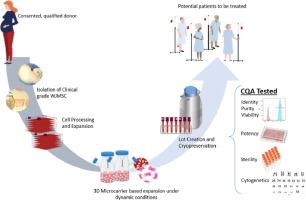
Due to their immunomodulatory and anti-inflammatory properties, tissue repair capabilities and regenerative potential, Wharton's jelly mesenchymal stem/stromal cells (WJMSCs) have been widely investigated as potential treatment for diverse clinical indications. WJMSCs have been found to be well-tolerated and safe, positioning them as a promising candidate for cellular therapy. To address the commercial need for manufacturing WJMSCs for clinical applications, the production scale should be capable of generating large quantities of cells that retain their expected identity, purity and potency. This study aimed to establish a current Good Manufacturing Practice (cGMP) compliant robust and scalable expansion process representing a critical step towards a cGMP-compliant large-scale production platform for WJMSC-based clinical applications. Using our in-house cGMP-manufactured WJMSCs, which are currently being tested in a Phase Ib clinical trial (NCT03158896) using two-dimensional (2D) planar systems, we optimized various culture parameters including type of microcarrier, seeding density, agitation and culture feed regime in a 3D microcarrier-based culture system in spinner flasks. The results showed that cell adhesion was potentiated under intermittent stirring (3 min of agitation at 25 rpm followed by a period of non-agitation for 30 min), with reduced supplementation (0.05%) during the initial 8 h of cultivation with an initial cell concentration of 0.45 × 10⁵ cells/mL. Microcarrier-based WJMSC expansion in spinner flasks achieved greater cell densities of 1.67 × 10⁶ cells/mL with a maximum of 37-fold expansion, yielding ∼84 × 106 cells after 6 days of culture with a 95% harvest efficiency. Additionally, post 3D expansion, WJMSCs maintained their phenotypic characteristics, differentiation potential, normal karyotype, functional properties and sterility in the culture systems evaluated. This cGMP-compliant expansion process described herein demonstrates a successful transition of an established 2D planar culture process of clinical grade WJMSCs to 3D microcarrier-based suspension process generating higher cell yields, is cost-effective and represents an important step toward fulfilling the commercial demand of clinical grade mesenchymal stromal cells.
期刊介绍:
The journal brings readers the latest developments in the fast moving field of cellular therapy in man. This includes cell therapy for cancer, immune disorders, inherited diseases, tissue repair and regenerative medicine. The journal covers the science, translational development and treatment with variety of cell types including hematopoietic stem cells, immune cells (dendritic cells, NK, cells, T cells, antigen presenting cells) mesenchymal stromal cells, adipose cells, nerve, muscle, vascular and endothelial cells, and induced pluripotential stem cells. We also welcome manuscripts on subcellular derivatives such as exosomes. A specific focus is on translational research that brings cell therapy to the clinic. Cytotherapy publishes original papers, reviews, position papers editorials, commentaries and letters to the editor. We welcome "Protocols in Cytotherapy" bringing standard operating procedure for production specific cell types for clinical use within the reach of the readership.




 京公网安备 11010802042870号
京ICP备2023020795号-1
京公网安备 11010802042870号
京ICP备2023020795号-1

 分享
分享
 求助内容:
求助内容: 应助结果提醒方式:
 扫码关注我们
