Samia , Muhammad Hasnain Jameel , Musfira Arain , Iftikhar Hussain , Muhammad Bilal Hanif , Shalu Atri , Mohd Zul Hilmi Mayzan , Haitao Dai
{"title":"A review on catalyst convergence: Unleashing the potential of MXenes for CO2 electrochemical reduction into high-value liquid product","authors":"Samia , Muhammad Hasnain Jameel , Musfira Arain , Iftikhar Hussain , Muhammad Bilal Hanif , Shalu Atri , Mohd Zul Hilmi Mayzan , Haitao Dai","doi":"10.1016/j.nanoms.2024.06.006","DOIUrl":null,"url":null,"abstract":"<div><div>The electrochemical reduction reaction of carbon dioxide (CO<sub>2</sub>-ERR) holds tremendous potential as a key approach for achieving carbon neutrality by harnessing renewable resources.</div><div>However, the current state of CO<sub>2</sub>-ERR encounters challenges in terms of efficiency and selectivity. Overcoming these obstacles requires the development of a robust electrocatalyst capable of enhancing process efficiency and improving selectivity towards desired products. In recent years, 2D materials have garnered significant attention as efficient catalysts. Among them, MXene stands out of high interest due to unique multilayered structure and presence of surface functional moieties. The MXene material offers high electrical conductivity, versatile surface chemistry, and tunable interface designs. This comprehensive review explores the utilization of MXene-based catalysts for CO<sub>2</sub>-ERR into valuable products. It covers fundamental aspects of electrochemical conversion, including CO<sub>2</sub> adsorption on MXene Ti<sub>3</sub>C<sub>2</sub>T<sub>x</sub>, the mechanism of CO<sub>2</sub>-ERR on MXene (Mo<sub>2</sub>CS<sub>2</sub>) single-atom catalysts, applications, synthesis methods of MXene production, and future prospects. Additionally, the review highlights the significance of modern artificial intelligence techniques, particularly machine learning, in screening and activating CO<sub>2</sub>, making it a pioneering scientific endeavor.</div></div>","PeriodicalId":33573,"journal":{"name":"Nano Materials Science","volume":"7 4","pages":"Pages 444-481"},"PeriodicalIF":17.9000,"publicationDate":"2025-08-01","publicationTypes":"Journal Article","fieldsOfStudy":null,"isOpenAccess":false,"openAccessPdf":"","citationCount":"0","resultStr":null,"platform":"Semanticscholar","paperid":null,"PeriodicalName":"Nano Materials Science","FirstCategoryId":"1089","ListUrlMain":"https://www.sciencedirect.com/science/article/pii/S2589965124000898","RegionNum":2,"RegionCategory":"材料科学","ArticlePicture":[],"TitleCN":null,"AbstractTextCN":null,"PMCID":null,"EPubDate":"2024/7/8 0:00:00","PubModel":"Epub","JCR":"Q1","JCRName":"Engineering","Score":null,"Total":0}
引用次数: 0
Abstract
The electrochemical reduction reaction of carbon dioxide (CO2-ERR) holds tremendous potential as a key approach for achieving carbon neutrality by harnessing renewable resources.
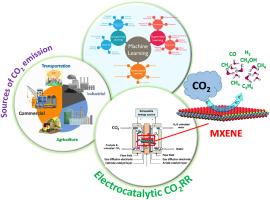
However, the current state of CO2-ERR encounters challenges in terms of efficiency and selectivity. Overcoming these obstacles requires the development of a robust electrocatalyst capable of enhancing process efficiency and improving selectivity towards desired products. In recent years, 2D materials have garnered significant attention as efficient catalysts. Among them, MXene stands out of high interest due to unique multilayered structure and presence of surface functional moieties. The MXene material offers high electrical conductivity, versatile surface chemistry, and tunable interface designs. This comprehensive review explores the utilization of MXene-based catalysts for CO2-ERR into valuable products. It covers fundamental aspects of electrochemical conversion, including CO2 adsorption on MXene Ti3C2Tx, the mechanism of CO2-ERR on MXene (Mo2CS2) single-atom catalysts, applications, synthesis methods of MXene production, and future prospects. Additionally, the review highlights the significance of modern artificial intelligence techniques, particularly machine learning, in screening and activating CO2, making it a pioneering scientific endeavor.
期刊介绍:
Nano Materials Science (NMS) is an international and interdisciplinary, open access, scholarly journal. NMS publishes peer-reviewed original articles and reviews on nanoscale material science and nanometer devices, with topics encompassing preparation and processing; high-throughput characterization; material performance evaluation and application of material characteristics such as the microstructure and properties of one-dimensional, two-dimensional, and three-dimensional nanostructured and nanofunctional materials; design, preparation, and processing techniques; and performance evaluation technology and nanometer device applications.




 京公网安备 11010802042870号
京ICP备2023020795号-1
京公网安备 11010802042870号
京ICP备2023020795号-1

 分享
分享
 求助内容:
求助内容: 应助结果提醒方式:
 扫码关注我们
