Jiansong Zhang, Kejiang Chen, Weixiang Li, Weiming Zhang, Neng H. Yu
{"title":"Steganography With Generated Images: Leveraging Volatility to Enhance Security","authors":"Jiansong Zhang, Kejiang Chen, Weixiang Li, Weiming Zhang, Neng H. Yu","doi":"10.1109/TDSC.2023.3341427","DOIUrl":null,"url":null,"abstract":"The development of generative AI applications has revolutionized the data environment for steganography, providing a new source of steganographic cover. However, existing generative data-based steganography methods typically require white-box access, rendering them unsuitable for black-box generative models. To overcome this limitation, we propose a novel steganography method for generated images, which leverages the volatility of generative models and is applicable in black-box scenarios. The volatility of generative models refers to the ability to generate a series of images with slight variations by fine-tuning the input parameters of the model. These generated images exhibit varying degrees of volatility in different areas. To resist steganalysis, we mask steganographic modifications by confusing them with the inherent volatility of the model. Specifically, by modeling distributions of generated pixels and estimating the parameters of the distributions, the occurrence probabilities of generated pixels can be obtained, which serve as an effective measure for steganographic modification probabilities to render stego images as indistinguishable as possible from the images producible by the model. Moreover, we further combine it with existing costs to develop a more comprehensive steganographic algorithm. Experimental results show that the proposed method significantly outperforms baseline and comparative methods in resisting both feature-based and CNN-based steganalyzers.","PeriodicalId":7,"journal":{"name":"ACS Applied Polymer Materials","volume":"12 1","pages":"3994-4005"},"PeriodicalIF":4.7000,"publicationDate":"2024-07-01","publicationTypes":"Journal Article","fieldsOfStudy":null,"isOpenAccess":false,"openAccessPdf":"","citationCount":"2","resultStr":null,"platform":"Semanticscholar","paperid":null,"PeriodicalName":"ACS Applied Polymer Materials","FirstCategoryId":"94","ListUrlMain":"https://doi.org/10.1109/TDSC.2023.3341427","RegionNum":2,"RegionCategory":"化学","ArticlePicture":[],"TitleCN":null,"AbstractTextCN":null,"PMCID":null,"EPubDate":"","PubModel":"","JCR":"Q2","JCRName":"MATERIALS SCIENCE, MULTIDISCIPLINARY","Score":null,"Total":0}
引用次数: 2
Abstract
The development of generative AI applications has revolutionized the data environment for steganography, providing a new source of steganographic cover. However, existing generative data-based steganography methods typically require white-box access, rendering them unsuitable for black-box generative models. To overcome this limitation, we propose a novel steganography method for generated images, which leverages the volatility of generative models and is applicable in black-box scenarios. The volatility of generative models refers to the ability to generate a series of images with slight variations by fine-tuning the input parameters of the model. These generated images exhibit varying degrees of volatility in different areas. To resist steganalysis, we mask steganographic modifications by confusing them with the inherent volatility of the model. Specifically, by modeling distributions of generated pixels and estimating the parameters of the distributions, the occurrence probabilities of generated pixels can be obtained, which serve as an effective measure for steganographic modification probabilities to render stego images as indistinguishable as possible from the images producible by the model. Moreover, we further combine it with existing costs to develop a more comprehensive steganographic algorithm. Experimental results show that the proposed method significantly outperforms baseline and comparative methods in resisting both feature-based and CNN-based steganalyzers.
期刊介绍:
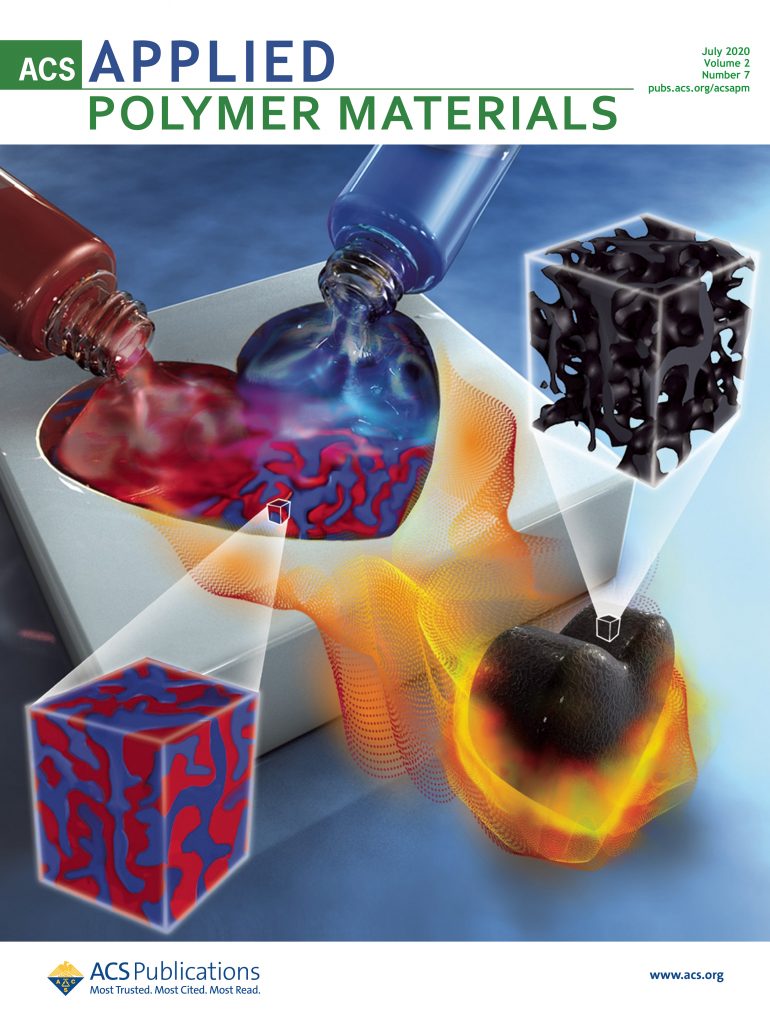
ACS Applied Polymer Materials is an interdisciplinary journal publishing original research covering all aspects of engineering, chemistry, physics, and biology relevant to applications of polymers.
The journal is devoted to reports of new and original experimental and theoretical research of an applied nature that integrates fundamental knowledge in the areas of materials, engineering, physics, bioscience, polymer science and chemistry into important polymer applications. The journal is specifically interested in work that addresses relationships among structure, processing, morphology, chemistry, properties, and function as well as work that provide insights into mechanisms critical to the performance of the polymer for applications.



 京公网安备 11010802042870号
京ICP备2023020795号-1
京公网安备 11010802042870号
京ICP备2023020795号-1

 分享
分享
 求助内容:
求助内容: 应助结果提醒方式:
 扫码关注我们
