{"title":"Optimizing Proof of Aliveness in Cyber-Physical Systems","authors":"Zheng Yang, Chenglu Jin, Xuelian Cao, Marten van Dijk, Jianying Zhou","doi":"10.1109/TDSC.2023.3335188","DOIUrl":null,"url":null,"abstract":"At ACSAC 2019, we introduced a new cryptographic primitive called proof of aliveness (PoA), allowing us to remotely and automatically track the running status (aliveness) of devices in the fields in cyber-physical systems. We proposed to use a one-way function (OWF) chain structure to build an efficient proof of aliveness, such that the prover sends every node on the OWF chain in a reverse order periodically. However, the finite nodes in OWF chains limited its practicality. We enhance our first PoA construction by linking multiple OWF chains together using a pseudo-random generator chain in our second PoA scheme. This enhancement allows us to integrate one-time signature (OTS) schemes into the structure of the second construction to realize the auto-replenishment of the aliveness proofs for continuous use without interruption for reinitialization. In this work, our primary motivation is to further improve our secondary PoA and auto-replenishment schemes. Instead of storing the tail nodes of multiple OWF chains on the verifier side, we use a Bloom Filter to compress them, reducing the storage cost by <inline-formula><tex-math notation=\"LaTeX\">$ 4.7$</tex-math><alternatives><mml:math><mml:mrow><mml:mn>4</mml:mn><mml:mo>.</mml:mo><mml:mn>7</mml:mn></mml:mrow></mml:math><inline-graphic xlink:href=\"yang-ieq1-3335188.gif\"/></alternatives></inline-formula> times. Moreover, the OTS-based auto-replenishment solution cannot be applied to our first scheme, and it is not so efficient despite its standard model security. To overcome these limitations, we design a new auto-replenishment scheme from a hash-based commitment under the random oracle model in this work, which is much faster and can be used by both PoA schemes. Considering the implementation on a storage/memory-constrained device, we particularly study the strategies for efficiently generating proofs.","PeriodicalId":7,"journal":{"name":"ACS Applied Polymer Materials","volume":"178 1","pages":"3610-3628"},"PeriodicalIF":4.7000,"publicationDate":"2024-07-01","publicationTypes":"Journal Article","fieldsOfStudy":null,"isOpenAccess":false,"openAccessPdf":"","citationCount":"0","resultStr":null,"platform":"Semanticscholar","paperid":null,"PeriodicalName":"ACS Applied Polymer Materials","FirstCategoryId":"94","ListUrlMain":"https://doi.org/10.1109/TDSC.2023.3335188","RegionNum":2,"RegionCategory":"化学","ArticlePicture":[],"TitleCN":null,"AbstractTextCN":null,"PMCID":null,"EPubDate":"","PubModel":"","JCR":"Q2","JCRName":"MATERIALS SCIENCE, MULTIDISCIPLINARY","Score":null,"Total":0}
引用次数: 0
Abstract
At ACSAC 2019, we introduced a new cryptographic primitive called proof of aliveness (PoA), allowing us to remotely and automatically track the running status (aliveness) of devices in the fields in cyber-physical systems. We proposed to use a one-way function (OWF) chain structure to build an efficient proof of aliveness, such that the prover sends every node on the OWF chain in a reverse order periodically. However, the finite nodes in OWF chains limited its practicality. We enhance our first PoA construction by linking multiple OWF chains together using a pseudo-random generator chain in our second PoA scheme. This enhancement allows us to integrate one-time signature (OTS) schemes into the structure of the second construction to realize the auto-replenishment of the aliveness proofs for continuous use without interruption for reinitialization. In this work, our primary motivation is to further improve our secondary PoA and auto-replenishment schemes. Instead of storing the tail nodes of multiple OWF chains on the verifier side, we use a Bloom Filter to compress them, reducing the storage cost by $ 4.7$4.7 times. Moreover, the OTS-based auto-replenishment solution cannot be applied to our first scheme, and it is not so efficient despite its standard model security. To overcome these limitations, we design a new auto-replenishment scheme from a hash-based commitment under the random oracle model in this work, which is much faster and can be used by both PoA schemes. Considering the implementation on a storage/memory-constrained device, we particularly study the strategies for efficiently generating proofs.
期刊介绍:
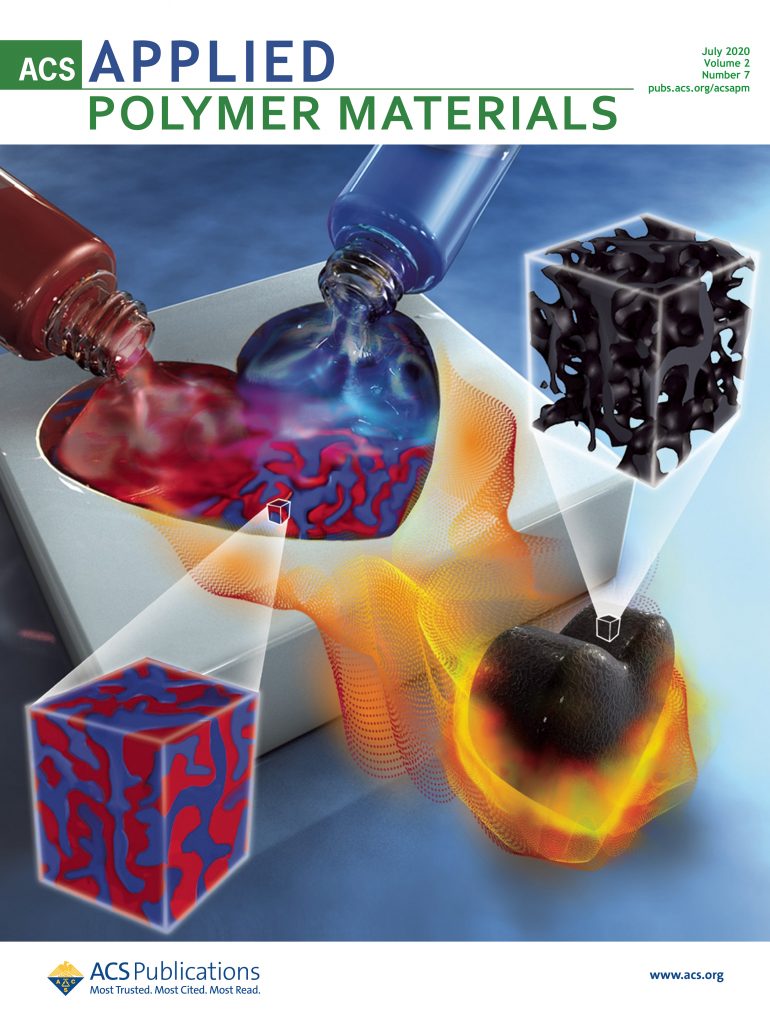
ACS Applied Polymer Materials is an interdisciplinary journal publishing original research covering all aspects of engineering, chemistry, physics, and biology relevant to applications of polymers.
The journal is devoted to reports of new and original experimental and theoretical research of an applied nature that integrates fundamental knowledge in the areas of materials, engineering, physics, bioscience, polymer science and chemistry into important polymer applications. The journal is specifically interested in work that addresses relationships among structure, processing, morphology, chemistry, properties, and function as well as work that provide insights into mechanisms critical to the performance of the polymer for applications.



 京公网安备 11010802042870号
京ICP备2023020795号-1
京公网安备 11010802042870号
京ICP备2023020795号-1

 分享
分享
 求助内容:
求助内容: 应助结果提醒方式:
 扫码关注我们
