{"title":"Deep learning based damage detection of concrete structures","authors":"Maheswara Rao Bandi, Laxmi Narayana Pasupuleti, Tanmay Das, Shyamal Guchhait","doi":"10.1007/s42107-024-01106-9","DOIUrl":null,"url":null,"abstract":"<div><p>Damage detection of any civil engineering structure is a part of the interest in the field of engineering from which one can estimate the stability and lifetime of the structure. With the advancement of technology in the field of infrastructure, damage assessment of any structure with the help of convolutional neural networks (CNNs) and deep learning is gaining importance because of the ease with which it can detect the damage. By using these computer-aided techniques, we can reduce manpower and detect damage in inaccessible places that we cannot see directly. In the current study, we used ResNet-50, which is a part of a deep convolutional neural network with 50 layers deep in it. ResNet-50 is a subclass of convolutional neural networks most popularly used for image classification. Furthermore, we used the image data set collected from the Utah State University, Logan, Utah, USA. This data set contains nearly 56,000 annotated images of both cracked and non-cracked bridge deck images, wall images, and pavement images. These images contain a variety of obstructions, such as shadows and surface roughness in some cases. The present study aimed to train and test the images and compare the accuracy of the results among themselves with an increase in training data. We devised an algorithm to measure cracks as soon as we detected them. The results show that the Resnet-50 architecture was in good agreement with the developed algorithm.</p></div>","PeriodicalId":8513,"journal":{"name":"Asian Journal of Civil Engineering","volume":"25 7","pages":"5197 - 5204"},"PeriodicalIF":0.0000,"publicationDate":"2024-07-01","publicationTypes":"Journal Article","fieldsOfStudy":null,"isOpenAccess":false,"openAccessPdf":"","citationCount":"0","resultStr":null,"platform":"Semanticscholar","paperid":null,"PeriodicalName":"Asian Journal of Civil Engineering","FirstCategoryId":"1085","ListUrlMain":"https://link.springer.com/article/10.1007/s42107-024-01106-9","RegionNum":0,"RegionCategory":null,"ArticlePicture":[],"TitleCN":null,"AbstractTextCN":null,"PMCID":null,"EPubDate":"","PubModel":"","JCR":"Q2","JCRName":"Engineering","Score":null,"Total":0}
引用次数: 0
Abstract
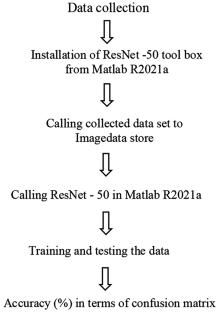
Damage detection of any civil engineering structure is a part of the interest in the field of engineering from which one can estimate the stability and lifetime of the structure. With the advancement of technology in the field of infrastructure, damage assessment of any structure with the help of convolutional neural networks (CNNs) and deep learning is gaining importance because of the ease with which it can detect the damage. By using these computer-aided techniques, we can reduce manpower and detect damage in inaccessible places that we cannot see directly. In the current study, we used ResNet-50, which is a part of a deep convolutional neural network with 50 layers deep in it. ResNet-50 is a subclass of convolutional neural networks most popularly used for image classification. Furthermore, we used the image data set collected from the Utah State University, Logan, Utah, USA. This data set contains nearly 56,000 annotated images of both cracked and non-cracked bridge deck images, wall images, and pavement images. These images contain a variety of obstructions, such as shadows and surface roughness in some cases. The present study aimed to train and test the images and compare the accuracy of the results among themselves with an increase in training data. We devised an algorithm to measure cracks as soon as we detected them. The results show that the Resnet-50 architecture was in good agreement with the developed algorithm.
期刊介绍:
The Asian Journal of Civil Engineering (Building and Housing) welcomes articles and research contributions on topics such as:- Structural analysis and design - Earthquake and structural engineering - New building materials and concrete technology - Sustainable building and energy conservation - Housing and planning - Construction management - Optimal design of structuresPlease note that the journal will not accept papers in the area of hydraulic or geotechnical engineering, traffic/transportation or road making engineering, and on materials relevant to non-structural buildings, e.g. materials for road making and asphalt. Although the journal will publish authoritative papers on theoretical and experimental research works and advanced applications, it may also feature, when appropriate: a) tutorial survey type papers reviewing some fields of civil engineering; b) short communications and research notes; c) book reviews and conference announcements.




 京公网安备 11010802042870号
京ICP备2023020795号-1
京公网安备 11010802042870号
京ICP备2023020795号-1

 分享
分享
 求助内容:
求助内容: 应助结果提醒方式:
 扫码关注我们
