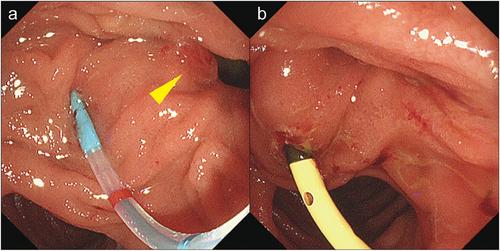
{"title":"Gastrointestinal: Rupture of a pancreaticoduodenal artery aneurysm after endoscopic sphincterotomy in a case of median arcuate ligament syndrome","authors":"H Katsuda, M Kobayashi, R Okamoto","doi":"10.1111/jgh.16688","DOIUrl":null,"url":null,"abstract":"<p>A 70-year-old woman underwent endoscopic retrograde cholangiopancreatography due to acute cholangitis caused by bile duct stones. Endoscopic findings showed a large peripapillary diverticulum, with the major papilla located within it (Fig. 1a). After performing an endoscopic sphincterotomy (EST), a plastic stent was placed. The procedure was completed in 20 min, and no obvious complications were observed during the procedure (Fig. 1b). Post-procedural laboratory findings showed no abnormalities, but the patient complained of abdominal discomfort starting the following day. Although the pre-procedural computed tomography (CT) scan showed no aneurysm, the post-procedural CT scan showed the appearance of a suspected aneurysm at the anterior superior pancreaticoduodenal artery (ASPDA), which was located slightly away from the major papilla where the EST was performed (Fig. 2a). A follow-up CT scan taken 5 h later revealed rupture of the newly emerged aneurysm and the appearance of a retroperitoneal hematoma (Fig. 2b). Upon conducting abdominal angiography, an aneurysm was identified in the arcade of the ASPDA (Fig. 2c), prompting immediate transarterial embolization. In retrospect, the pre-procedural CT scan also revealed focal narrowing of the proximal celiac artery due to median arcuate ligament syndrome (MALS) (Fig. 2d).</p><p>Endoscopic sphincterotomy has become an essential technique for many procedures using endoscopic retrograde cholangiopancreatography.<span><sup>1</sup></span> Adverse events associated with EST, such as bleeding from the incision site, perforation, and pancreatitis, have been reported.<span><sup>2</sup></span> However, rupture of an ASPDA aneurysm after EST is extremely rare. MALS is known to be a risk factor for the development of true aneurysms in the pancreatoduodenal artery.<span><sup>3</sup></span> Although no aneurysm was found pre-procedurally in this case, there was a potential risk of aneurysm development due to MALS, and the energization with EST may have caused the appearance and rupture of the aneurysm. When performing EST, it is essential to check for the presence of MALS. If detected, diligent post-procedural monitoring is warranted.</p>","PeriodicalId":15877,"journal":{"name":"Journal of Gastroenterology and Hepatology","volume":"40 1","pages":"8-9"},"PeriodicalIF":3.4000,"publicationDate":"2024-07-22","publicationTypes":"Journal Article","fieldsOfStudy":null,"isOpenAccess":false,"openAccessPdf":"https://onlinelibrary.wiley.com/doi/epdf/10.1111/jgh.16688","citationCount":"0","resultStr":null,"platform":"Semanticscholar","paperid":null,"PeriodicalName":"Journal of Gastroenterology and Hepatology","FirstCategoryId":"3","ListUrlMain":"https://onlinelibrary.wiley.com/doi/10.1111/jgh.16688","RegionNum":3,"RegionCategory":"医学","ArticlePicture":[],"TitleCN":null,"AbstractTextCN":null,"PMCID":null,"EPubDate":"","PubModel":"","JCR":"Q2","JCRName":"GASTROENTEROLOGY & HEPATOLOGY","Score":null,"Total":0}
引用次数: 0
Abstract
A 70-year-old woman underwent endoscopic retrograde cholangiopancreatography due to acute cholangitis caused by bile duct stones. Endoscopic findings showed a large peripapillary diverticulum, with the major papilla located within it (Fig. 1a). After performing an endoscopic sphincterotomy (EST), a plastic stent was placed. The procedure was completed in 20 min, and no obvious complications were observed during the procedure (Fig. 1b). Post-procedural laboratory findings showed no abnormalities, but the patient complained of abdominal discomfort starting the following day. Although the pre-procedural computed tomography (CT) scan showed no aneurysm, the post-procedural CT scan showed the appearance of a suspected aneurysm at the anterior superior pancreaticoduodenal artery (ASPDA), which was located slightly away from the major papilla where the EST was performed (Fig. 2a). A follow-up CT scan taken 5 h later revealed rupture of the newly emerged aneurysm and the appearance of a retroperitoneal hematoma (Fig. 2b). Upon conducting abdominal angiography, an aneurysm was identified in the arcade of the ASPDA (Fig. 2c), prompting immediate transarterial embolization. In retrospect, the pre-procedural CT scan also revealed focal narrowing of the proximal celiac artery due to median arcuate ligament syndrome (MALS) (Fig. 2d).
Endoscopic sphincterotomy has become an essential technique for many procedures using endoscopic retrograde cholangiopancreatography.1 Adverse events associated with EST, such as bleeding from the incision site, perforation, and pancreatitis, have been reported.2 However, rupture of an ASPDA aneurysm after EST is extremely rare. MALS is known to be a risk factor for the development of true aneurysms in the pancreatoduodenal artery.3 Although no aneurysm was found pre-procedurally in this case, there was a potential risk of aneurysm development due to MALS, and the energization with EST may have caused the appearance and rupture of the aneurysm. When performing EST, it is essential to check for the presence of MALS. If detected, diligent post-procedural monitoring is warranted.
期刊介绍:
Journal of Gastroenterology and Hepatology is produced 12 times per year and publishes peer-reviewed original papers, reviews and editorials concerned with clinical practice and research in the fields of hepatology, gastroenterology and endoscopy. Papers cover the medical, radiological, pathological, biochemical, physiological and historical aspects of the subject areas. All submitted papers are reviewed by at least two referees expert in the field of the submitted paper.




 京公网安备 11010802042870号
京ICP备2023020795号-1
京公网安备 11010802042870号
京ICP备2023020795号-1

 分享
分享
 求助内容:
求助内容: 应助结果提醒方式:
 扫码关注我们
