Naiyao Li, Dr. Yawen Li, Zengrong Wang, Tianle Cao, Chenjing Liu, Prof. Dr. Hongyue Wang, Dr. Guoping Li, Prof. Dr. Gang He
{"title":"Directional Electron Flow in a Selenoviologen-Based Tetracationic Cyclophane for Enhanced Visible-Light-Driven Hydrogen Evolution","authors":"Naiyao Li, Dr. Yawen Li, Zengrong Wang, Tianle Cao, Chenjing Liu, Prof. Dr. Hongyue Wang, Dr. Guoping Li, Prof. Dr. Gang He","doi":"10.1002/anie.202410525","DOIUrl":null,"url":null,"abstract":"<p>Directional electron flow in the photocatalyst enables efficient charge separation, which is essential for efficient photocatalysis of H<sub>2</sub> production. Here, we report a novel class of tetracationic cyclophanes (<b>7</b>) incorporating bipyridine Pt(II) and selenoviologen. X-ray single-crystal structures reveal that <b>7</b> not only fixes the distances and spatial positions between its individual units but also exhibits a box-like rigid electron-deficient cavity. Moreover, host–guest recognition phenomena are observed between <b>7</b> and ferrocene, forming host–guest complexes with a 1 : 1 stoichiometry. <b>7</b> exhibits good redox properties, narrow energy gaps, and strong absorption in the visible range (370–500 nm) due to containing two selenoviologen (SeV<sup>2+</sup>) units. Meanwhile, the femtosecond transient absorption (fs-TA) reveals that <b>7</b> has stabilized dicationic biradical, efficient charge separation, and facilitates directional electron flow to achieve efficient electron transfer due to the formation of rigid cyclophane and electronic architecture. Then, <b>7</b> is applied to visible-light-driven hydrogen evolution with high hydrogen production (132 μmol), generation rate (11 μmol/h), turnover number (221), and apparent quantum yield (1.7 %), which provides a simplified and efficient photocatalytic strategy for solar energy conversion.</p>","PeriodicalId":125,"journal":{"name":"Angewandte Chemie International Edition","volume":"63 47","pages":""},"PeriodicalIF":16.9000,"publicationDate":"2024-07-23","publicationTypes":"Journal Article","fieldsOfStudy":null,"isOpenAccess":false,"openAccessPdf":"","citationCount":"0","resultStr":null,"platform":"Semanticscholar","paperid":null,"PeriodicalName":"Angewandte Chemie International Edition","FirstCategoryId":"92","ListUrlMain":"https://onlinelibrary.wiley.com/doi/10.1002/anie.202410525","RegionNum":1,"RegionCategory":"化学","ArticlePicture":[],"TitleCN":null,"AbstractTextCN":null,"PMCID":null,"EPubDate":"","PubModel":"","JCR":"Q1","JCRName":"CHEMISTRY, MULTIDISCIPLINARY","Score":null,"Total":0}
引用次数: 0
Abstract
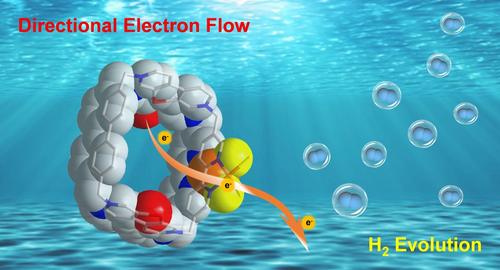
Directional electron flow in the photocatalyst enables efficient charge separation, which is essential for efficient photocatalysis of H2 production. Here, we report a novel class of tetracationic cyclophanes (7) incorporating bipyridine Pt(II) and selenoviologen. X-ray single-crystal structures reveal that 7 not only fixes the distances and spatial positions between its individual units but also exhibits a box-like rigid electron-deficient cavity. Moreover, host–guest recognition phenomena are observed between 7 and ferrocene, forming host–guest complexes with a 1 : 1 stoichiometry. 7 exhibits good redox properties, narrow energy gaps, and strong absorption in the visible range (370–500 nm) due to containing two selenoviologen (SeV2+) units. Meanwhile, the femtosecond transient absorption (fs-TA) reveals that 7 has stabilized dicationic biradical, efficient charge separation, and facilitates directional electron flow to achieve efficient electron transfer due to the formation of rigid cyclophane and electronic architecture. Then, 7 is applied to visible-light-driven hydrogen evolution with high hydrogen production (132 μmol), generation rate (11 μmol/h), turnover number (221), and apparent quantum yield (1.7 %), which provides a simplified and efficient photocatalytic strategy for solar energy conversion.
期刊介绍:
Angewandte Chemie, a journal of the German Chemical Society (GDCh), maintains a leading position among scholarly journals in general chemistry with an impressive Impact Factor of 16.6 (2022 Journal Citation Reports, Clarivate, 2023). Published weekly in a reader-friendly format, it features new articles almost every day. Established in 1887, Angewandte Chemie is a prominent chemistry journal, offering a dynamic blend of Review-type articles, Highlights, Communications, and Research Articles on a weekly basis, making it unique in the field.



 京公网安备 11010802042870号
京ICP备2023020795号-1
京公网安备 11010802042870号
京ICP备2023020795号-1

 分享
分享
 求助内容:
求助内容: 应助结果提醒方式:
 扫码关注我们
