Avrilynn Ding, Heather Noga, Katrina N Bouchard, Mohamed A Bedaiwy, Caroline Lee, Catherine Allaire, Natasha L Orr, Paul J Yong
{"title":"Pain with orgasm in endometriosis: potential etiologic factors and clinical correlates.","authors":"Avrilynn Ding, Heather Noga, Katrina N Bouchard, Mohamed A Bedaiwy, Caroline Lee, Catherine Allaire, Natasha L Orr, Paul J Yong","doi":"10.1093/jsxmed/qdae084","DOIUrl":null,"url":null,"abstract":"<p><strong>Background: </strong>Pelvic pain worsened by orgasm is a poorly understood symptom in patients with endometriosis.</p><p><strong>Aim: </strong>To assess the prevalence of pelvic pain worsened by orgasm in patients with endometriosis and explore its association with potential etiologic factors, including pelvic floor myalgia, uterine tenderness and adenomyosis, and central nervous system sensitization.</p><p><strong>Methods: </strong>An analysis was done of a prospective data registry based at a tertiary referral center for endometriosis. Eligible participants were patients aged 18 to 50 years who were referred between January 1, 2018, and December 31, 2019, diagnosed with endometriosis, and subsequently underwent surgery at the center. Clinical features were compared between participants reporting worsening pelvic pain with orgasm and those without worsening pain with orgasm, including patient-reported variables, physical examination findings, and anatomic phenotyping at the time of surgery. Pelvic floor myalgia and uterine tenderness were assessed by palpation on pelvic examination, adenomyosis by ultrasound, and central nervous system sensitization via the Central Sensitization Inventory (range, 0-100).</p><p><strong>Outcomes: </strong>Outcomes included pelvic or lower abdominal pain in the last 3 months that worsened with orgasm (yes/no).</p><p><strong>Results: </strong>Among 358 participants with endometriosis, 14% (49/358) reported pain worsened by orgasm while 86% (309/358) did not. Pain with orgasm was significantly associated with pelvic floor myalgia (55% [27/49] vs 35% [109/309]; Cohen's h = 0.40, P = .01) and higher scores on the Central Sensitization Inventory (mean ± SD, 53.3 ± 17.0 vs 42.7 ± 18.2; Cohen's d = 0.60, P < .001) but not with uterine tenderness or adenomyosis. Other clinical features associated with pain with orgasm were poorer sexual health (higher scores: deep dyspareunia, Cohen's h = 0.60; superficial dyspareunia, Cohen's h = 0.34; and Female Sexual Distress Scale-Revised, Cohen's d = 0.68; all P < .05) and poorer mental health (higher scores: Patient Health Questionnaire-9, 12.9 ± 6.7 vs 9.1 ± 6.3, Cohen's d = 0.59, P < .001; Generalized Anxiety Disorder-7, 9.4 ± 5.6 vs 6.8 ± 5.5, Cohen's d = 0.48, P = .002). Anatomic findings at the time of surgery did not significantly differ between the groups.</p><p><strong>Clinical implications: </strong>Interventions targeting pelvic floor myalgia and central nervous system sensitization may help alleviate pain worsened by orgasm in patients with endometriosis.</p><p><strong>Strengths and limitations: </strong>A strength is that pain worsened by orgasm was differentiated from dyspareunia. However, pain with orgasm was assessed by only a binary question (yes/no). Also, the study is limited to a single center, and there were limited data on sexual function.</p><p><strong>Conclusion: </strong>Pelvic pain exacerbated by orgasm in people with endometriosis may be related to concurrent pelvic floor myalgia and central sensitization.</p>","PeriodicalId":51100,"journal":{"name":"Journal of Sexual Medicine","volume":" ","pages":"807-815"},"PeriodicalIF":3.3000,"publicationDate":"2024-09-03","publicationTypes":"Journal Article","fieldsOfStudy":null,"isOpenAccess":false,"openAccessPdf":"https://www.ncbi.nlm.nih.gov/pmc/articles/PMC11372072/pdf/","citationCount":"0","resultStr":null,"platform":"Semanticscholar","paperid":null,"PeriodicalName":"Journal of Sexual Medicine","FirstCategoryId":"3","ListUrlMain":"https://doi.org/10.1093/jsxmed/qdae084","RegionNum":3,"RegionCategory":"医学","ArticlePicture":[],"TitleCN":null,"AbstractTextCN":null,"PMCID":null,"EPubDate":"","PubModel":"","JCR":"Q1","JCRName":"UROLOGY & NEPHROLOGY","Score":null,"Total":0}
引用次数: 0
Abstract
Background: Pelvic pain worsened by orgasm is a poorly understood symptom in patients with endometriosis.
Aim: To assess the prevalence of pelvic pain worsened by orgasm in patients with endometriosis and explore its association with potential etiologic factors, including pelvic floor myalgia, uterine tenderness and adenomyosis, and central nervous system sensitization.
Methods: An analysis was done of a prospective data registry based at a tertiary referral center for endometriosis. Eligible participants were patients aged 18 to 50 years who were referred between January 1, 2018, and December 31, 2019, diagnosed with endometriosis, and subsequently underwent surgery at the center. Clinical features were compared between participants reporting worsening pelvic pain with orgasm and those without worsening pain with orgasm, including patient-reported variables, physical examination findings, and anatomic phenotyping at the time of surgery. Pelvic floor myalgia and uterine tenderness were assessed by palpation on pelvic examination, adenomyosis by ultrasound, and central nervous system sensitization via the Central Sensitization Inventory (range, 0-100).
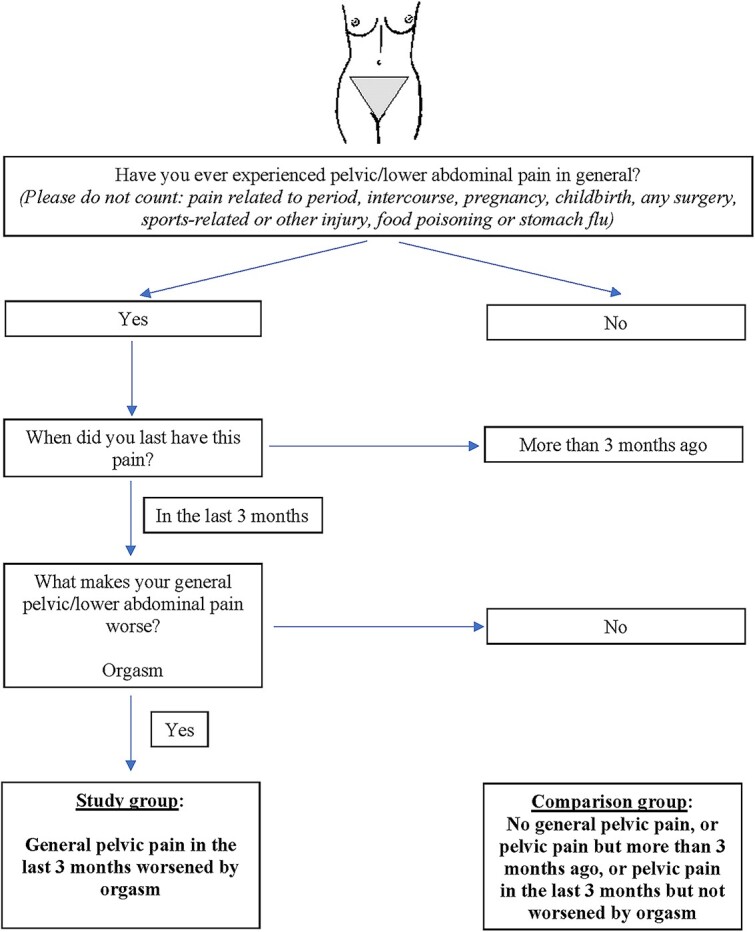
Outcomes: Outcomes included pelvic or lower abdominal pain in the last 3 months that worsened with orgasm (yes/no).
Results: Among 358 participants with endometriosis, 14% (49/358) reported pain worsened by orgasm while 86% (309/358) did not. Pain with orgasm was significantly associated with pelvic floor myalgia (55% [27/49] vs 35% [109/309]; Cohen's h = 0.40, P = .01) and higher scores on the Central Sensitization Inventory (mean ± SD, 53.3 ± 17.0 vs 42.7 ± 18.2; Cohen's d = 0.60, P < .001) but not with uterine tenderness or adenomyosis. Other clinical features associated with pain with orgasm were poorer sexual health (higher scores: deep dyspareunia, Cohen's h = 0.60; superficial dyspareunia, Cohen's h = 0.34; and Female Sexual Distress Scale-Revised, Cohen's d = 0.68; all P < .05) and poorer mental health (higher scores: Patient Health Questionnaire-9, 12.9 ± 6.7 vs 9.1 ± 6.3, Cohen's d = 0.59, P < .001; Generalized Anxiety Disorder-7, 9.4 ± 5.6 vs 6.8 ± 5.5, Cohen's d = 0.48, P = .002). Anatomic findings at the time of surgery did not significantly differ between the groups.
Clinical implications: Interventions targeting pelvic floor myalgia and central nervous system sensitization may help alleviate pain worsened by orgasm in patients with endometriosis.
Strengths and limitations: A strength is that pain worsened by orgasm was differentiated from dyspareunia. However, pain with orgasm was assessed by only a binary question (yes/no). Also, the study is limited to a single center, and there were limited data on sexual function.
Conclusion: Pelvic pain exacerbated by orgasm in people with endometriosis may be related to concurrent pelvic floor myalgia and central sensitization.
期刊介绍:
The Journal of Sexual Medicine publishes multidisciplinary basic science and clinical research to define and understand the scientific basis of male, female, and couples sexual function and dysfunction. As an official journal of the International Society for Sexual Medicine and the International Society for the Study of Women''s Sexual Health, it provides healthcare professionals in sexual medicine with essential educational content and promotes the exchange of scientific information generated from experimental and clinical research.
The Journal of Sexual Medicine includes basic science and clinical research studies in the psychologic and biologic aspects of male, female, and couples sexual function and dysfunction, and highlights new observations and research, results with innovative treatments and all other topics relevant to clinical sexual medicine.
The objective of The Journal of Sexual Medicine is to serve as an interdisciplinary forum to integrate the exchange among disciplines concerned with the whole field of human sexuality. The journal accomplishes this objective by publishing original articles, as well as other scientific and educational documents that support the mission of the International Society for Sexual Medicine.




 京公网安备 11010802042870号
京ICP备2023020795号-1
京公网安备 11010802042870号
京ICP备2023020795号-1

 分享
分享
 求助内容:
求助内容: 应助结果提醒方式:
 扫码关注我们
