Jan-Inge Henter, Elena Sieni, Julia Eriksson, Elisabet Bergsten, Ida Hed Myrberg, Scott W Canna, Maria Luisa Coniglio, Randy Q Cron, Kate F Kernan, Ashish R Kumar, Kai Lehmberg, Francesca Minoia, Ahmed Naqvi, Angelo Ravelli, Yong-Min Tang, Matteo Bottai, Yenan T Bryceson, AnnaCarin Horne, Michael B Jordan
{"title":"Diagnostic guidelines for familial hemophagocytic lymphohistiocytosis revisited.","authors":"Jan-Inge Henter, Elena Sieni, Julia Eriksson, Elisabet Bergsten, Ida Hed Myrberg, Scott W Canna, Maria Luisa Coniglio, Randy Q Cron, Kate F Kernan, Ashish R Kumar, Kai Lehmberg, Francesca Minoia, Ahmed Naqvi, Angelo Ravelli, Yong-Min Tang, Matteo Bottai, Yenan T Bryceson, AnnaCarin Horne, Michael B Jordan","doi":"10.1182/blood.2024025077","DOIUrl":null,"url":null,"abstract":"<p><strong>Abstract: </strong>Current hemophagocytic lymphohistiocytosis 2004 (HLH-2004)-based diagnostic criteria for familial hemophagocytic lymphohistiocytosis (FHL) are based on expert opinion. Here, we performed a case-control study to test and possibly improve these criteria. We also developed 2 complementary expert opinion-based diagnostic strategies for FHL in patients with signs/symptoms suggestive of HLH, based on genetic and cellular cytotoxicity assays. The cases (N = 366) were children aged <16 years with verified familial and/or genetic FHL (n = 341) or Griscelli syndrome type 2 (n = 25); 276 from the HLH-94/HLH-2004 databases and 90 from the Italian HLH Registry. All fulfilled the HLH-94/HLH-2004 patient inclusion criteria. Controls were 374 children with systemic-onset juvenile idiopathic arthritis (sJIA) and 329 + 361 children in 2 cohorts with febrile infections that could be confused with HLH and sepsis, respectively. To provide complete data sets, multiple imputations were performed. The optimal model, based on 17 variables studied, revealed almost similar diagnostic thresholds as the existing criteria, with accuracy 99.1% (sensitivity 97.1%; specificity 99.5%); the original HLH-2004 criteria had accuracy 97.4% (sensitivity 99.0%; specificity 97.1%). Because cellular cytotoxicity assays here constitute a separate diagnostic strategy, HLH-2004 criteria without natural killer (NK)-cell function was also studied, which showed accuracy 99.0% (sensitivity, 96.2%; specificity, 99.5%). Thus, we conclude that the HLH-2004 criteria (without NK-cell function) have significant validity in their current form when tested against severe infections or sJIA. It is important to exclude underlying malignancies and atypical infections. In addition, complementary cellular and genetic diagnostic guidelines can facilitate necessary confirmation of clinical diagnosis.</p>","PeriodicalId":9102,"journal":{"name":"Blood","volume":" ","pages":"2308-2318"},"PeriodicalIF":23.1000,"publicationDate":"2024-11-28","publicationTypes":"Journal Article","fieldsOfStudy":null,"isOpenAccess":false,"openAccessPdf":"https://www.ncbi.nlm.nih.gov/pmc/articles/PMC11619794/pdf/","citationCount":"0","resultStr":null,"platform":"Semanticscholar","paperid":null,"PeriodicalName":"Blood","FirstCategoryId":"3","ListUrlMain":"https://doi.org/10.1182/blood.2024025077","RegionNum":1,"RegionCategory":"医学","ArticlePicture":[],"TitleCN":null,"AbstractTextCN":null,"PMCID":null,"EPubDate":"","PubModel":"","JCR":"Q1","JCRName":"HEMATOLOGY","Score":null,"Total":0}
引用次数: 0
Abstract
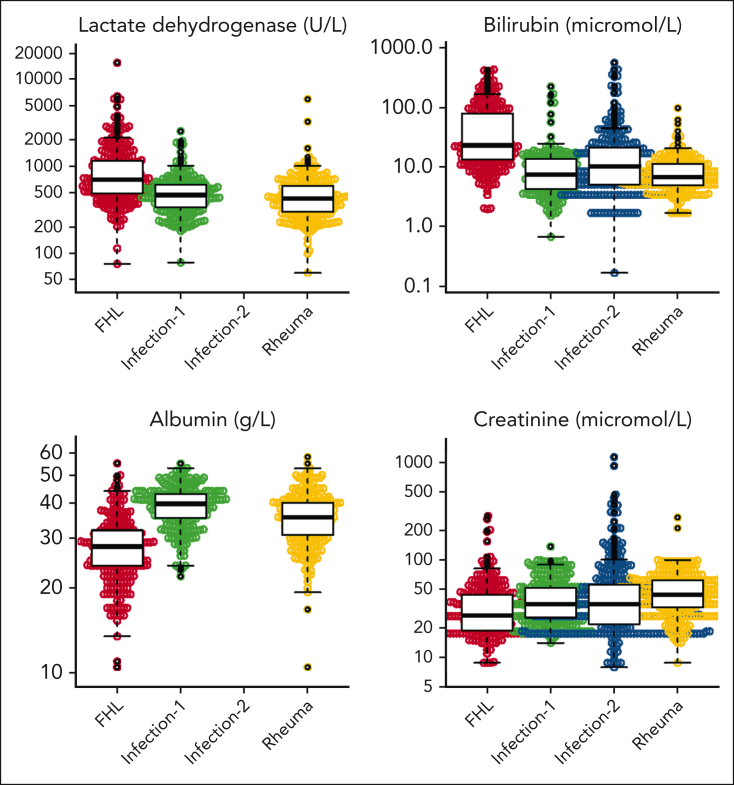
Abstract: Current hemophagocytic lymphohistiocytosis 2004 (HLH-2004)-based diagnostic criteria for familial hemophagocytic lymphohistiocytosis (FHL) are based on expert opinion. Here, we performed a case-control study to test and possibly improve these criteria. We also developed 2 complementary expert opinion-based diagnostic strategies for FHL in patients with signs/symptoms suggestive of HLH, based on genetic and cellular cytotoxicity assays. The cases (N = 366) were children aged <16 years with verified familial and/or genetic FHL (n = 341) or Griscelli syndrome type 2 (n = 25); 276 from the HLH-94/HLH-2004 databases and 90 from the Italian HLH Registry. All fulfilled the HLH-94/HLH-2004 patient inclusion criteria. Controls were 374 children with systemic-onset juvenile idiopathic arthritis (sJIA) and 329 + 361 children in 2 cohorts with febrile infections that could be confused with HLH and sepsis, respectively. To provide complete data sets, multiple imputations were performed. The optimal model, based on 17 variables studied, revealed almost similar diagnostic thresholds as the existing criteria, with accuracy 99.1% (sensitivity 97.1%; specificity 99.5%); the original HLH-2004 criteria had accuracy 97.4% (sensitivity 99.0%; specificity 97.1%). Because cellular cytotoxicity assays here constitute a separate diagnostic strategy, HLH-2004 criteria without natural killer (NK)-cell function was also studied, which showed accuracy 99.0% (sensitivity, 96.2%; specificity, 99.5%). Thus, we conclude that the HLH-2004 criteria (without NK-cell function) have significant validity in their current form when tested against severe infections or sJIA. It is important to exclude underlying malignancies and atypical infections. In addition, complementary cellular and genetic diagnostic guidelines can facilitate necessary confirmation of clinical diagnosis.
期刊介绍:
Blood, the official journal of the American Society of Hematology, published online and in print, provides an international forum for the publication of original articles describing basic laboratory, translational, and clinical investigations in hematology. Primary research articles will be published under the following scientific categories: Clinical Trials and Observations; Gene Therapy; Hematopoiesis and Stem Cells; Immunobiology and Immunotherapy scope; Myeloid Neoplasia; Lymphoid Neoplasia; Phagocytes, Granulocytes and Myelopoiesis; Platelets and Thrombopoiesis; Red Cells, Iron and Erythropoiesis; Thrombosis and Hemostasis; Transfusion Medicine; Transplantation; and Vascular Biology. Papers can be listed under more than one category as appropriate.





 京公网安备 11010802042870号
京ICP备2023020795号-1
京公网安备 11010802042870号
京ICP备2023020795号-1

 分享
分享
 求助内容:
求助内容: 应助结果提醒方式:
 扫码关注我们
