Michal Levin, Yongkui Tang, Claus D. Eisenbach, Megan T. Valentine, Noy Cohen
{"title":"Understanding the Response of Poly(ethylene glycol) diacrylate (PEGDA) Hydrogel Networks: A Statistical Mechanics-Based Framework","authors":"Michal Levin, Yongkui Tang, Claus D. Eisenbach, Megan T. Valentine, Noy Cohen","doi":"10.1021/acs.macromol.3c02635","DOIUrl":null,"url":null,"abstract":"Thanks to many promising properties, including biocompatibility and the ability to experience large deformations, poly(ethylene glycol) diacrylate (PEGDA) hydrogels are excellent candidate materials for a wide range of applications. Interestingly, the polymerization of PEGDA leads to a network microstructure that is fundamentally different from that of the “classic” polymeric gels. Specifically, PEGDA hydrogels comprise PEG chains that are interconnected by multifunctional densely grafted rod-like polyacrylates (PAs), which serve as cross-linkers. In this work, we derive a microstructurally motivated model that captures the essential features which enable deformation in PEGDA hydrogels: (1) entropic elasticity of PEG chains, (2) deformation of PA rods, and (3) PA–PA interactions. Expressions for the energy-density functions and the stress associated with each of the three contributions are derived. The model demonstrates the microstructural evolution of the network during loading and reveals the role of key microscopic quantities. To validate the model, we fabricate and compress PEGDA hydrogel discs. The model is in excellent agreement with our experimental findings for a broad range of PEGDA compositions. Interestingly, we show that the response of PEGDA hydrogels with short PEG chains and long PA rods is governed by PA–PA interactions, whereas networks with longer PEG chains are dominated by entropy. To enable design, we employ the model to investigate the influence of key microstructural quantities, such as the length of the PEG and the PA chains, on the macroscopic properties and response. The findings from this work pave the way to the efficient design of PEGDA hydrogels with tunable properties and behaviors, which will enable the optimization of their performance in various applications.","PeriodicalId":51,"journal":{"name":"Macromolecules","volume":"7 1","pages":""},"PeriodicalIF":5.2000,"publicationDate":"2024-07-17","publicationTypes":"Journal Article","fieldsOfStudy":null,"isOpenAccess":false,"openAccessPdf":"","citationCount":"0","resultStr":null,"platform":"Semanticscholar","paperid":null,"PeriodicalName":"Macromolecules","FirstCategoryId":"92","ListUrlMain":"https://doi.org/10.1021/acs.macromol.3c02635","RegionNum":1,"RegionCategory":"化学","ArticlePicture":[],"TitleCN":null,"AbstractTextCN":null,"PMCID":null,"EPubDate":"","PubModel":"","JCR":"Q1","JCRName":"POLYMER SCIENCE","Score":null,"Total":0}
引用次数: 0
Abstract
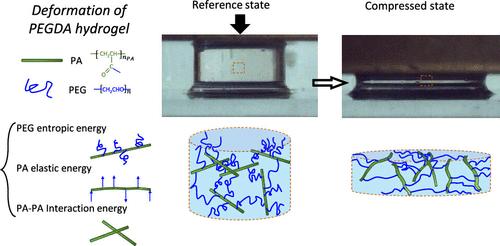
Thanks to many promising properties, including biocompatibility and the ability to experience large deformations, poly(ethylene glycol) diacrylate (PEGDA) hydrogels are excellent candidate materials for a wide range of applications. Interestingly, the polymerization of PEGDA leads to a network microstructure that is fundamentally different from that of the “classic” polymeric gels. Specifically, PEGDA hydrogels comprise PEG chains that are interconnected by multifunctional densely grafted rod-like polyacrylates (PAs), which serve as cross-linkers. In this work, we derive a microstructurally motivated model that captures the essential features which enable deformation in PEGDA hydrogels: (1) entropic elasticity of PEG chains, (2) deformation of PA rods, and (3) PA–PA interactions. Expressions for the energy-density functions and the stress associated with each of the three contributions are derived. The model demonstrates the microstructural evolution of the network during loading and reveals the role of key microscopic quantities. To validate the model, we fabricate and compress PEGDA hydrogel discs. The model is in excellent agreement with our experimental findings for a broad range of PEGDA compositions. Interestingly, we show that the response of PEGDA hydrogels with short PEG chains and long PA rods is governed by PA–PA interactions, whereas networks with longer PEG chains are dominated by entropy. To enable design, we employ the model to investigate the influence of key microstructural quantities, such as the length of the PEG and the PA chains, on the macroscopic properties and response. The findings from this work pave the way to the efficient design of PEGDA hydrogels with tunable properties and behaviors, which will enable the optimization of their performance in various applications.
期刊介绍:
Macromolecules publishes original, fundamental, and impactful research on all aspects of polymer science. Topics of interest include synthesis (e.g., controlled polymerizations, polymerization catalysis, post polymerization modification, new monomer structures and polymer architectures, and polymerization mechanisms/kinetics analysis); phase behavior, thermodynamics, dynamic, and ordering/disordering phenomena (e.g., self-assembly, gelation, crystallization, solution/melt/solid-state characteristics); structure and properties (e.g., mechanical and rheological properties, surface/interfacial characteristics, electronic and transport properties); new state of the art characterization (e.g., spectroscopy, scattering, microscopy, rheology), simulation (e.g., Monte Carlo, molecular dynamics, multi-scale/coarse-grained modeling), and theoretical methods. Renewable/sustainable polymers, polymer networks, responsive polymers, electro-, magneto- and opto-active macromolecules, inorganic polymers, charge-transporting polymers (ion-containing, semiconducting, and conducting), nanostructured polymers, and polymer composites are also of interest. Typical papers published in Macromolecules showcase important and innovative concepts, experimental methods/observations, and theoretical/computational approaches that demonstrate a fundamental advance in the understanding of polymers.



 京公网安备 11010802042870号
京ICP备2023020795号-1
京公网安备 11010802042870号
京ICP备2023020795号-1

 分享
分享
 求助内容:
求助内容: 应助结果提醒方式:
 扫码关注我们
