Daniel Quan Hui Ooi, Joshua Quan Chen Ooi, London Lucien Peng Jin Ooi MBBS, MD
{"title":"Splenic abscesses in the new millenium – a systematic review","authors":"Daniel Quan Hui Ooi, Joshua Quan Chen Ooi, London Lucien Peng Jin Ooi MBBS, MD","doi":"10.1111/ans.19178","DOIUrl":null,"url":null,"abstract":"<div>\n \n \n <section>\n \n <h3> Background</h3>\n \n <p>Isolated splenic abscesses are rare, but increasingly reported with newer organisms and changes in mechanisms involved. We conducted a comparative review of publications from 1900–1977, 1977–1986, 1987–1995, and 1996–2022.</p>\n </section>\n \n <section>\n \n <h3> Methods</h3>\n \n <p>A systematic search in Embase and PubMed resulted in 522 publications (1111 cases). Data was tabulated, analysed, and compared.</p>\n </section>\n \n <section>\n \n <h3> Results</h3>\n \n <p>Patient demographics and symptoms remain unchanged although more Asian patients were reported. Metastatic infections remain the main cause, but COVID-19-linked and iatrogenic causes post bariatric surgery and splenic artery embolization are increasingly reported. Aerobic organisms remain the commonest (68%), with a variety of exotic organisms reported. Splenectomy remains the definitive treatment, although antibiotics only and percutaneous aspiration/catheter-drainage are increasingly used with reasonable outcomes, with salvage splenectomy for therapeutic failures not having significantly higher mortality than upfront splenectomy.</p>\n </section>\n \n <section>\n \n <h3> Conclusions</h3>\n \n <p>Isolated splenic abscesses continue to be uncommon, with diagnosis requiring a high degree of suspicion. Non-surgical options for treatment can sometimes be definitive.</p>\n </section>\n </div>","PeriodicalId":8158,"journal":{"name":"ANZ Journal of Surgery","volume":"94 10","pages":"1702-1709"},"PeriodicalIF":1.6000,"publicationDate":"2024-07-25","publicationTypes":"Journal Article","fieldsOfStudy":null,"isOpenAccess":false,"openAccessPdf":"","citationCount":"0","resultStr":null,"platform":"Semanticscholar","paperid":null,"PeriodicalName":"ANZ Journal of Surgery","FirstCategoryId":"3","ListUrlMain":"https://onlinelibrary.wiley.com/doi/10.1111/ans.19178","RegionNum":4,"RegionCategory":"医学","ArticlePicture":[],"TitleCN":null,"AbstractTextCN":null,"PMCID":null,"EPubDate":"","PubModel":"","JCR":"Q3","JCRName":"SURGERY","Score":null,"Total":0}
引用次数: 0
Abstract
Background
Isolated splenic abscesses are rare, but increasingly reported with newer organisms and changes in mechanisms involved. We conducted a comparative review of publications from 1900–1977, 1977–1986, 1987–1995, and 1996–2022.
Methods
A systematic search in Embase and PubMed resulted in 522 publications (1111 cases). Data was tabulated, analysed, and compared.
Results
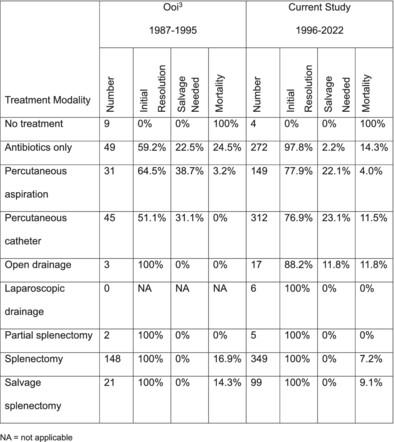
Patient demographics and symptoms remain unchanged although more Asian patients were reported. Metastatic infections remain the main cause, but COVID-19-linked and iatrogenic causes post bariatric surgery and splenic artery embolization are increasingly reported. Aerobic organisms remain the commonest (68%), with a variety of exotic organisms reported. Splenectomy remains the definitive treatment, although antibiotics only and percutaneous aspiration/catheter-drainage are increasingly used with reasonable outcomes, with salvage splenectomy for therapeutic failures not having significantly higher mortality than upfront splenectomy.
Conclusions
Isolated splenic abscesses continue to be uncommon, with diagnosis requiring a high degree of suspicion. Non-surgical options for treatment can sometimes be definitive.
期刊介绍:
ANZ Journal of Surgery is published by Wiley on behalf of the Royal Australasian College of Surgeons to provide a medium for the publication of peer-reviewed original contributions related to clinical practice and/or research in all fields of surgery and related disciplines. It also provides a programme of continuing education for surgeons. All articles are peer-reviewed by at least two researchers expert in the field of the submitted paper.



 京公网安备 11010802042870号
京ICP备2023020795号-1
京公网安备 11010802042870号
京ICP备2023020795号-1

 分享
分享
 求助内容:
求助内容: 应助结果提醒方式:
 扫码关注我们
