In Vitro Study of Tensile Strength Comparison of Selected Nonabsorbable and Absorbable Suture Materials after Immersion in 0.12% Chlorhexidine Gluconate.
Ezra Emmanuel B Ching, Teeranut Chaiyasamut, Chakorn Vorakulpipat
{"title":"<i>In Vitro</i> Study of Tensile Strength Comparison of Selected Nonabsorbable and Absorbable Suture Materials after Immersion in 0.12% Chlorhexidine Gluconate.","authors":"Ezra Emmanuel B Ching, Teeranut Chaiyasamut, Chakorn Vorakulpipat","doi":"10.4103/jispcd.jispcd_162_23","DOIUrl":null,"url":null,"abstract":"<p><strong>Aim: </strong>To compare the tensile strength (TS) of absorbable and nonabsorbable suture materials after immersion in 0.12% chlorhexidine gluconate.</p><p><strong>Materials and methods: </strong>Six 4-0-gauge suture materials were used, namely silk (S), polypropylene (PP), polyamide 6 (PA6), polyglactin 910 (PG910), poliglecaprone 25 (PL25), and polydioxanone (PDX). A total of 540 suture materials were divided equally (90) into six groups and tested. These materials were divided into a nonimmersed condition (10) and two thermostatically controlled immersion media (40 each), using artificial saliva for the control group (CG) and 0.12% chlorhexidine gluconate for the test group (TG). The specimens were tied to prefabricated rubber rods before immersion and removed at the testing timepoint. By using a universal testing machine (Instron 5566) with hooks attached, a hook-mounted specimen TS testing was performed on days 0, 1, 3, 7, and 14 at a 10 mm/min crosshead speed until the material was stretched to failure, and the maximum TS was recorded in Newtons (N). The continuous variables were taken as the mean and standard deviation across the six study groups to assess the significance at <i>α</i> = 0.05. A two-factor analysis of variance (ANOVA) was performed to assess the TSs over time in different media. A Bonferroni correction was performed when the data were statistically significant according to a two-factor ANOVA. Intragroup statistical comparisons were performed by repeated ANOVA for each study group. All data were analyzed using SPSS 26.</p><p><strong>Results: </strong>The suture material TS analysis showed that nonabsorbable suture materials maintained their TS throughout the study; silk exhibited different behaviors, decreasing in TS from baseline to day 1 and maintaining its TS until day 14. All absorbable suture materials decreased in TSs by day 14. The silk and PG910 samples in the TG performed significantly better than those in the CG.</p><p><strong>Conclusions: </strong>Prescribing 0.12% chlorhexidine gluconate as a postsurgical mouth rinse is safest when silk and PG910 are the optimal suture materials.</p>","PeriodicalId":47247,"journal":{"name":"Journal of International Society of Preventive and Community Dentistry","volume":"14 3","pages":"201-210"},"PeriodicalIF":2.1000,"publicationDate":"2024-06-27","publicationTypes":"Journal Article","fieldsOfStudy":null,"isOpenAccess":false,"openAccessPdf":"https://www.ncbi.nlm.nih.gov/pmc/articles/PMC11268532/pdf/","citationCount":"0","resultStr":null,"platform":"Semanticscholar","paperid":null,"PeriodicalName":"Journal of International Society of Preventive and Community Dentistry","FirstCategoryId":"1085","ListUrlMain":"https://doi.org/10.4103/jispcd.jispcd_162_23","RegionNum":0,"RegionCategory":null,"ArticlePicture":[],"TitleCN":null,"AbstractTextCN":null,"PMCID":null,"EPubDate":"2024/5/1 0:00:00","PubModel":"eCollection","JCR":"Q3","JCRName":"DENTISTRY, ORAL SURGERY & MEDICINE","Score":null,"Total":0}
引用次数: 0
Abstract
Aim: To compare the tensile strength (TS) of absorbable and nonabsorbable suture materials after immersion in 0.12% chlorhexidine gluconate.
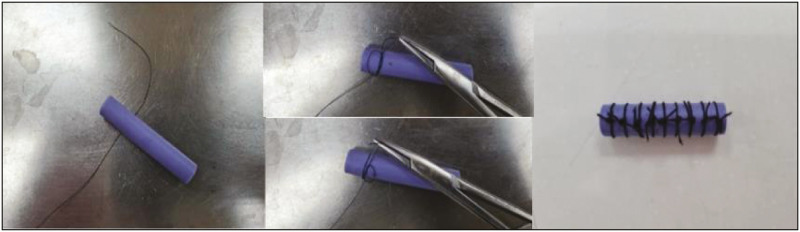
Materials and methods: Six 4-0-gauge suture materials were used, namely silk (S), polypropylene (PP), polyamide 6 (PA6), polyglactin 910 (PG910), poliglecaprone 25 (PL25), and polydioxanone (PDX). A total of 540 suture materials were divided equally (90) into six groups and tested. These materials were divided into a nonimmersed condition (10) and two thermostatically controlled immersion media (40 each), using artificial saliva for the control group (CG) and 0.12% chlorhexidine gluconate for the test group (TG). The specimens were tied to prefabricated rubber rods before immersion and removed at the testing timepoint. By using a universal testing machine (Instron 5566) with hooks attached, a hook-mounted specimen TS testing was performed on days 0, 1, 3, 7, and 14 at a 10 mm/min crosshead speed until the material was stretched to failure, and the maximum TS was recorded in Newtons (N). The continuous variables were taken as the mean and standard deviation across the six study groups to assess the significance at α = 0.05. A two-factor analysis of variance (ANOVA) was performed to assess the TSs over time in different media. A Bonferroni correction was performed when the data were statistically significant according to a two-factor ANOVA. Intragroup statistical comparisons were performed by repeated ANOVA for each study group. All data were analyzed using SPSS 26.
Results: The suture material TS analysis showed that nonabsorbable suture materials maintained their TS throughout the study; silk exhibited different behaviors, decreasing in TS from baseline to day 1 and maintaining its TS until day 14. All absorbable suture materials decreased in TSs by day 14. The silk and PG910 samples in the TG performed significantly better than those in the CG.
Conclusions: Prescribing 0.12% chlorhexidine gluconate as a postsurgical mouth rinse is safest when silk and PG910 are the optimal suture materials.
期刊介绍:
It is a journal aimed for research, scientific facts and details covering all specialties of dentistry with a good determination for exploring and sharing the knowledge in the medical and dental fraternity. The scope is therefore huge covering almost all streams of dentistry - starting from original studies, systematic reviews, narrative reviews, very unique case reports. Journal scope is not limited to these subjects and is more wider covering all specialities of dentistry follows: -Preventive and Community dentistry (Dental public health)- Endodontics- Oral and maxillofacial pathology- Oral and maxillofacial radiology- Oral and maxillofacial surgery (also called oral surgery)- Orthodontics and dentofacial orthopedics- Periodontology (also called periodontics)- Pediatric dentistry (also called pedodontics)- Prosthodontics (also called prosthetic dentistry)- Oral medicine- Special needs dentistry (also called special care dentistry)- Oral Biology- Forensic odontology- Geriatric dentistry or Geriodontics- Preventive and Social Medicine (Public health)- Our journal appreciates research articles pertaining with advancement of dentistry, preventive and community dentistry including oral epidemiology, oral health services research, oral health education and promotion, behavioral sciences related to dentistry, dental jurisprudence, ethics and oral health, economics, and quality assessment, recent advances in preventive dentistry and community dentistry.






 京公网安备 11010802042870号
京ICP备2023020795号-1
京公网安备 11010802042870号
京ICP备2023020795号-1

 分享
分享
 求助内容:
求助内容: 应助结果提醒方式:
 扫码关注我们
