Jochen A Sembill, Maximilian I Sprügel, David Haupenthal, Svenja Kremer, Michael Knott, Iris Mühlen, Bernd Kallmünzer, Joji B Kuramatsu
{"title":"Endovascular thrombectomy in patients with anterior circulation stroke: an emulated real-world comparison.","authors":"Jochen A Sembill, Maximilian I Sprügel, David Haupenthal, Svenja Kremer, Michael Knott, Iris Mühlen, Bernd Kallmünzer, Joji B Kuramatsu","doi":"10.1186/s42466-024-00331-6","DOIUrl":null,"url":null,"abstract":"<p><strong>Background: </strong>Endovascular thrombectomy (EVT) has been proven effective in anterior circulation stroke due to large vessel occlusion (LVO). However, translation from randomized clinical trials (RCTs) with highly selected patients to real-world requires confirmation, particularly to identify associations outside of strict selection criteria.</p><p><strong>Aims: </strong>This study aims to compare functional outcomes after EVT in real-world with those reported in RCTs, and to identify associations with functional outcome after EVT outside RCT-criteria.</p><p><strong>Methods: </strong>This study analyzed longitudinal German real-world data from the Stroke Research Consortium in Northern Bavaria (STAMINA) cohort from January, 2015 to June, 2019. We conducted a trial emulation, comparing patients with anterior circulation stroke and LVO meeting selection criteria for RCTs investigating EVT (1) predominantly within 6 hours with those from HERMES meta-analysis, and (2) within 6-24 hours with those from AURORA meta-analysis. We (3) analyzed treatment effects of EVT and association with functional outcome in patients treated outside RCT criteria.</p><p><strong>Results: </strong>Of 598 patients, 281 (47.0%) met RCT-criteria for treatment within 6 hours (hereinafter STAMINA-HERMES), 74 (12.4%) met RCT-criteria for treatment within 6-24 hours (STAMINA-AURORA), and 277 (46.3%) patients received EVT outside RCT-criteria. We observed no difference in rates of functional independence or mortality, comparing STAMINA-HERMES with HERMES meta-analysis (mRS 0-1: n=120/281 [43%] vs. 291/633 [46%], p=0.36; mortality: n=34/281 [12%] vs. 97/633 [15%], p=0.20), and STAMINA-AURORA with AURORA meta-analysis (mRS 0-1: n=26/74 [35%] vs. 122/266 [46%], p=0.10, mortality: n=10/74 [14%] vs. 45/266 [17%], p=0.48). Patients treated outside RCT-criteria had worse outcome (mRS 0-1: n=38/277 [14%], mortality: n=90/277 [32%], both p<0.001); possibly driven by pre-existing functional dependence (n=172/277 [62%]). Compared to matched controls, EVT outside of RCT-criteria was associated with lower mortality (absolute treatment effect: -14%, 95% Confidence Interval [CI] -23 to -5, p<0.01), but not with recovery to functional independence or premorbid functional status (treatment effect: 4%, CI -4 to 11, p=0.34), which was associated with lower NIHSS (Odds ratio [OR] 0.86, CI 0.80-0.92, p<0.001) and age (OR 0.95, CI 0.93-0.98, p=0.002).</p><p><strong>Conclusions: </strong>Translation of EVT outcomes reported in RCTs into real-world is possible, however, almost half of patients did not meet trial criteria. Identification of patients who functionally benefit from frequently performed EVT outside RCT-criteria requires further investigation.</p><p><strong>Trial registration: </strong>Clinicaltrials.gov, NCT04357899.</p>","PeriodicalId":94156,"journal":{"name":"Neurological research and practice","volume":"6 1","pages":"37"},"PeriodicalIF":3.2000,"publicationDate":"2024-07-25","publicationTypes":"Journal Article","fieldsOfStudy":null,"isOpenAccess":false,"openAccessPdf":"https://www.ncbi.nlm.nih.gov/pmc/articles/PMC11270839/pdf/","citationCount":"0","resultStr":null,"platform":"Semanticscholar","paperid":null,"PeriodicalName":"Neurological research and practice","FirstCategoryId":"1085","ListUrlMain":"https://doi.org/10.1186/s42466-024-00331-6","RegionNum":0,"RegionCategory":null,"ArticlePicture":[],"TitleCN":null,"AbstractTextCN":null,"PMCID":null,"EPubDate":"","PubModel":"","JCR":"Q2","JCRName":"Medicine","Score":null,"Total":0}
引用次数: 0
Abstract
Background: Endovascular thrombectomy (EVT) has been proven effective in anterior circulation stroke due to large vessel occlusion (LVO). However, translation from randomized clinical trials (RCTs) with highly selected patients to real-world requires confirmation, particularly to identify associations outside of strict selection criteria.
Aims: This study aims to compare functional outcomes after EVT in real-world with those reported in RCTs, and to identify associations with functional outcome after EVT outside RCT-criteria.
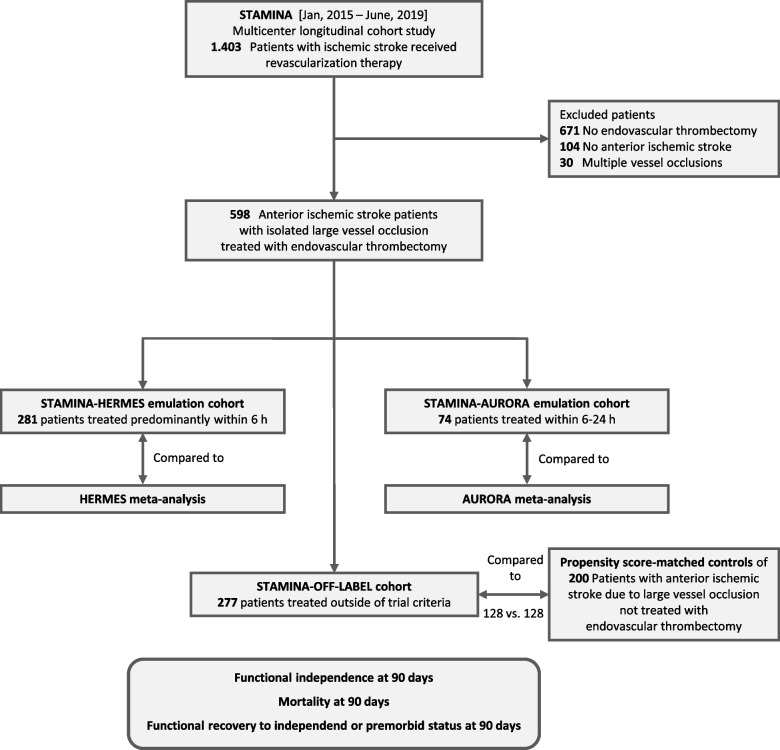
Methods: This study analyzed longitudinal German real-world data from the Stroke Research Consortium in Northern Bavaria (STAMINA) cohort from January, 2015 to June, 2019. We conducted a trial emulation, comparing patients with anterior circulation stroke and LVO meeting selection criteria for RCTs investigating EVT (1) predominantly within 6 hours with those from HERMES meta-analysis, and (2) within 6-24 hours with those from AURORA meta-analysis. We (3) analyzed treatment effects of EVT and association with functional outcome in patients treated outside RCT criteria.
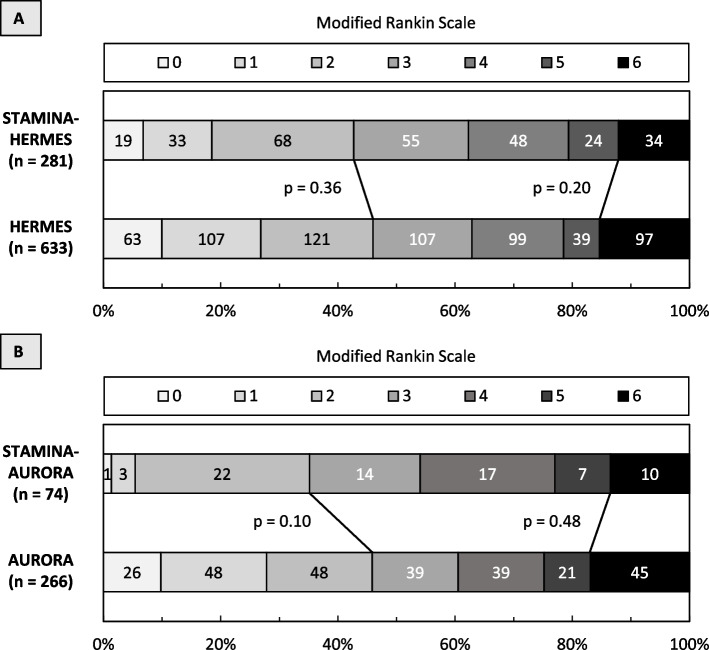
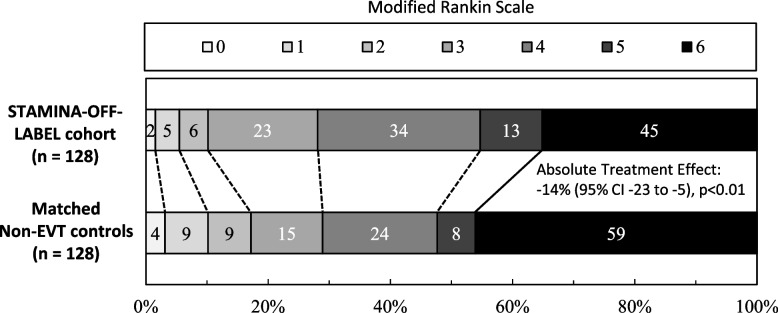
Results: Of 598 patients, 281 (47.0%) met RCT-criteria for treatment within 6 hours (hereinafter STAMINA-HERMES), 74 (12.4%) met RCT-criteria for treatment within 6-24 hours (STAMINA-AURORA), and 277 (46.3%) patients received EVT outside RCT-criteria. We observed no difference in rates of functional independence or mortality, comparing STAMINA-HERMES with HERMES meta-analysis (mRS 0-1: n=120/281 [43%] vs. 291/633 [46%], p=0.36; mortality: n=34/281 [12%] vs. 97/633 [15%], p=0.20), and STAMINA-AURORA with AURORA meta-analysis (mRS 0-1: n=26/74 [35%] vs. 122/266 [46%], p=0.10, mortality: n=10/74 [14%] vs. 45/266 [17%], p=0.48). Patients treated outside RCT-criteria had worse outcome (mRS 0-1: n=38/277 [14%], mortality: n=90/277 [32%], both p<0.001); possibly driven by pre-existing functional dependence (n=172/277 [62%]). Compared to matched controls, EVT outside of RCT-criteria was associated with lower mortality (absolute treatment effect: -14%, 95% Confidence Interval [CI] -23 to -5, p<0.01), but not with recovery to functional independence or premorbid functional status (treatment effect: 4%, CI -4 to 11, p=0.34), which was associated with lower NIHSS (Odds ratio [OR] 0.86, CI 0.80-0.92, p<0.001) and age (OR 0.95, CI 0.93-0.98, p=0.002).
Conclusions: Translation of EVT outcomes reported in RCTs into real-world is possible, however, almost half of patients did not meet trial criteria. Identification of patients who functionally benefit from frequently performed EVT outside RCT-criteria requires further investigation.



 京公网安备 11010802042870号
京ICP备2023020795号-1
京公网安备 11010802042870号
京ICP备2023020795号-1

 分享
分享

 求助内容:
求助内容: 应助结果提醒方式:
 扫码关注我们
