Zehra Oluz, Nicholas Macke, Sarah Candelaria, Abrianna Ambus, Aurora Zemborain, Chinwe S. Udemgba, Adam M. Weiss, Céline Calvino, Stuart J. Rowan
{"title":"Melt-functionalization of cellulose nanocrystals using dynamic hindered ureas","authors":"Zehra Oluz, Nicholas Macke, Sarah Candelaria, Abrianna Ambus, Aurora Zemborain, Chinwe S. Udemgba, Adam M. Weiss, Céline Calvino, Stuart J. Rowan","doi":"10.1002/pol.20240452","DOIUrl":null,"url":null,"abstract":"<p>Cellulose nanocrystal (CNC)-reinforced composites are gaining commercial attention on account of their high strength and sustainable sourcing. Grafting polymers to the CNCs in these composites has the potential to improve their properties, but current solution-based synthesis methods limit their production at scale. Utilizing dynamic hindered urea chemistry, a new method for the melt-functionalization of cellulose nanocrystals has been developed. This method does not require toxic solvents during the grafting step and can achieve grafting densities competitive with state-of-the-art solution-based grafting methods. Using cotton-sourced, TEMPO-oxidized CNCs, multiple molecular weights of poly(ethylene glycol) (PEG) as well as dodecane, polycaprolactone, and poly(butyl acrylate) were grafted to the CNC surface. With PEG-grafted nanoparticles, grafting densities of 0.47 chains nm<sup>−2</sup> and 0.10 chains nm<sup>−2</sup> were achieved with 2000 and 10,000 g mol<sup>−1</sup> polymer chains respectively, both of which represent significant improvements over previous reports for solution-based PEG grafting onto CNCs.</p>","PeriodicalId":16888,"journal":{"name":"Journal of Polymer Science","volume":"62 20","pages":"4676-4686"},"PeriodicalIF":3.6000,"publicationDate":"2024-07-25","publicationTypes":"Journal Article","fieldsOfStudy":null,"isOpenAccess":false,"openAccessPdf":"https://onlinelibrary.wiley.com/doi/epdf/10.1002/pol.20240452","citationCount":"0","resultStr":null,"platform":"Semanticscholar","paperid":null,"PeriodicalName":"Journal of Polymer Science","FirstCategoryId":"92","ListUrlMain":"https://onlinelibrary.wiley.com/doi/10.1002/pol.20240452","RegionNum":3,"RegionCategory":"化学","ArticlePicture":[],"TitleCN":null,"AbstractTextCN":null,"PMCID":null,"EPubDate":"","PubModel":"","JCR":"Q2","JCRName":"POLYMER SCIENCE","Score":null,"Total":0}
引用次数: 0
Abstract
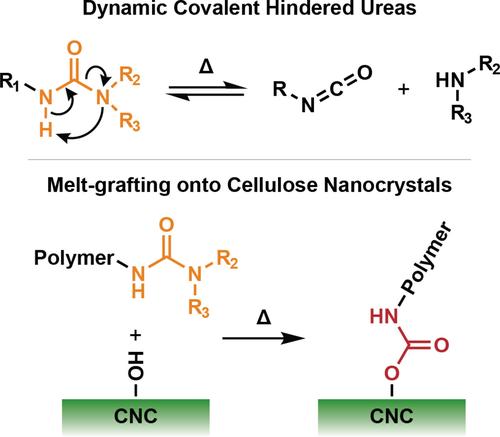
Cellulose nanocrystal (CNC)-reinforced composites are gaining commercial attention on account of their high strength and sustainable sourcing. Grafting polymers to the CNCs in these composites has the potential to improve their properties, but current solution-based synthesis methods limit their production at scale. Utilizing dynamic hindered urea chemistry, a new method for the melt-functionalization of cellulose nanocrystals has been developed. This method does not require toxic solvents during the grafting step and can achieve grafting densities competitive with state-of-the-art solution-based grafting methods. Using cotton-sourced, TEMPO-oxidized CNCs, multiple molecular weights of poly(ethylene glycol) (PEG) as well as dodecane, polycaprolactone, and poly(butyl acrylate) were grafted to the CNC surface. With PEG-grafted nanoparticles, grafting densities of 0.47 chains nm−2 and 0.10 chains nm−2 were achieved with 2000 and 10,000 g mol−1 polymer chains respectively, both of which represent significant improvements over previous reports for solution-based PEG grafting onto CNCs.
期刊介绍:
Journal of Polymer Research provides a forum for the prompt publication of articles concerning the fundamental and applied research of polymers. Its great feature lies in the diversity of content which it encompasses, drawing together results from all aspects of polymer science and technology.
As polymer research is rapidly growing around the globe, the aim of this journal is to establish itself as a significant information tool not only for the international polymer researchers in academia but also for those working in industry. The scope of the journal covers a wide range of the highly interdisciplinary field of polymer science and technology.




 京公网安备 11010802042870号
京ICP备2023020795号-1
京公网安备 11010802042870号
京ICP备2023020795号-1

 分享
分享
 求助内容:
求助内容: 应助结果提醒方式:
 扫码关注我们
