Satya K. Ammu, Xianfeng Chen, Derin Goulart Ulcay, Saurav Sharma, Farbod Alijani, Peter G. Steeneken, Pim Groen, Kunal Masania
{"title":"3D Printing of Lead-Free Piezoelectric Ultrasound Transducers","authors":"Satya K. Ammu, Xianfeng Chen, Derin Goulart Ulcay, Saurav Sharma, Farbod Alijani, Peter G. Steeneken, Pim Groen, Kunal Masania","doi":"10.1002/admt.202400858","DOIUrl":null,"url":null,"abstract":"<p>Multi-material direct ink writing (DIW) of smart materials opens new possibilities for manufacturing complex-shaped structures with embedded sensing and actuation capabilities. In this study, DIW of UV-curable piezoelectric actuators is developed, which do not require high-temperature sintering, allowing direct integration with structural materials. Through particle size and ink rheology optimization, the highest d<sub>33</sub><sup>*</sup>g<sub>33</sub> piezoelectric constant compared to other DIW fabricated piezo composites is achieved, enabling tunable actuation performance. This is used to fabricate ultrasound transducers by printing piezoelectric vibrating membranes along with their support structures made from a structural ink. The impact of transducer design and scaling up transducer dimensions on the resonance behavior to design millimeter-scale ultrasound transducers with desired out-of-plane displacement is explored. A significant increase in output pressure with increasing membrane dimensions is observed. Finally, a practical application is demonstrated by using the printed transducer for accurate proximity sensing using time of flight measurements. The scalability and flexibility of the reported DIW of piezo composites can open up new advancements in biomedical, human-computer interaction, and aerospace fields.</p>","PeriodicalId":7292,"journal":{"name":"Advanced Materials Technologies","volume":"9 23","pages":""},"PeriodicalIF":6.4000,"publicationDate":"2024-07-27","publicationTypes":"Journal Article","fieldsOfStudy":null,"isOpenAccess":false,"openAccessPdf":"https://onlinelibrary.wiley.com/doi/epdf/10.1002/admt.202400858","citationCount":"0","resultStr":null,"platform":"Semanticscholar","paperid":null,"PeriodicalName":"Advanced Materials Technologies","FirstCategoryId":"88","ListUrlMain":"https://advanced.onlinelibrary.wiley.com/doi/10.1002/admt.202400858","RegionNum":3,"RegionCategory":"材料科学","ArticlePicture":[],"TitleCN":null,"AbstractTextCN":null,"PMCID":null,"EPubDate":"","PubModel":"","JCR":"Q1","JCRName":"MATERIALS SCIENCE, MULTIDISCIPLINARY","Score":null,"Total":0}
引用次数: 0
Abstract
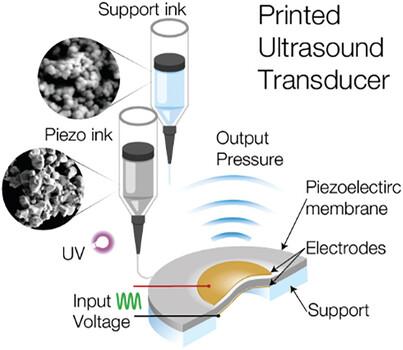
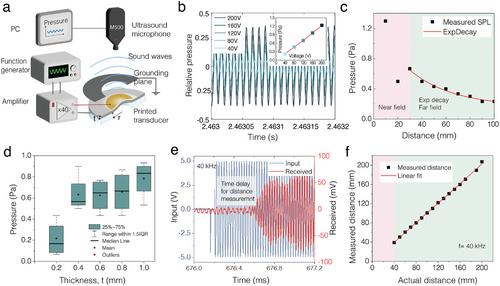
Multi-material direct ink writing (DIW) of smart materials opens new possibilities for manufacturing complex-shaped structures with embedded sensing and actuation capabilities. In this study, DIW of UV-curable piezoelectric actuators is developed, which do not require high-temperature sintering, allowing direct integration with structural materials. Through particle size and ink rheology optimization, the highest d33*g33 piezoelectric constant compared to other DIW fabricated piezo composites is achieved, enabling tunable actuation performance. This is used to fabricate ultrasound transducers by printing piezoelectric vibrating membranes along with their support structures made from a structural ink. The impact of transducer design and scaling up transducer dimensions on the resonance behavior to design millimeter-scale ultrasound transducers with desired out-of-plane displacement is explored. A significant increase in output pressure with increasing membrane dimensions is observed. Finally, a practical application is demonstrated by using the printed transducer for accurate proximity sensing using time of flight measurements. The scalability and flexibility of the reported DIW of piezo composites can open up new advancements in biomedical, human-computer interaction, and aerospace fields.
期刊介绍:
Advanced Materials Technologies Advanced Materials Technologies is the new home for all technology-related materials applications research, with particular focus on advanced device design, fabrication and integration, as well as new technologies based on novel materials. It bridges the gap between fundamental laboratory research and industry.





 京公网安备 11010802042870号
京ICP备2023020795号-1
京公网安备 11010802042870号
京ICP备2023020795号-1

 分享
分享
 求助内容:
求助内容: 应助结果提醒方式:
 扫码关注我们
