Lisa Nachtsheim MD, L. Jansen, S. Shabli MD, C. Arolt MD, A. Quaas MD, J. P. Klussmann MD, M. Mayer MD, P. Wolber MD
{"title":"Recurrence after primary salivary gland carcinoma: Frequency, survival, and risk factors","authors":"Lisa Nachtsheim MD, L. Jansen, S. Shabli MD, C. Arolt MD, A. Quaas MD, J. P. Klussmann MD, M. Mayer MD, P. Wolber MD","doi":"10.1002/hed.27880","DOIUrl":null,"url":null,"abstract":"<div>\n \n \n <section>\n \n <h3> Background</h3>\n \n <p>Primary salivary gland carcinomas (SGC) are rare neoplasms that present therapeutic challenges especially in recurrent tumors. The aim of this study was to investigate the incidence and distribution of tumor recurrence, associated risk factors, and survival.</p>\n </section>\n \n <section>\n \n <h3> Methods</h3>\n \n <p>This analysis includes data from 318 patients treated for SGC between 1992 and 2020. Survival analysis was performed using the Kaplan–Meier method. Univariate and multivariate analyses were used to identify risk factors associated with recurrence.</p>\n </section>\n \n <section>\n \n <h3> Results</h3>\n \n <p>21.7% of the patients developed recurrent disease after a mean of 38.2 months. In multivariate analysis, positive-resection margins, vascular invasion, and tumor localization in the submandibular gland and small salivary glands were independent factors for recurrence. The 5-year overall survival was 67%, the 5-year disease-free survival was 54%.</p>\n </section>\n \n <section>\n \n <h3> Conclusion</h3>\n \n <p>Tumor recurrence in SGC occurred in one out of five patients. In highly aggressive entities and patients with risk factors, treatment intensification should be considered.</p>\n </section>\n </div>","PeriodicalId":55072,"journal":{"name":"Head and Neck-Journal for the Sciences and Specialties of the Head and Neck","volume":"47 1","pages":"47-56"},"PeriodicalIF":2.2000,"publicationDate":"2024-07-27","publicationTypes":"Journal Article","fieldsOfStudy":null,"isOpenAccess":false,"openAccessPdf":"https://onlinelibrary.wiley.com/doi/epdf/10.1002/hed.27880","citationCount":"0","resultStr":null,"platform":"Semanticscholar","paperid":null,"PeriodicalName":"Head and Neck-Journal for the Sciences and Specialties of the Head and Neck","FirstCategoryId":"3","ListUrlMain":"https://onlinelibrary.wiley.com/doi/10.1002/hed.27880","RegionNum":3,"RegionCategory":"医学","ArticlePicture":[],"TitleCN":null,"AbstractTextCN":null,"PMCID":null,"EPubDate":"","PubModel":"","JCR":"Q1","JCRName":"OTORHINOLARYNGOLOGY","Score":null,"Total":0}
引用次数: 0
Abstract
Background
Primary salivary gland carcinomas (SGC) are rare neoplasms that present therapeutic challenges especially in recurrent tumors. The aim of this study was to investigate the incidence and distribution of tumor recurrence, associated risk factors, and survival.
Methods
This analysis includes data from 318 patients treated for SGC between 1992 and 2020. Survival analysis was performed using the Kaplan–Meier method. Univariate and multivariate analyses were used to identify risk factors associated with recurrence.
Results
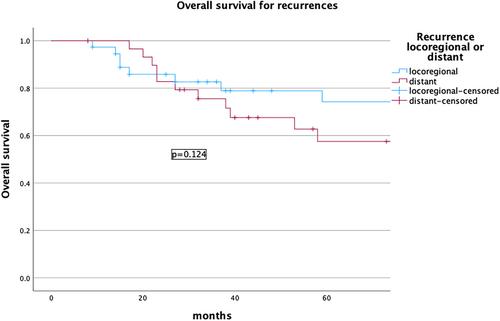
21.7% of the patients developed recurrent disease after a mean of 38.2 months. In multivariate analysis, positive-resection margins, vascular invasion, and tumor localization in the submandibular gland and small salivary glands were independent factors for recurrence. The 5-year overall survival was 67%, the 5-year disease-free survival was 54%.
Conclusion
Tumor recurrence in SGC occurred in one out of five patients. In highly aggressive entities and patients with risk factors, treatment intensification should be considered.
期刊介绍:
Head & Neck is an international multidisciplinary publication of original contributions concerning the diagnosis and management of diseases of the head and neck. This area involves the overlapping interests and expertise of several surgical and medical specialties, including general surgery, neurosurgery, otolaryngology, plastic surgery, oral surgery, dermatology, ophthalmology, pathology, radiotherapy, medical oncology, and the corresponding basic sciences.




 京公网安备 11010802042870号
京ICP备2023020795号-1
京公网安备 11010802042870号
京ICP备2023020795号-1

 分享
分享
 求助内容:
求助内容: 应助结果提醒方式:
 扫码关注我们
