Quantification of the association constant of caffeic acid-cyclodextrin complex using a novel micro-conductometric sensor for bitter taste masking of caffeic acid
{"title":"Quantification of the association constant of caffeic acid-cyclodextrin complex using a novel micro-conductometric sensor for bitter taste masking of caffeic acid","authors":"Jihen Kallel, Oluwatoyin Aina, Pedro Marote, Claire Bordes, Yves Chevalier, Souhaira Hbaieb, Nicole Jaffrezic-Renault","doi":"10.1002/elan.202400223","DOIUrl":null,"url":null,"abstract":"<p>Caffeic acid (CA), a member of the hydroxycinnamic acid family, has garnered attention in the medical community for its wide-ranging health benefits. However, its application in pharmaceutical and nutraceutical products has been hampered by its distinctly bitter taste, which deters many consumers. This study investigates the taste-masking of caffeic acid (CA) using hydroxypropyl-β-cyclodextrin (HP-β-CD). A CA micro-conductometric sensor was developed. This advanced technology demonstrated remarkable sensitivity, capable of detecting CA at concentrations as low as 10<sup>−5</sup> M, with a rapid response time between 10 and 50 seconds. The binding constant of the CA-HP-β-CD complex was determined to be 240±24. <sup>1</sup>H NMR spectroscopy analysis provided concrete evidence of the formation of a 1 : 1 inclusion complex between CA and HP-β-CD. These findings collectively suggest that HP-β-CD is highly effective in masking CA's bitterness, thereby significantly enhancing its palatability.</p>","PeriodicalId":162,"journal":{"name":"Electroanalysis","volume":"37 1","pages":""},"PeriodicalIF":2.3000,"publicationDate":"2024-07-22","publicationTypes":"Journal Article","fieldsOfStudy":null,"isOpenAccess":false,"openAccessPdf":"","citationCount":"0","resultStr":null,"platform":"Semanticscholar","paperid":null,"PeriodicalName":"Electroanalysis","FirstCategoryId":"92","ListUrlMain":"https://analyticalsciencejournals.onlinelibrary.wiley.com/doi/10.1002/elan.202400223","RegionNum":3,"RegionCategory":"化学","ArticlePicture":[],"TitleCN":null,"AbstractTextCN":null,"PMCID":null,"EPubDate":"","PubModel":"","JCR":"Q2","JCRName":"CHEMISTRY, ANALYTICAL","Score":null,"Total":0}
引用次数: 0
Abstract
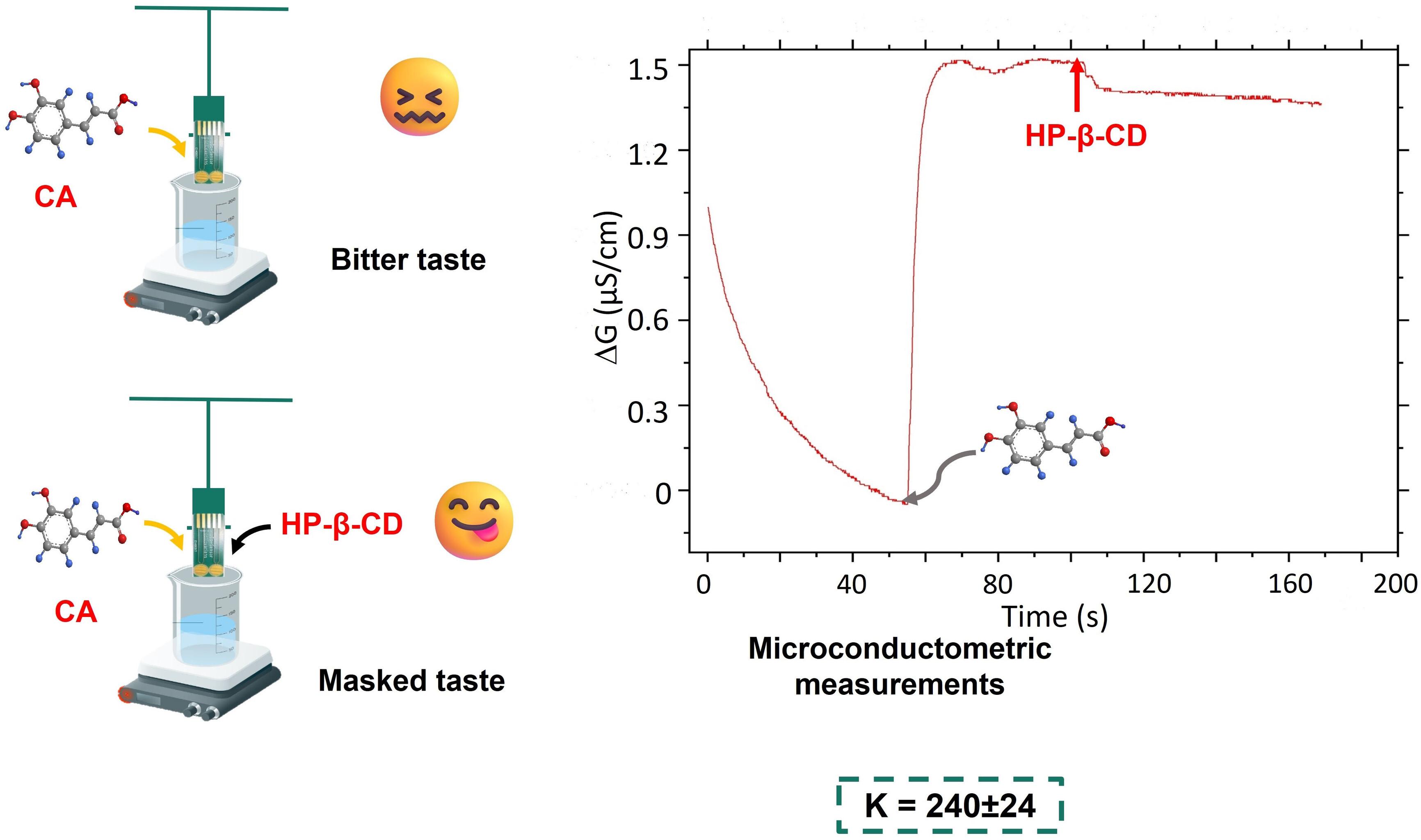
Caffeic acid (CA), a member of the hydroxycinnamic acid family, has garnered attention in the medical community for its wide-ranging health benefits. However, its application in pharmaceutical and nutraceutical products has been hampered by its distinctly bitter taste, which deters many consumers. This study investigates the taste-masking of caffeic acid (CA) using hydroxypropyl-β-cyclodextrin (HP-β-CD). A CA micro-conductometric sensor was developed. This advanced technology demonstrated remarkable sensitivity, capable of detecting CA at concentrations as low as 10−5 M, with a rapid response time between 10 and 50 seconds. The binding constant of the CA-HP-β-CD complex was determined to be 240±24. 1H NMR spectroscopy analysis provided concrete evidence of the formation of a 1 : 1 inclusion complex between CA and HP-β-CD. These findings collectively suggest that HP-β-CD is highly effective in masking CA's bitterness, thereby significantly enhancing its palatability.
期刊介绍:
Electroanalysis is an international, peer-reviewed journal covering all branches of electroanalytical chemistry, including both fundamental and application papers as well as reviews dealing with new electrochemical sensors and biosensors, nanobioelectronics devices, analytical voltammetry, potentiometry, new electrochemical detection schemes based on novel nanomaterials, fuel cells and biofuel cells, and important practical applications.
Serving as a vital communication link between the research labs and the field, Electroanalysis helps you to quickly adapt the latest innovations into practical clinical, environmental, food analysis, industrial and energy-related applications. Electroanalysis provides the most comprehensive coverage of the field and is the number one source for information on electroanalytical chemistry, electrochemical sensors and biosensors and fuel/biofuel cells.





 京公网安备 11010802042870号
京ICP备2023020795号-1
京公网安备 11010802042870号
京ICP备2023020795号-1

 分享
分享
 求助内容:
求助内容: 应助结果提醒方式:
 扫码关注我们
